


More news on this day
Americans with passports in hand are being urged to take a fresh look at their travel plans as a series of worldwide cautions, heightened regional advisories, and recent terror-related cases point to a more volatile security environment for trips abroad in 2026.
Get the latest news straight to your inbox!
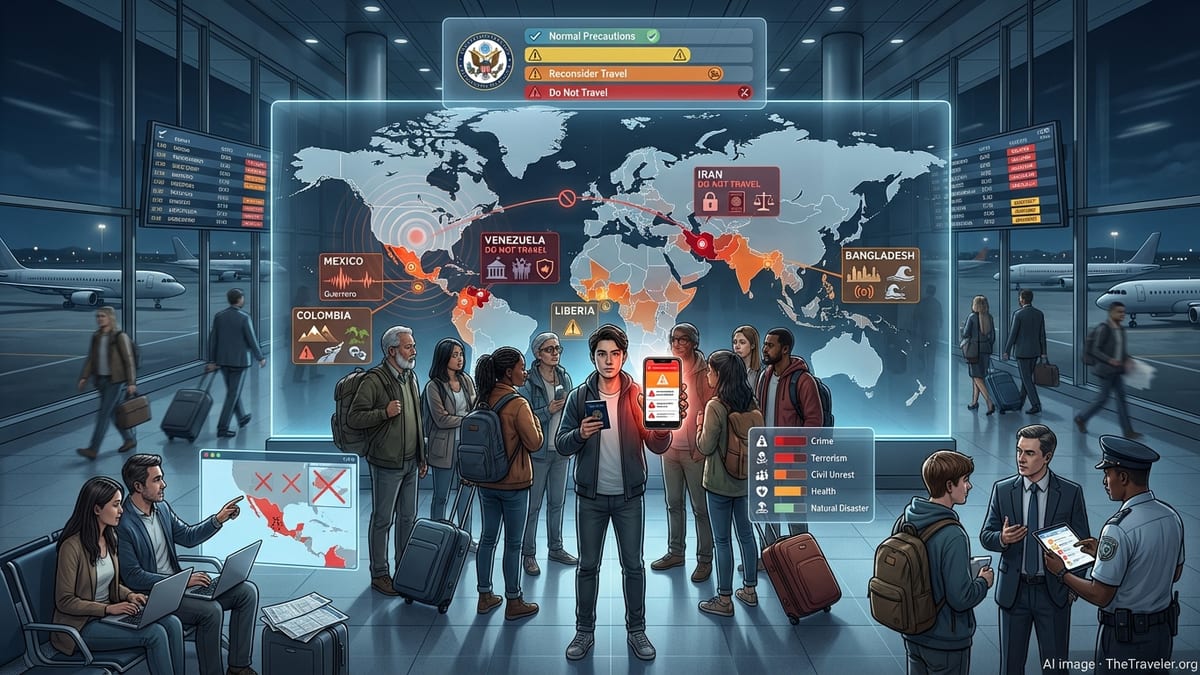
Worldwide Caution Underscores a Shifting Threat Landscape
A renewed Worldwide Caution from the U.S. government in 2026 is drawing attention to a complex and evolving terror environment, advising Americans worldwide to exercise increased vigilance when traveling. Publicly available advisories emphasize the potential for terrorist attacks, demonstrations, or violent actions against U.S. citizens and interests, even in destinations that traditionally attract large numbers of American visitors.
The global alert follows a pattern of periodic warnings over the past several years, but recent language highlights rising geopolitical tensions and the possibility of sudden disruptions affecting air travel and major transit hubs, particularly in and around the Middle East. Travelers are warned that airspace closures, flight cancellations, and last-minute security changes can occur with little notice, complicating itineraries that once felt straightforward.
Intelligence assessments published in 2026 describe a threat picture in which both organized terror groups and lone actors retain intent and some capability to target Western interests. While large-scale attacks remain relatively rare, reports indicate that smaller, opportunistic incidents and plots continue to surface, often inspired by online propaganda and global conflicts rather than directed by a central leadership structure.
For American travelers, the practical implication is not necessarily to stay home, but to understand that the baseline of risk in many regions has shifted. Government risk ratings for certain destinations now explicitly reference terrorism as a key factor, even when overall advisory levels remain below the most severe categories.
Regional Hotspots Face Heightened Scrutiny
Recent updates to country-specific advisories underscore why Americans are being urged to reassess some itineraries more carefully than others. In parts of the Middle East, for example, travel guidance now points to elevated risks tied to armed conflict, potential missile or drone activity, and terrorism, particularly around U.S. interests and key infrastructure.
Saudi Arabia, long a key regional hub for business and religious travel, has been assigned a “Reconsider travel” designation, reflecting concerns about terrorism, conflict-related threats, and restrictions that could affect visitors. Public guidance notes the risk of targeting American interests and warns against travel to border regions where terror threats are considered especially acute.
Beyond the Middle East, terrorism is listed as a contributing factor in higher-risk ratings for a number of destinations spanning Africa and parts of Asia. U.S. advisory materials highlight recent or potential terrorist attacks, kidnapping risks, and the possibility of sudden security deteriorations. Some locations remain categorized at the most severe “Do not travel” level, where the U.S. government states it may have limited ability to assist citizens in an emergency.
These regional patterns align with broader threat assessments from U.S. intelligence agencies, which describe terrorism as one element of a wider security picture that also features cyber activity, proxy conflicts, and political instability. For leisure travelers, the net effect is a more fragmented global map, where neighboring countries can carry sharply different risk profiles.
Domestic Cases Highlight Persistent Extremist Motivation
While most travel advisories focus on risks beyond U.S. borders, recent terrorism-related cases inside the United States are adding context to warnings about a fluid global threat. In one 2026 case, an Albany, New York resident was charged in connection with an ISIS-inspired plot allegedly targeting a state government complex, according to Justice Department filings. In another, three individuals in Kansas and California were accused of conspiring to provide support to ISIS, including discussions of violent attacks and attempts to finance weapons and drones.
Although these incidents did not involve attacks on travelers, they illustrate the continued appeal of extremist narratives to a small number of individuals and the way global conflicts can resonate domestically. Publicly available FBI and intelligence briefings continue to identify ISIS, al Qaeda, and like-minded groups, along with homegrown extremists, as persistent concerns for U.S. security agencies.
For Americans considering international trips, these domestic cases serve as a reminder that terror threats are not strictly confined to faraway locations. Officials and analysts often point out that the same propaganda that motivates plots at home can encourage attacks on Western visitors and symbolic targets overseas, especially in countries where security services have less capacity or where conflict has weakened state control.
Experts in travel risk note that this backdrop does not mean global travel must stop; instead, it reinforces the need for careful planning, realistic expectations about security conditions, and flexible itineraries that can adapt to emerging developments.
What Reassessment Looks Like for Ordinary Travelers
For many Americans, “reevaluating” travel plans in 2026 does not necessarily mean canceling long-anticipated trips, but it may involve changing destinations, adjusting routes, or upgrading preparation. Government guidance encourages travelers to study destination-specific advisories, which break down risk factors such as terrorism, crime, civil unrest, and health concerns, and to recognize when a country or region has moved into a higher-risk category.
One practical step is to review whether any parts of an itinerary pass through locations cited in higher-level advisories or in sections of countries where terrorism is a particular concern. In some cases, travelers are choosing to avoid border regions, remote areas, or crowded symbolic sites noted in public guidance as potential targets for attacks.
Published information from consular services also highlights the importance of preparing for disruptions. Travelers are encouraged to keep itineraries flexible, monitor local and international news, and register trips with government programs that provide security alerts by email or text. Guidance on global events affecting international travel notes that major political or religious gatherings, sporting events, and regional crises can quickly alter risk levels and strain local infrastructure.
Insurance and cancellation policies are also drawing closer scrutiny. Some travelers are turning to policies that explicitly cover terrorism-related disruptions, airspace closures, or government advisories that make a trip impractical, while others are revisiting whether to route flights through regions mentioned in global caution notices.
Balancing Caution with the Realities of Modern Travel
The mounting terror warnings in 2026 are landing in a world where international travel has rebounded and many Americans are reluctant to give up long-awaited vacations, family visits, or study abroad plans. Industry analysts observe that even in periods of elevated threat, global travel rarely stops; instead, patterns shift as travelers weigh perceived safety, cost, and the strength of official warnings.
Publicly available State Department materials stress that advisories are intended as guidance, not bans, and that many destinations flagged for terrorism risks still receive steady flows of visitors who complete trips without incident. However, the same resources also emphasize that conditions can change rapidly and that individuals ultimately bear responsibility for understanding the risks they accept.
Security specialists caution that travelers should avoid becoming desensitized to repeated warnings. While worldwide cautions have appeared periodically over the years, the current alerts are emerging against a backdrop of active conflicts, documented plots, and high-profile assessments describing an unusually complex and interconnected set of threats. For Americans heading overseas, the message is to match the enduring desire to see the world with a level of preparation and situational awareness that reflects today’s realities.
U.S. State Department Travel Advisories
Worldwide Caution Security Alert