

More news on this day
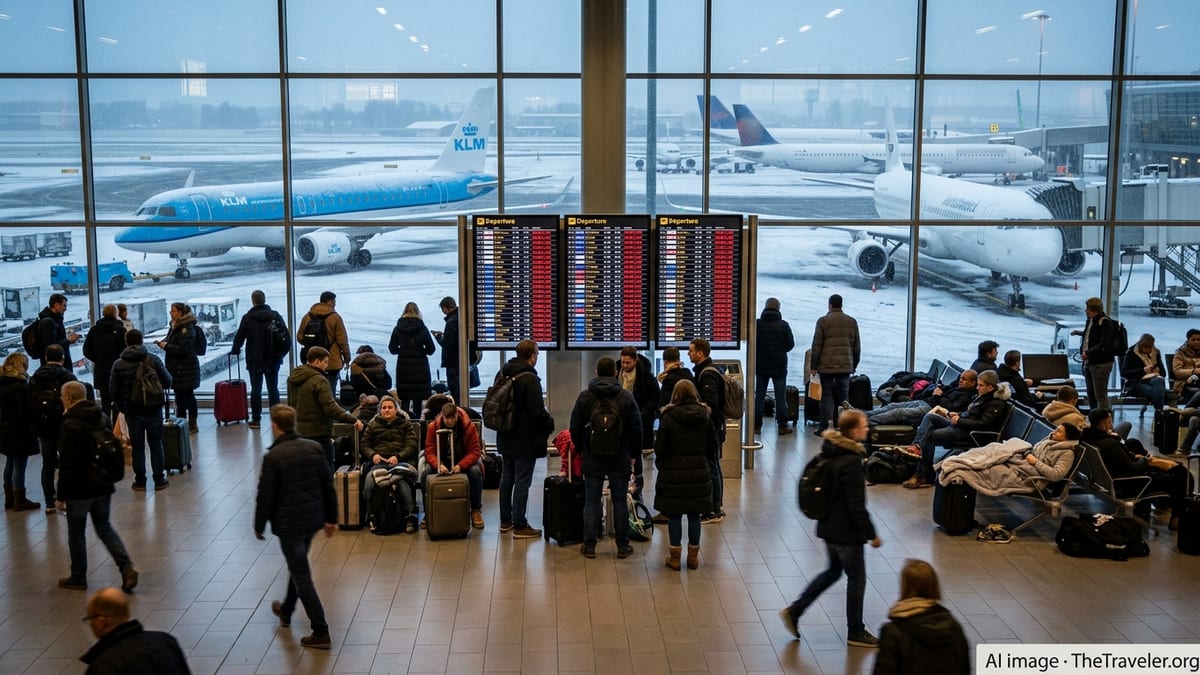
Amsterdam’s Schiphol Airport is in the grip of one of its most disruptive winter episodes in recent years, with severe snow, strong winds and operational bottlenecks combining to cancel or delay hundreds of flights and derail travel plans across Europe and beyond.
Get the latest news straight to your inbox!
Severe Winter Weather Triggers Prolonged Disruption
A powerful winter system sweeping across the Netherlands since early January 2026 has repeatedly pushed Amsterdam Schiphol Airport beyond its operating limits. Heavy snow, shifting crosswinds and persistent low visibility have forced significant cuts to runway capacity, disrupting the tightly timed flow of arrivals and departures that normally makes Schiphol one of Europe’s most efficient hubs.
According to publicly available flight data and recent news coverage, the peak of the crisis came around the start of the year when a winter storm led to the cancellation of more than 300 flights in a single day and delays for hundreds more. In subsequent days, fresh snow and gusting winds compounded the disruption, with several waves of advance cancellations as airlines attempted to stabilize schedules before passengers reached the airport.
Reports indicate that on at least one day in early January, Schiphol registered roughly 700 cancellations as snow and wind intensified, placing it among the most affected major airports in Europe this winter. Aviation and weather observers note that the combination of snowfall amounts, deicing requirements and crosswind conditions has been unusually severe for the Netherlands, a country that typically experiences relatively few heavy snow days each year.
Published weather summaries for 2026 highlight the storm season as particularly active across northwestern Europe, with systems tracking over the North Sea frequently targeting the low-lying Dutch coast. Schiphol’s open polder location leaves it especially exposed to crosswinds, and when multiple runways cannot be used safely at the same time, the airport’s overall capacity quickly drops.
Scale of Cancellations and the Knock-On Effect Across Europe
The immediate effect for travelers has been widespread and, in many cases, prolonged disruption. Over the course of several consecutive days, data compiled by airlines, aviation trackers and passenger-rights organizations point to several thousand flights to and from Schiphol being canceled or heavily delayed. KLM, as the main hub carrier, has been at the center of the turmoil, with a substantial share of its Amsterdam schedule repeatedly trimmed.
On days when weather conditions briefly improved, airlines continued to pare back operations to work through the backlog of stranded passengers and reposition aircraft. This meant that even flights scheduled during clearer periods were sometimes removed from the timetable so that crews and planes could be realigned. The ripple effects have been felt at major connecting airports including London Heathrow, Paris Charles de Gaulle, Frankfurt and several North American hubs that feed traffic through Amsterdam.
Schiphol’s role as a transfer hub has amplified the impact. A single canceled long haul departure can disrupt hundreds of onward connections, while missed inbound links strand passengers in outstations, limiting the pool of aircraft that can be deployed from Amsterdam. Industry analyses suggest that during the height of the disruption, airlines faced severe challenges in sourcing spare seats for rebookings anywhere in the network, not just on direct Amsterdam routes.
Travel forums and social media posts from recent days describe a patchwork of experiences: some travelers being rebooked relatively quickly via alternative European hubs, others spending long hours in terminals or hotels while waiting for new itineraries. Passenger accounts also indicate that certain destinations, particularly long haul routes and flights to regions with limited frequency, have seen multiple days of cancellations.
Operational Constraints: Deicing, Capacity and Crew
Beyond the weather itself, operational constraints at Schiphol have played a major role in turning a difficult situation into a large-scale travel crisis. Airport and airline statements in recent weeks have pointed to pressure on deicing resources, with high demand for deicing fluid and equipment leading to departure queues, aircraft waiting for treatment and eventual tactical cancellations when time limits were exceeded.
Each snowfall event has required extensive runway and taxiway clearing. With only a reduced number of runways available during plowing and brushing operations, the airport’s hourly capacity has dropped well below normal levels. Air traffic management data for the region shows extended arrival holding patterns and outbound slot restrictions, prompting airlines to cancel flights proactively rather than operate heavily delayed rotations that would cause further knock-on disruption.
Airlines have also faced crew scheduling complications. Extended duty days, unexpected overnights and aircraft stranded away from base have all contributed to roster imbalances. When crews time out under safety regulations, flights must be canceled or reassigned even if weather and runway capacity would otherwise permit operation. Publicly available airline updates indicate that some cancellations have been attributed to these crew availability issues following earlier weather disruptions.
Aviation analysts observe that while major North American and Nordic airports are routinely equipped for frequent heavy snow, facilities in the Netherlands are calibrated for milder conditions. That leaves limited redundancy in extreme scenarios, making it harder to scale up snow-clearing teams, deicing operations and stand capacity when several days of significant winter weather arrive back to back.
What Travelers Need to Know Before Heading to Schiphol
For passengers with upcoming trips via Amsterdam, planning has become essential. Recent advisories from the airport and multiple airlines consistently urge travelers to check the latest flight status before setting out, as same-day schedule changes and preemptive cancellations remain possible whenever fresh snow or high winds are forecast. Online check-in pages and airline apps are being updated frequently as conditions evolve.
Travel experts and consumer organizations recommend allowing extra time at the airport in case of longer check-in and security queues, as well as potential gate changes. However, passengers are being urged not to arrive excessively early if their flight has not yet been confirmed as operating, to avoid unnecessary crowding in terminal areas during sensitive operational periods.
Those whose flights are canceled are generally being offered rebooking at no additional fare, subject to availability, or the option of a refund. Under European passenger-rights rules, travelers on canceled flights may in some circumstances be entitled to compensation, though extreme weather is often classified as an extraordinary circumstance. Specialist advisory services caution that eligibility can depend on the exact cause of each individual cancellation and the timing of notifications, meaning that outcomes may vary case by case.
In the current environment, travelers with urgent itineraries are increasingly seeking alternative routings that bypass Amsterdam altogether, booking from or via airports less affected by the recent storms. Published commentary from passenger groups suggests that routes via Brussels, Paris, Frankfurt and some UK airports are being used as workarounds, with train connections filling in gaps where direct flights are unavailable.
Outlook: Stabilization Efforts and the Risk of Future Disruptions
As of late March 2026, publicly available information indicates that operations at Schiphol have largely returned to a more stable pattern, with only isolated weather-related cancellations on most days. Flight schedules remain slightly thinner than during peak pre-disruption periods as airlines rebuild resilience into their networks and continue to work through aircraft and crew repositioning.
Airport statements and airline operational briefings suggest a focus on lessons learned from this winter’s events, including reviews of deicing capacity, snow-clearing resources and communication protocols with passengers during prolonged disruption. Observers note that any structural changes, such as additional equipment or revised staffing models for rare extreme-weather events, will require time and investment.
Meteorologists caution that while the most intense phase of the 2025–26 winter storm season appears to have passed, late-season systems can still affect northwestern Europe. Even brief episodes of snow or high winds can cause new waves of disruption when air traffic is already operating close to capacity, particularly around holiday periods and school breaks when demand for travel through Amsterdam remains strong.
For now, the recent crisis at Schiphol serves as a reminder of how quickly conditions at a key European hub can deteriorate when severe weather, infrastructure limits and complex airline networks align. Travelers planning itineraries through Amsterdam in the coming weeks are being advised by travel professionals and consumer advocates to remain flexible, monitor conditions closely and build contingency time into their journeys where possible.