

From desert music marathons to seaside food feasts and small-town parades, California’s calendar is packed with annual festivals that capture the state’s restless creativity. Whether you are planning a dedicated festival road trip or looking to anchor a longer West Coast vacation around a signature event, these are the recurring California festivals that belong on every traveler’s radar.
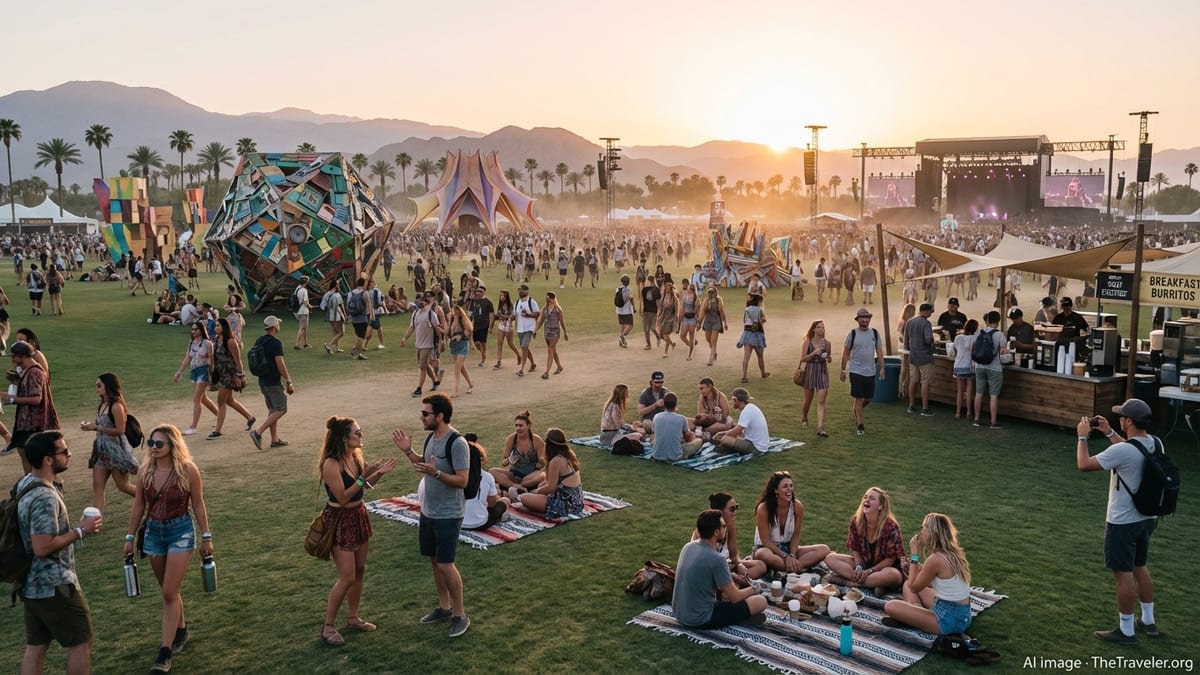
Coachella Valley Music and Arts Festival, Indio
Each April, the Coachella Valley Music and Arts Festival turns the quiet resort city of Indio into one of the most talked-about destinations on the planet. Held over two consecutive three-day weekends at the Empire Polo Club, Coachella has become a cultural shorthand for big-name headliners, surprise guest appearances, and the kind of festival fashion that trends worldwide within hours. Recent editions have brought together pop, hip-hop, rock, Latin, and electronic acts, cementing its reputation as a festival that mirrors the full spectrum of contemporary music.
Beyond the main stages, Coachella’s personality is shaped by its large-scale art installations and experimental spaces. Sculptures rise out of the desert floor, light tunnels pulse after dark, and shaded lounges offer a welcome break from the daytime heat. Food has also grown into a core part of the experience, with curated restaurant pop-ups and chef-driven stands that go far beyond typical festival fare. For many visitors, it is as much about wandering, people-watching, and lingering over a shared meal as it is about catching every minute at the main stage.
Weather is a defining force here. Days can be hot and dry, and temperatures after sunset drop noticeably, which makes thoughtful packing essential. Travelers who want a less frenzied experience often aim for mid-afternoon arrivals, using mornings for poolside downtime in nearby Palm Springs or desert hikes in the surrounding Coachella Valley. Tickets typically sell out quickly, so planning months ahead, including accommodations and transportation, is key.
Veteran festivalgoers talk about Coachella less as a single event and more as a rite of passage. The mix of global headliners, boundary-pushing visuals, and the sheer scale of the crowds creates an energy that is hard to replicate anywhere else in the state. For visitors looking to understand why California remains a center of pop culture influence, a well-planned weekend in Indio is an unforgettable place to start.
Stagecoach Festival, Indio
Just when the last festivalgoers leave the Empire Polo Club in April, the grounds reset for Stagecoach, Coachella’s country-focused counterpart. Held the following weekend, Stagecoach is one of the largest dedicated country music festivals in the world, drawing fans in cowboy boots and hats from across the United States. Its lineups blend Nashville superstars with Americana, alt-country, and roots rock artists, offering a rich cross-section of today’s country sound.
The mood at Stagecoach leans a little more relaxed than its pop-leaning sibling, with fans spending long afternoons in the sun, drifting between stages, and chatting around RV campsites that have become gathering points for repeat visitors. Barbecue smoke drifts across the site, dance halls host line-dancing lessons, and late-night sets keep the energy going well past sunset. It feels like a mash-up of state fair, honky-tonk, and stadium concert, set against a backdrop of palm trees and desert mountains.
From a traveler’s perspective, the logistics are similar to Coachella, with limited shade on-site and strong desert sun in the middle of the day. Many visitors choose to stay in Palm Springs, Palm Desert, or La Quinta, combining festival nights with mornings spent exploring midcentury architecture, golf courses, and spa resorts. Others embrace the campground culture, arriving early to secure favored spots and treating the festival as a three-day neighborhood.
For those curious about contemporary country culture or simply looking for a distinctly American musical experience, Stagecoach delivers. It offers a window into the country music community at a scale rarely seen on the West Coast, and its timing means travelers can, with careful planning, experience back-to-back desert festivals without ever leaving the Coachella Valley.
Outside Lands, San Francisco
While the desert offers heat and palm trees, San Francisco’s Outside Lands trades that for mist, eucalyptus groves, and the rolling lawns of Golden Gate Park. Held annually in August, this three-day festival has grown into one of the country’s most respected multi-genre events. Lineups routinely pair rock and indie acts with major hip-hop, electronic, and pop stars, mirroring the eclectic tastes of the city itself.
Outside Lands stands out for how deeply it integrates San Francisco’s culinary and cultural identity. Entire areas of the park are turned into tasting grounds for local restaurants, food trucks, wineries, and craft breweries. There are dedicated spaces for regional wine, craft cocktails, and often experimental food concepts that feel like pop-up neighborhoods within the festival. Many visitors plan their days around both musical sets and must-try dishes, grazing from vendor to vendor between stages.
Fog is an unofficial headliner. Even in August, San Francisco’s famous coastal microclimate means that afternoons can swing from warm sun to chilly wind in minutes, especially as evening sets in. Experienced festivalgoers dress in layers and rely on sturdy shoes, since Golden Gate Park’s lawns can become soft under heavy foot traffic. The payoff is a uniquely atmospheric setting, with stage lights cutting through drifting fog and the silhouettes of tall trees framing the crowds.
Beyond music and food, Outside Lands often includes curated art installations, comedy performances, and dedicated spaces celebrating local culture and environmental initiatives. For travelers, it pairs easily with a broader San Francisco itinerary, since the park sits within city limits and is accessible via public transit or short rideshare trips. If your idea of the perfect festival weekend blends serious music with serious food in a cool coastal setting, this is the California festival to anchor a Bay Area visit.
California State Fair, Sacramento
Not all of California’s unmissable festivals revolve around headlining bands and light shows. Every July, the California State Fair transforms the Cal Expo grounds in Sacramento into a weeks-long celebration of the state’s agriculture, industry, and regional cultures. Visitors will find livestock exhibitions, produce competitions, wine and cheese tastings, carnival rides, and free concerts, all laid out across broad, sun-drenched fairgrounds.
The fair’s agricultural roots remain its defining feature. Barns showcase prize cattle, sheep, goats, and poultry, while exhibit halls highlight the state’s vast output of fruits, nuts, and vegetables. Tastings and demonstrations help connect visitors with the farms and producers that quietly power California’s economy. In a single afternoon, travelers can learn about water conservation in the Central Valley, watch a cattle-judging competition, and then sample award-winning olive oils or wines.
Of course, it would not be a state fair without indulgent food and a sprawling midway. Deep-fried specialties, giant lemonades, and barbecue stands line the main thoroughfares, while roller coasters and classic rides light up the night. Musical performances, which typically feature touring acts and tribute bands, are included with fair admission on most nights, making it easy to add an outdoor concert to a day of exploring exhibits.
The California State Fair is particularly appealing for families and travelers interested in the everyday culture of the state beyond its coastal cities. Sacramento’s central location makes it an accessible stop on road trips that cross the state north to south or east to west. Plan for hot daytime temperatures, especially in mid-July, and consider visiting in the late afternoon to catch both daytime exhibits and cooler evening entertainment.
Monterey Jazz Festival, Monterey
Along the central coast, the Monterey Jazz Festival holds a special place in music history. Established in the late 1950s and held annually each September on the Monterey County Fairgrounds, it is widely regarded as one of the longest-running jazz festivals in the world. Over the decades it has welcomed many of the genre’s most important figures, and its programming continues to balance jazz legends, innovative bandleaders, and rising artists.
The setting contributes significantly to the festival’s appeal. Monterey’s coastal climate is typically mild in early autumn, with cool mornings, pleasantly warm afternoons, and evenings that call for a light jacket. Stages are spread across the fairgrounds, offering both intimate indoor venues and open-air lawns where visitors spread blankets and settle in for entire sets. Compared to some larger music festivals, the atmosphere feels focused yet relaxed, with audiences that are deeply engaged in the music.
Education and community remain central to the Monterey Jazz Festival’s mission. In addition to headline shows, the program often includes student ensembles, workshops, and conversations with artists. Travelers who are serious about jazz can easily fill entire days hopping between performances and panel discussions, while more casual listeners can treat it as a chance to experience world-class live music in a compact, walkable setting.
For visitors, Monterey itself adds another layer of attraction. The town sits close to the coastal scenery of Pacific Grove, Carmel-by-the-Sea, and the Big Sur shoreline, all easily reached by car. Many festivalgoers pair afternoon sets with morning visits to the Monterey Bay Aquarium or scenic drives along Highway 1. If you are looking for a festival that combines musical depth with coastal charm, Monterey in September is hard to beat.
Rose Parade & Rose Bowl Game, Pasadena
While many of California’s signature festivals unfold under summer or autumn skies, one of its most iconic takes place on the very first morning of the year. On January 1, Pasadena hosts the Tournament of Roses Parade, a lavish procession of flower-covered floats, marching bands, and equestrian units that lines Colorado Boulevard. Millions watch on television, but being there in person reveals details that do not always reach the screen: the scent of fresh blooms, the intricate texture of petals and seeds used to create float designs, and the low rumble of drums echoing off historic storefronts.
The parade has run for well over a century, becoming a New Year tradition for Southern California. Floats are famously constructed almost entirely from natural materials, including flowers, leaves, seeds, and spices. In the days leading up to the event, volunteers and staff work around the clock in vast float barns, an experience that some visitors arrange to see through ticketed tours. On parade morning, dedicated fans arrive before dawn with blankets and thermoses in hand to secure curbside spots, while grandstand seating offers reserved views for those who prefer a more structured experience.
Complementing the parade is the Rose Bowl Game, a major college football matchup held later that day in the nearby Rose Bowl Stadium. The combination of pageantry and sport gives the entire city a festival feel, with crowds spilling into Old Pasadena’s cafes and streets long after the last float has passed. For travelers, attending both the parade and the game provides a full day that blends Americana spectacle, tradition, and stadium energy.
Weather in Pasadena on New Year’s Day is often cool in the morning and comfortably mild by afternoon, although rain is always a possibility. Advance planning is essential, as hotels across Pasadena and nearby Los Angeles neighborhoods tend to book out months ahead. For those willing to commit, it is a California festival experience that frames the entire year that follows.
Beyond Music: Food, Culture, and Neighborhood Festivals
California’s annual festival landscape is not limited to marquee music events and statewide fairs. Across the state, smaller neighborhood and regional festivals reveal more intimate layers of local culture. Wine regions in Napa, Sonoma, and Paso Robles host recurring harvest and wine festivals in late summer and autumn, where visitors can sample new vintages, attend winemaker dinners, and stroll through vineyards as grapes are brought in from the fields. Coastal towns mark seafood seasons with crab feeds, clam festivals, and oyster celebrations, pairing regional catches with live music and local craft beverages.
In cities like Los Angeles, San Diego, and San Jose, multicultural festivals spotlight the traditions of the communities that call California home. Annual events celebrate everything from Lunar New Year parades and Cinco de Mayo festivities to Filipino, Indian, and Pacific Islander cultural gatherings, often featuring folk dance, regional cuisine, and artisan markets. While smaller in scale than statewide events, these festivals offer visitors a chance to experience local neighborhoods at their most vibrant, with streets closed to traffic and residents turning out in full force.
Many of these festivals are timed to seasonal milestones. Spring brings cherry blossom festivals and outdoor night markets as days grow longer. Summer weekends fill city parks with free or low-cost concert series, food truck gatherings, and film screenings, all of which take on a festival feel even if they last only an evening or two. Autumn harvest celebrations highlight apples, pumpkins, and wine grapes, particularly in the Sierra foothills and coastal agricultural valleys.
Travelers who build flexibility into their itineraries often discover these smaller festivals by chance, spotting street posters or hearing about them from hotel staff and restaurant servers. Keeping an eye on local event calendars in the weeks before your trip can help you align your plans with these community gatherings. While they may not have the global name recognition of Coachella or the Rose Parade, they provide some of the most authentic and memorable encounters with everyday California life.
The Takeaway
California’s annual festivals are as varied as its landscapes, stretching from wind-swept coastal parks and foggy city lawns to sunbaked desert polo fields and inland fairgrounds. For travelers, they offer a framework around which to build journeys, turning a simple weekend away into a deep dive into local culture, whether through the agricultural pride of the California State Fair, the improvisational brilliance of Monterey’s jazz stages, or the flower-laden spectacle of Pasadena on New Year’s Day.
Planning is essential. The largest events sell out early and can drive up accommodation prices across entire regions, while smaller festivals may require careful attention to shifting dates and weather conditions. Yet the rewards for that effort are significant. Attending a festival anchors your trip in a specific moment in the state’s yearly rhythm, placing you shoulder to shoulder with Californians who return year after year.
Most importantly, these festivals reveal a California that is always in motion, constantly remixing music, food, art, and tradition into new forms of celebration. Whether you are drawn to the sound of guitars echoing across the desert, the smell of street food in San Francisco’s parklands, or the quiet pride of growers at a county fair, the state offers a festival that feels tailored to your interests. Choose one anchor event, build a few unstructured days around it, and let California’s festival culture show you just how expansive a single state can be.
FAQ
Q1. When is the best time of year to plan a California festival trip?
The most festival-heavy months are April through October, with major music events in spring and late summer, plus state and county fairs in mid-summer.
Q2. How far in advance should I buy tickets for big festivals like Coachella or Outside Lands?
For the largest events, it is wise to purchase as soon as general sales open, often six to nine months ahead, since popular weekends can sell out quickly.
Q3. Are California festivals suitable for families with children?
Many are, particularly the California State Fair and community cultural festivals. Large music festivals can be crowded and noisy, so families should review age policies and amenities.
Q4. What should I pack for a desert festival such as Coachella or Stagecoach?
Plan for strong sun and cooler evenings. Lightweight clothing, a hat, sunscreen, refillable water bottle, closed-toe shoes, and a warm layer for nights are all useful.
Q5. How important is it to book accommodations early for festival visits?
Very important. Hotels and vacation rentals near major festival sites often sell out months in advance, and prices usually rise as the event approaches.
Q6. Can I rely on public transportation to reach festivals in California?
In major cities like San Francisco and Los Angeles, transit and official shuttles can work well. Desert and rural events often require driving or using dedicated shuttle services.
Q7. Are there quieter alternatives to the biggest music festivals?
Yes. Events like Monterey Jazz Festival or smaller regional food and wine festivals offer rich experiences with more manageable crowds and a slower pace.
Q8. How do California’s coastal festivals differ from inland ones?
Coastal festivals typically have cooler, more variable weather and a strong emphasis on seafood or maritime culture, while inland events lean into heat, agriculture, or desert landscapes.
Q9. What is the typical price range for festival tickets in California?
Prices vary widely. Community festivals may be free or low cost, while three-day music festivals can range from a few hundred dollars for general admission to significantly more for VIP access.
Q10. How can I find out which smaller local festivals are happening during my trip?
Checking city tourism sites, local news outlets, and social media event listings in the weeks before you travel is the best way to discover neighborhood and regional festivals.