

More news on this day
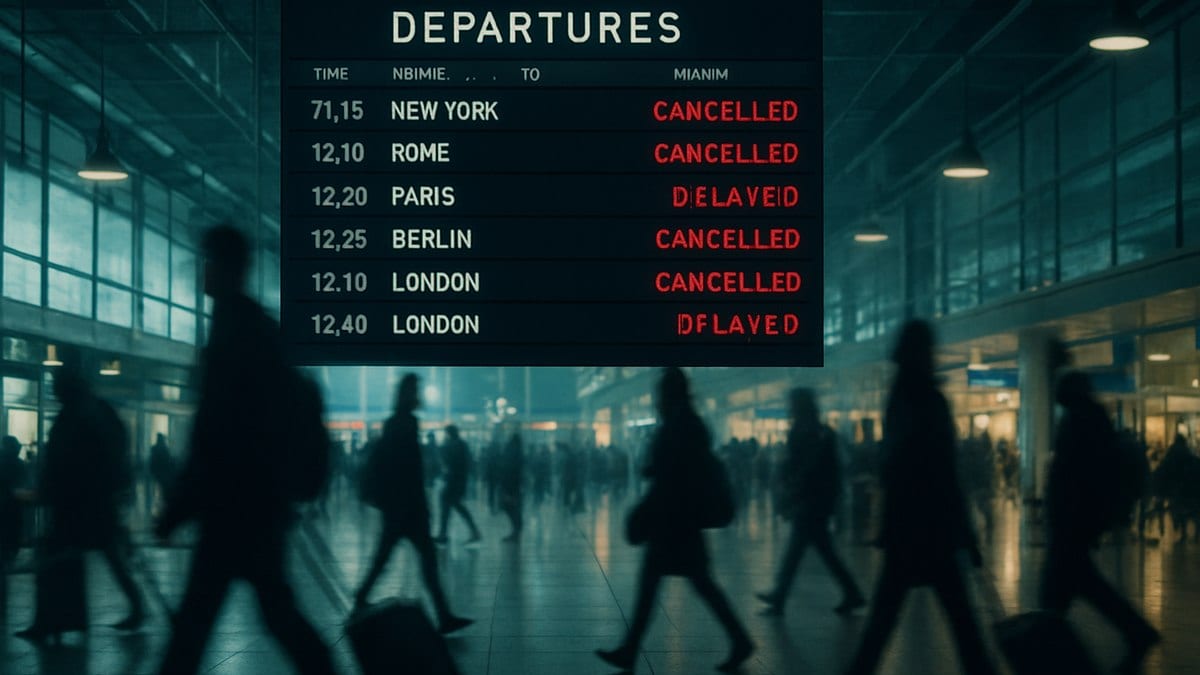
Flight disruptions are rippling across Asia in April 2026, with thousands of passengers facing cancellations, missed connections and rolling delays as fragile airline schedules collide with weather, airspace restrictions and lingering post‑pandemic capacity constraints.
Get the latest news straight to your inbox!
Early April Data Show Disruptions Spreading Across Key Hubs
Public aviation dashboards tracking the first week of April 2026 indicate that Asia’s major hubs are under sustained pressure, with hundreds of cancellations and several thousand delays recorded in just a few days. Aggregated figures cited in recent industry coverage show that across Asia and the wider Asia Pacific, recent days have brought thousands of delayed flights and hundreds of outright cancellations spread across up to half a dozen countries on a single date.
Tokyo, Shanghai, Singapore, Abu Dhabi and Kolkata are among the airports repeatedly appearing in disruption tallies, with one recent two‑day snapshot showing 264 cancellations and 3,829 delays affecting carriers including Air China, IndiGo, Batik Air and FlyDubai. Reports indicate that while no single airline dominates the cancellation charts, many are contending with long chains of late‑running aircraft that undermine carefully timed hub operations.
China’s network is a particular pressure point. Publicly available data for early April show China Eastern and Lao Airlines associated with 449 combined delays on routes touching Chinese hubs, compounding a wider wave of disruption in domestic and international services. Travel analysis notes that China Eastern appears repeatedly among the region’s most delay‑affected airlines, alongside Japanese and Korean carriers and several low‑cost operators in Southeast Asia.
These early April snapshots build on a pattern visible through March, when several large disruption days saw Asia‑Pacific networks hit by hundreds of cancellations and well over 2,000 delays in a single 24‑hour period. Analysts observing those events describe an environment in which even modest weather or airspace shocks can trigger system‑wide knock‑on effects that last well into subsequent days.
Weather, Airspace Restrictions and Jet Fuel Costs Combine
Multiple strands of reporting link the current turbulence in Asian flight operations to an overlapping set of pressures. In March 2026, a rare convergence of severe weather, geopolitical tensions and operational strain produced one of the worst recent disruption days in the Asia‑Pacific region, with more than 700 cancellations and over 2,000 delays logged in a single day from Tokyo to Dubai. That event, industry commentary suggests, exposed how little spare capacity exists in many airline schedules.
At the same time, the broader airspace picture over West Asia and parts of the Middle East continues to affect long‑haul services touching Asia. Public information on route adjustments shows that closures and restrictions related to the 2026 Iran conflict and ongoing Pakistani airspace limitations are forcing Indian and Gulf carriers to adopt longer routings to Europe and North America. These diversions add flight time, increase fuel burn and reduce aircraft and crew availability for Asia‑focused rotations.
Jet fuel prices remain another key factor. Regional business media have highlighted that a sharp increase in fuel costs through early 2026 has already driven surcharges and capacity trimming across Asian networks. Some analysts link these financial pressures directly to the current pattern of cancellations, noting that airlines are more likely to consolidate lightly booked rotations or pre‑emptively trim frequencies when fuel and financing conditions remain tight.
These macro‑level constraints mean that when local thunderstorms, low visibility or short‑notice air traffic restrictions hit a big hub such as Tokyo Haneda or Singapore Changi, airlines have fewer spare aircraft and crews available to plug gaps. The result is that what might previously have produced only short delays can now cascade into widespread cancellation waves that persist into the following week.
Japanese, Chinese and Southeast Asian Hubs Under Strain
Recent operational tallies illustrate how the disruptions are concentrating on key Northeast and Southeast Asian hubs. One widely cited breakdown from early April shows more than 3,000 delays and over 150 cancellations in a single day across a cluster of airports including Tokyo Haneda and Narita, Hong Kong, Guangzhou, Shenzhen, Incheon, Manila, Beijing Capital and Daxing, Singapore Changi and several inland Chinese cities.
Tokyo’s dual‑airport system has featured prominently in these lists, with Haneda and Narita together accounting for several hundred delays on the worst days. Japanese carriers appear more affected by late arrivals than by outright cancellations, but long holding times and repeated slot re‑timings are eroding on‑time performance and disrupting connections to domestic and regional spokes.
In China, multiple large airports including Guangzhou, Hangzhou, Kunming, Chengdu and Xi’an have recorded elevated disruption levels, with some interior hubs also reporting notable clusters of cancellations. Observers point to the combination of dense traffic, complex airspace and volatile weather patterns, particularly in southern China, as drivers of these bottlenecks. The impact is not confined to Chinese airlines, as foreign carriers operating into these hubs face similar air traffic and sequencing constraints.
Farther south, Singapore Changi and Manila’s Ninoy Aquino International Airport continue to act as chokepoints. While Singapore has seen fewer cancellations than some North Asian gateways on recent bad days, a steady build‑up of delayed departures caused by late‑arriving aircraft from Japan, India and China has strained gate capacity and ground handling resources. Manila, already operating close to infrastructure limits, has reported long queues in departure banks when regional disruptions coincide with local weather or congestion.
Airlines Juggle Schedules as Post‑Pandemic Fragility Persists
Behind the scenes, airlines across Asia are still managing the aftershocks of the pandemic on fleets, staffing and maintenance. Financial analysis published in late March notes that many carriers mothballed aircraft, reduced technical headcount and stretched maintenance intervals during the downturn, leaving thin margins in engineering and crew rosters. As travel demand has rebounded, these fragile systems are under intense stress.
Recent commentary on Asia’s disruption days highlights how a single technical fault at a hub can now trigger hours of downstream delays, affecting passengers far from the original incident. One case study from late March described how a maintenance hold at a major Chinese airport, initially involving just one aircraft, multiplied into dozens of knock‑on delays touching travelers in Manila, Delhi and Singapore whose long‑haul connections in Europe were subsequently broken.
Staffing patterns remain another constraint. New flight duty time rules in India, for example, have lengthened pilot rest windows and reduced overnight flying flexibility, changes designed to improve safety that nonetheless limit last‑minute rescheduling options. Across the region, carriers are also still rebuilding cabin crew ranks after voluntary departures and layoffs, which limits their ability to add extra sections or stand‑by crews when disruption hits.
Network restructuring decisions are occurring in parallel. In Japan, group consolidation moves such as the planned wind‑down of certain secondary brands in 2026 are intended to simplify operations, but in the short term they concentrate traffic on fewer flight numbers and aircraft types. Industry observers suggest that while such consolidation should improve resilience over time, it can initially magnify the impact of any one aircraft or crew issue on the broader schedule.
Travelers Face Higher Fares and a Need for Backup Plans
For passengers, the immediate impact of April’s disruption wave is visible in longer journeys and tighter seat availability on remaining flights. Financial analysis focused on UK‑to‑Asia itineraries suggests that when large disruption days coincide with capacity cuts, fares on alternative April departures can surge by 12 to 20 percent, adding the equivalent of several hundred dollars per person on some long‑haul economy tickets.
Reports from booking platforms and travel forums in recent weeks indicate that many Asia‑bound travelers are now building extra buffer days into itineraries, particularly when traveling through heavily affected hubs in Japan, China or Southeast Asia. Some are choosing routings via less congested secondary airports or opting for carriers that have, in recent disruption snapshots, recorded fewer outright cancellations even if they still face delays.
Consumer‑focused coverage also notes that flexible tickets and accommodation bookings have become more attractive, despite their higher upfront cost. In an environment where cancellations may be triggered by factors ranging from sandstorms and typhoons to distant geopolitical events, travelers with changeable reservations and comprehensive travel insurance are better positioned to adapt when schedules unravel.
With April only beginning, analysts following Asia’s aviation sector suggest that the coming weeks will test whether airlines and airports can restore more stable operations as seasonal travel ramps up. For now, the data emerging from early April 2026 point to a region where even routine weather and airspace challenges can swiftly spill into widespread cancellations and delays across interconnected flight networks.