

More news on this day
Hundreds of air travelers have been left stranded across Europe in early April 2026 as a surge of delays and cancellations rippled through more than ten major hubs, snarling holiday traffic and exposing ongoing strains in the continent’s aviation system.
Get the latest news straight to your inbox!
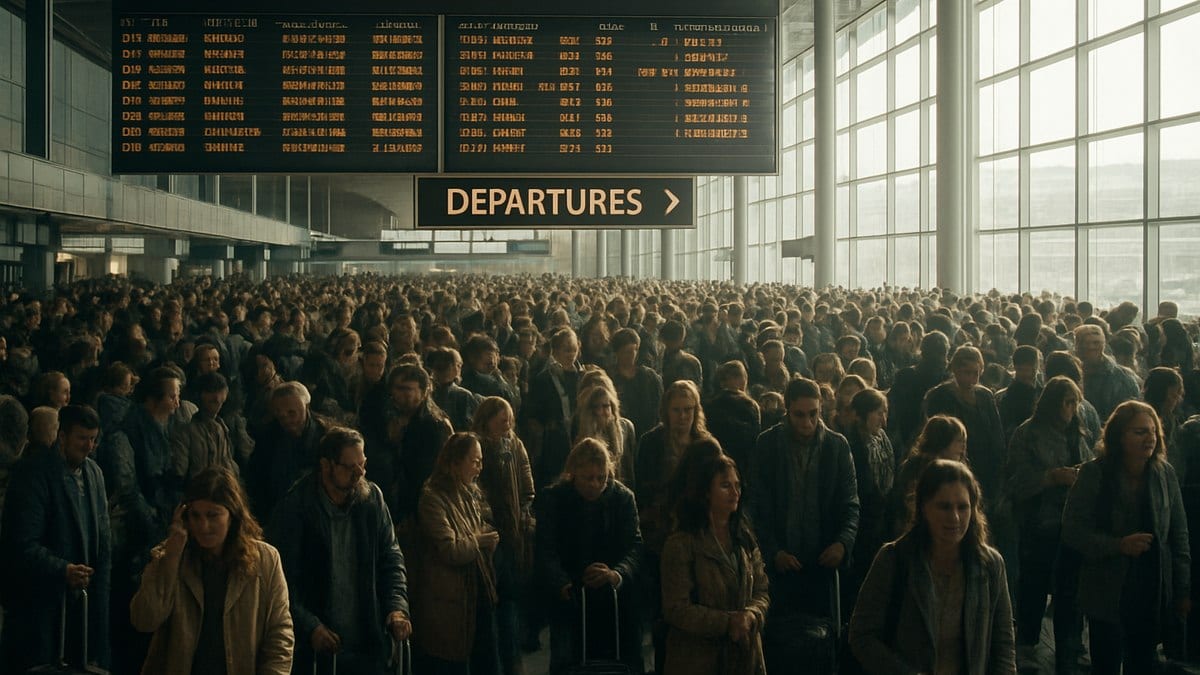
Delays and Cancellations Mount Across the Continent
Operational data from multiple flight-tracking and travel-industry reports indicate that the first week of April saw several days of unusually high disruption across European airports. On some days, more than 2,400 flights were reported delayed and over 150 cancelled in a 24-hour period, far above typical early spring levels. These figures translated into long queues, missed connections and overnight stays for passengers caught in the wrong place at the wrong time.
Coverage from travel news outlets describes a pattern of repeated shocks rather than a single, isolated incident. On April 1, more than 1,200 flights were reportedly delayed across Europe, with at least 65 cancellations contributing to scenes of congestion and frustration at major gateways. Similar turbulence followed on April 6 and 7, when combined totals of several thousand delayed flights and hundreds of cancellations again pushed the network to its limits.
Publicly available aviation data highlights that while many flights eventually operated, rolling delays of one to three hours were common at some hubs. For travelers with tight onward connections or fixed event dates, these timetable slips proved as disruptive as outright cancellations, forcing last-minute rebookings and, in some cases, unexpected nights in airport hotels.
Even where airports remained technically open and functioning, the volume of delayed aircraft circulating through the system created bottlenecks. Late-arriving planes struggled to be turned around in time for subsequent departures, leading to a cascading effect that affected passengers across multiple countries, including many who were not flying to or from the original trouble spots.
Major Hubs Hit from London to Rome
Reports from travel-industry briefings and consumer-facing advisories suggest that at least ten major European hubs have been significantly affected by the April turmoil. London’s main airports, especially Heathrow and Gatwick, have seen repeated episodes of heavy delay, with disruption rippling into the wider United Kingdom network. Paris Charles de Gaulle, one of Europe’s busiest international gateways, has likewise appeared frequently in disruption tallies, registering hundreds of delayed flights on some days.
Further north, hubs in Denmark, Norway and Finland, including Copenhagen, Oslo and Helsinki, have experienced clusters of delayed and cancelled services, particularly on peak travel days. These airports act as vital connection points for Scandinavian and Baltic routes, meaning knock-on effects have been felt well beyond their immediate catchment areas.
To the west and south, Frankfurt and other German airports, Amsterdam Schiphol in the Netherlands, and Spanish hubs such as Madrid and Barcelona have all featured in recent summaries of badly affected locations. In Italy, Rome Fiumicino and Milan Malpensa have been singled out in some analyses as among the hardest hit on specific April dates, with more than 200 delays recorded at a single airport on one of the worst days.
For passengers transiting these hubs, the result has been uncertainty over missed onward flights and the potential loss of nonrefundable rail tickets, hotel bookings and tour reservations. Travel companies monitoring the situation note that even travelers departing from smaller regional airports have been swept into the chaos when their journeys depended on connections through the most congested hubs.
Weather, Staffing and System Strain Converge
Available reporting points to a mix of contributing factors behind the April disruption rather than a single dominant cause. Unsettled spring weather has continued to affect flight operations, with gusty winds and bands of heavy rain or low cloud periodically slowing runway movements and requiring increased spacing between aircraft. When such conditions appear at already busy hubs, they can rapidly trigger backlogs that are difficult to clear before the next wave of scheduled flights arrives.
Alongside weather, staffing and air traffic management constraints remain a recurring theme across the European network. Since the pandemic, several countries have struggled to fully rebuild air traffic control capacity and ground-handling teams, leaving limited margin to absorb sudden demand spikes or operational glitches. In early April 2026, that structural fragility appeared again, as even relatively modest disturbances turned into large-scale timetable disruption.
Some travel-industry analyses also point to the lingering effects of earlier geopolitical turbulence and airspace restrictions outside Europe, which have forced airlines to adjust routings and fleet rotations. These changes can tighten scheduling buffers and increase the knock-on impact when an aircraft runs late on one leg, especially for carriers that rely on complex hub-and-spoke networks across multiple regions.
Compounding the pressure, the first week of April coincided with the tail end of the Easter holiday period in many markets, when leisure travel demand remains elevated and many flights are close to or at capacity. With fewer empty seats available, rebooking stranded passengers became more complex, leading to longer waits and, in some cases, overnight stays in terminal buildings.
Passenger Experience: Queues, Rebookings and Rights
Images and accounts shared across mainstream travel coverage describe crowded departure halls, long lines at airline service desks and passengers resting on terminal floors as they waited for rebooked flights. While such scenes are familiar from earlier episodes of disruption, the breadth of airports affected in early April has meant limited options for rapid rerouting on alternative carriers or via different hubs.
Consumer advocates and travel specialists have used this latest wave of disruption to reiterate standard advice for passengers caught in large-scale operational breakdowns. Recommendations commonly include checking flight status directly through airline apps and independent tracking platforms, keeping boarding passes and receipts for any extra accommodation or meals, and, where applicable, reviewing eligibility for compensation or reimbursement under European passenger-protection rules.
However, the practical reality for many stranded passengers has been one of uncertainty and limited information. When disruption extends across multiple countries and carriers simultaneously, call centers and digital customer-service channels can become saturated, making it difficult to secure timely assistance. At the airport level, ground staff have also faced intense pressure as they attempt to manage queues and rebookings while normal operations continue around them.
For travelers with connecting itineraries, missed onward flights have posed additional challenges, including the risk of being separated from checked baggage and the need to rearrange hotel stays, car rentals and event tickets at short notice. Travel insurance policies have offered some protection in certain cases, but coverage varies widely between providers and policy types.
Concerns Ahead of the Summer Travel Surge
The scale and frequency of early April’s flight disruption have prompted renewed questions about how well Europe’s aviation system is prepared for the peak summer season. Industry observers note that, while recent days do not rival the continent-wide shutdowns triggered by volcanic ash clouds or pandemic-era border closures, the pattern of recurring multi-country disruption is a warning sign for the months ahead.
Several analyses highlight that European carriers and airports are simultaneously contending with capacity constraints, infrastructure upgrades, regulatory changes and shifting travel patterns. Some hubs are implementing new border-control systems and security procedures in 2026, a transition that may temporarily slow passenger processing at precisely the time when travel volumes are climbing.
For now, the immediate focus remains on clearing backlogs, stabilizing schedules and getting stranded passengers to their destinations. Yet the events of early April 2026 are likely to feed into broader debates over staffing levels, investment in air traffic control technology, and the resilience of hub-and-spoke networks in an era of frequent shocks.
Travelers planning European trips in the coming weeks are being encouraged by consumer groups and travel platforms to build in longer connection times, consider earlier departures before critical events, and stay alert to evolving conditions. If the first days of April are any indication, the margin for error in Europe’s skies may remain thin as the summer rush approaches.