

More news on this day
Hundreds of travelers have been left sleeping in terminals or scrambling for alternative routes as a fresh wave of April flight chaos ripples across Europe’s biggest hub airports, compounding weeks of strain on already stressed airline schedules.
Get the latest news straight to your inbox!
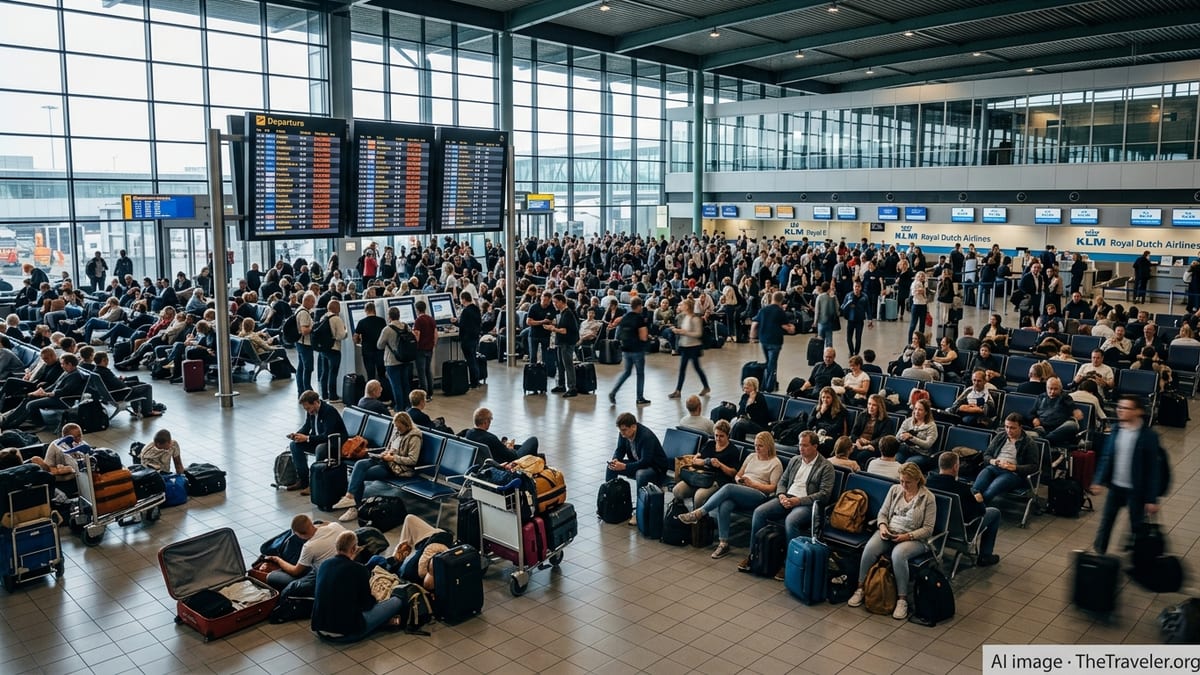
Wave of Disruptions Hits Key European Gateways
Publicly available data from flight tracking and aviation analytics platforms indicates that Europe entered April 2026 with a sharp spike in delays and cancellations at major hubs including London Heathrow, Amsterdam Schiphol, Frankfurt, Munich, Madrid, Barcelona, Istanbul and Copenhagen. On April 7 and 8 alone, several sources report more than 1,400 delayed flights and dozens of cancellations in a single day as thunderstorms, airspace constraints and staffing shortages converged.
Coverage from specialist travel and aviation outlets describes Heathrow and Amsterdam among the hardest hit in recent days, each logging several hundred delays and a cluster of cancellations as bad weather over western Europe forced reroutes, slower air traffic management and temporary flow restrictions. Similar patterns have been observed at Frankfurt and Munich, where knock-on effects from earlier disruptions left aircraft and crews out of position just as peak morning and evening banks built up.
Further south, travel industry reporting notes that Rome Fiumicino and Milan Malpensa have also seen unusually high disruption, with more than 200 delays combined on some days this week. Italian hubs have been affected by a mix of convective weather, ground handling strain and broader regional complexities tied to traffic flows between Europe, North Africa and the Middle East.
The net result for passengers has been a familiar but acute form of gridlock: long queues at rebooking desks, limited same-day alternatives on popular trunk routes, and overnight stays for those misconnecting at congested hubs. While many flights have eventually departed, schedule reliability at key European gateways has dipped noticeably at the very moment spring holiday demand begins to build.
Weather, Staffing and Regional Tensions Combine
Several strands are feeding into the latest bout of April disruption. Aviation and weather bulletins highlight fast-moving storm systems over western and central Europe in early April, triggering temporary ground stops, runway capacity reductions and extended separation between aircraft. Even modest reductions in hourly movements at hub airports can cascade quickly when load factors are high and spare slots are scarce.
At the same time, industry briefings and consultancy analyses point to persistent staffing tightness at ground handling companies and air traffic control centers in parts of Europe. While the acute staffing crises seen in 2022 and 2023 have eased, sick leave spikes and training backlogs continue to limit flexibility. When weather or technical issues prompt a surge in last-minute changes, airports and airlines may lack spare teams to absorb the shock, stretching turnaround times and forcing schedule trims.
Overlaying these structural pressures is an unsettled geopolitical backdrop. With several Middle Eastern hubs still operating on reduced schedules after recent regional tensions and airspace restrictions, more Europe–Asia traffic has been re-routed via alternative corridors. Analysts note that this has lengthened certain flight times and tightened aircraft rotation windows, leaving carriers more vulnerable when European weather deteriorates or local incidents arise.
Reports also reference lingering disruption at key non-European hubs, such as Dubai and Doha, which continue to manage backlogs of stranded long-haul travelers. When onward connections into Europe from those hubs are delayed or consolidated, pressure shifts onto European airports tasked with accommodating late-arriving passengers and repositioned aircraft at short notice.
Hubs Struggle With Knock-on Effects Across the Continent
What has distinguished the first week of April 2026, according to multiple published overviews, is less a single catastrophic event and more the cumulative impact of repeated medium-scale disruptions across many hubs on consecutive days. One day of storms over Germany and the Benelux region, another day of local ground handling bottlenecks in Italy, and a fresh round of delays tied to airspace congestion over the eastern Mediterranean have together produced a rolling pattern of irregular operations.
For hub airports like Frankfurt, Amsterdam, London and Istanbul, the challenge is amplified by their role as transfer nodes. When a morning bank of inbound flights arrives late from North America or the Middle East, it can trigger missed connections onto European short-haul services. Aircraft that should have turned quickly for intra-European rotations instead depart hours behind schedule or are swapped out entirely, reducing overall capacity for the rest of the day.
Regional airports are feeling the ripple effects. Travel industry coverage highlights secondary hubs such as Manchester, Málaga, Copenhagen and Athens reporting elevated delays even on days of relatively benign local weather, largely because they depend on aircraft arriving from already disrupted major hubs. In practice, this has meant late-night arrivals turning into cancellations when curfew limits are reached or crew duty time limits are exceeded.
Some operational data shared by flight compensation and passenger rights platforms suggests that on several recent days in April, more than 1,000 flights across Europe have been delayed or canceled, with a concentration at hubs that serve as spokes for multiple carriers. The distribution of disruption has shifted from country to country, but the common thread remains an aviation system operating close to capacity with limited room to recover when things go wrong.
Passenger Rights and Practical Options Under EU261
The latest turmoil has once again pushed Europe’s passenger rights framework into the spotlight. Legal and consumer-facing explainers emphasize that under EU Regulation 261/2004, travelers departing from an EU or EEA airport, or flying with an EU carrier, may be entitled to care provisions such as meals, refreshments and hotel accommodation during long delays, regardless of the underlying cause.
Cash compensation, by contrast, generally depends on whether the disruption is deemed within the airline’s control. When delays and cancellations are primarily attributed to severe weather, widespread air traffic management restrictions or security-related airspace closures, experts note that carriers frequently classify these as extraordinary circumstances. In such cases, passengers can still request rerouting or a refund, but lump-sum compensation is often not payable.
Consumer advocates and travel law commentators advise that affected travelers keep detailed records, including boarding passes, booking confirmations and written explanations of the cause of disruption when available. These documents can be important when submitting claims directly to airlines or through third-party claim platforms, especially if disputes arise over whether an event falls within EU261’s compensation thresholds.
Given the rolling nature of April’s disruption, some guidance also recommends a more proactive approach: monitoring flight status closely in the 24 hours before departure, considering earlier departures or longer layovers when connecting through known bottleneck hubs, and being prepared to ask airlines about rebooking via alternative cities when a primary hub becomes severely constrained.
What April’s Chaos Signals for the Summer Peak
Beyond the immediate inconvenience for travelers stranded on makeshift beds in terminal corridors, the current episode is being read by analysts as an early stress test for Europe’s aviation system ahead of the busy summer season. Industry outlooks published in recent weeks project passenger volumes in 2026 that are at or above 2019 levels on many key routes, with low-cost and leisure traffic particularly strong.
Consultancy forecasts and airline financial disclosures suggest that many carriers have limited spare aircraft capacity in their fleets, having optimized schedules to keep planes flying more hours per day. While this boosts efficiency in normal conditions, it leaves fewer backup aircraft on hand when multiple hubs are hit by disruption at once. Ground handling and air traffic control staffing, although improved since the pandemic-era lows, are also not yet back to the comfortable buffers of a decade ago.
Travel risk advisories are already encouraging passengers planning spring and summer trips to build in extra resilience, especially when itineraries involve tight connections at large European hubs or onward travel to regions affected by geopolitical tensions. Recommendations commonly include choosing longer layovers, avoiding the last flight of the day on critical legs, and considering direct services where possible even if they come at a premium.
For now, the expectation among many industry observers is that European hub operations will gradually stabilize if weather patterns improve and no new systemic shocks emerge. Yet the first days of April have underscored how thin the margin for error remains. With hundreds of passengers already stranded by this month’s wave of disruption, the coming weeks will be watched closely as an indicator of whether Europe’s aviation network is ready for the pressures of peak summer demand.