

More news on this day
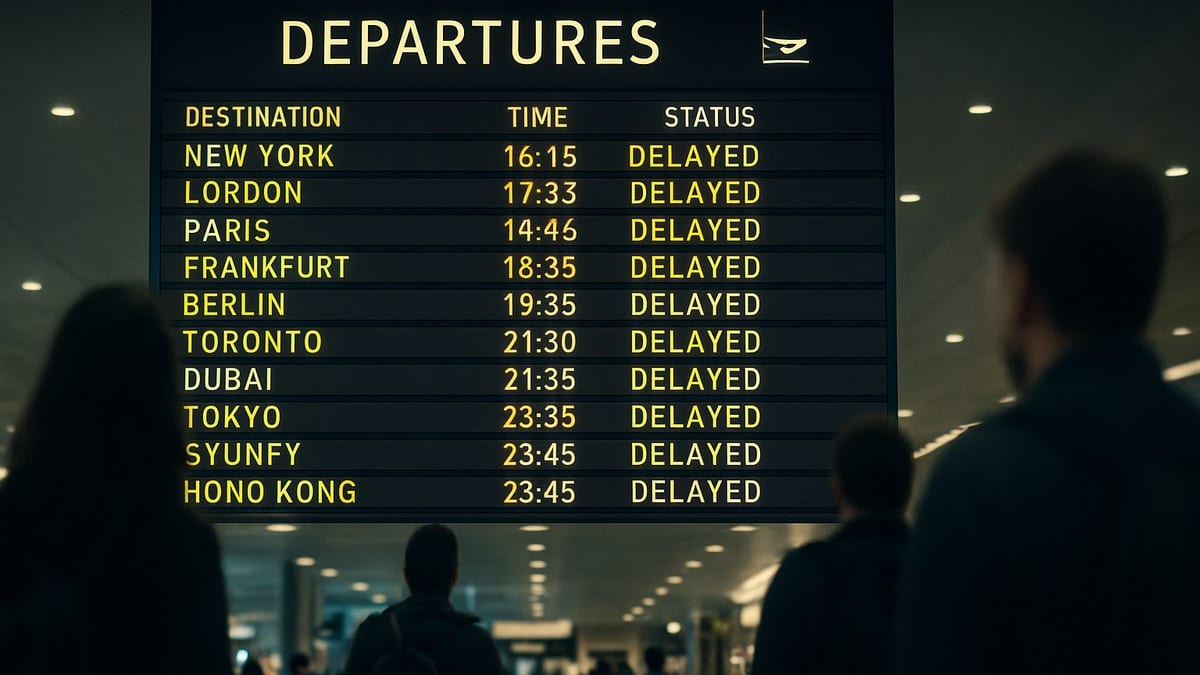
Air travelers faced another difficult weekend in mid-April as publicly available tracking data and industry reports pointed to 311 flight delays and dozens of cancellations across seven nations, underscoring how fragile global aviation networks remain in 2026.
Get the latest news straight to your inbox!
Seven Nations Grapple With a Fresh Wave of Disruptions
Reports compiled on April 12 indicate that Canada, the United States, China, Germany, Bahrain, Qatar, and Russia all experienced notable schedule upheaval as airlines struggled to keep aircraft and crews in position. A detailed snapshot from Canadian airports pointed to 311 delayed flights and 29 cancellations in a single day, with similar though smaller patterns observed across the other six countries.
Publicly available coverage describes crowded terminals, extended queues at check in and security, and passengers contending with missed connections as delays at major hubs cascaded into regional networks. The figures are modest compared with the worst holiday meltdowns of recent years, but the breadth across seven separate jurisdictions highlights continuing pressure on aviation operations early in the northern spring travel season.
Information gathered from travel industry outlets characterizes the April 12 disruption as part of a rolling pattern rather than an isolated anomaly. Data from previous days in April already showed rising delay totals in Europe, North America, and parts of Asia Pacific, suggesting that the system was operating with little slack before the latest problems emerged.
Although the 311 delay count is tied most clearly to Canada’s busiest gateways, references to persistent issues in the United States, China, Germany, and Russia point to an increasingly interconnected problem. When key aircraft or flight crews fall behind schedule in one country, the consequences ripple quickly into another, particularly on long haul routes linking North America, Europe, and Asia.
Weather, Staffing and Fuel Markets Combine to Stretch Capacity
Published coverage of the April events links the latest delays to a mix of causes, including lingering winter weather in parts of Canada and Russia, bouts of heavy rain and storms in North America, and ongoing staffing gaps in several major markets. In Germany and neighboring European states, recent reports have emphasized the build up of air traffic control delay minutes over the past decade, which leaves less margin for handling even routine weather systems.
In the Middle East and adjoining regions, aviation analyses throughout March and April have highlighted the impact of route restrictions and jet fuel supply constraints linked to geopolitical tensions near key energy corridors. Separate reporting on Asia Pacific hubs in April describes how these fuel market disruptions and airspace adjustments have forced airlines to reroute or retime services, lengthening block times and tightening aircraft rotations.
Operational data from consumer rights and flight tracking services also point to staff availability and crew duty limits as important contributing factors. Airlines that reduced headcount during the pandemic now face higher absenteeism and training backlogs, which can quickly translate into missing crew for a particular departure. Once one sector is delayed and a crew reaches its maximum duty hours, the onward flight often cannot depart as scheduled, further amplifying the disruption.
Analysts writing in specialist aviation and travel finance outlets stress that none of these factors alone fully explains the April 12 pattern. Instead, they describe a complex mix in which weather, fuel supply, staffing, and high seasonal demand interact, leaving the system vulnerable to relatively modest shocks that might have been absorbed more easily in previous years.
Knock-On Effects for Passengers and Airlines
For passengers, the most immediate impact of the 311 delays and associated cancellations was time lost in airports, missed connections, and the challenge of securing new itineraries on already busy routes. Accounts collected by travel consumer platforms describe families attempting to rebook multi segment journeys through North American and European hubs, only to find alternative seats limited or significantly more expensive.
Travel insurance and air passenger rights organizations note that the financial consequences can extend well beyond the airfare itself. Additional hotel nights, meals, local transport, and rebooked ground services can quickly accumulate, particularly when travelers are connecting across continents and cannot easily shift their plans. Guidance published in recent days encourages travelers to keep detailed records of delay times, boarding passes, and receipts to support any future claims.
On the airline side, April’s disruptions feed into a mounting cost base. Industry commentary circulated this month estimates that extended delays generate extra spending on crew accommodations, overtime, ground handling, and aircraft repositioning. In some jurisdictions, carriers may also face compensation or care obligations when delays fall within their control, although exemptions for extreme weather or air traffic restrictions can limit payouts.
Airport operators are also feeling the strain. Terminals designed around relatively smooth passenger flows are seeing chokepoints at security checkpoints, check in halls, and immigration desks when delayed departures leave more travelers in the building at once. Several recent network operations reports for European hubs have already documented this pattern, warning that a lack of buffer capacity could turn even short disruptions into all day events.
April Disruptions Extend a Difficult Start to 2026
The mid April turbulence comes after a challenging first quarter for global aviation. In March, multiple tracking services documented tens of thousands of delays and cancellations across the Americas following severe winter weather and storms, while Asia Pacific faced its own crisis day with thousands of disrupted flights linked to heavy rain, typhoon activity, and regional geopolitical tensions.
Europe has also entered April on the back foot. Network summaries for early April show significant disruption at major hubs in the United Kingdom, the Netherlands, France, and Central Europe, with technical issues, industrial action, and localized weather events all contributing to escalating delay minutes. More recent reporting indicates that schedule instability has spilled into secondary hubs such as Prague, underscoring how interconnected the continent’s airspace has become.
These earlier events help explain why the 311 delays and seven country footprint on April 12 had such immediate consequences. Aircraft and crews were already out of position from earlier disruptions, leaving fewer spare aircraft on standby and limited flexibility in roster planning. As a result, even airports that were not directly affected by bad weather or fuel constraints experienced late arrivals and missed departure slots.
Travel trade publications observe that the pattern fits a broader post pandemic trend, in which airlines and airports have rebuilt capacity, but often with leaner staffing and less redundancy. While this can improve efficiency in stable conditions, it reduces resilience when faced with overlapping shocks, from weather systems to geopolitical crises.
What Travelers Can Expect Through the Rest of April
With northern hemisphere spring breaks and early summer planning already shaping booking patterns, industry observers are cautious about the outlook for the rest of April. Forecasts from aviation data firms suggest that scheduled seat capacity across many key markets will remain high, particularly on transatlantic and transpacific routes, leaving little room to absorb further disruptions.
Consumer advocacy organizations recommend that travelers build additional time into connections, particularly when itineraries involve major hubs in Canada, the United States, Europe, or Asia Pacific that have been highlighted in recent disruption reports. Flexible tickets and travel insurance products that explicitly cover delays and missed connections are being promoted as tools to mitigate some of the risk, although they do not remove the inconvenience of extended travel days.
Some airline network planners quoted in sector analyses argue that the current turbulence could ease as fuel markets adjust and seasonal weather patterns stabilize heading into late spring. However, they also acknowledge that structural issues, such as air traffic control staffing and infrastructure bottlenecks, will take longer to resolve and may continue to generate pockets of disruption even in otherwise favorable conditions.
For now, the April 12 figures of 311 delays and related cancellations across seven nations serve as another reminder that global air travel remains vulnerable. Travelers are being encouraged by public information campaigns and travel advisories to monitor flight status closely, remain flexible where possible, and prepare for the possibility that journeys in 2026 may still look very different from pre pandemic norms.