

More news on this day
A rapidly escalating security crisis in the Strait of Hormuz has brought the 2025–2026 Arabian Gulf cruise season to a near standstill, leaving thousands of passengers and six major ships unexpectedly paused in Dubai, Abu Dhabi and Doha while cruise lines race to rework itineraries and repatriation plans.
Get the latest news straight to your inbox!
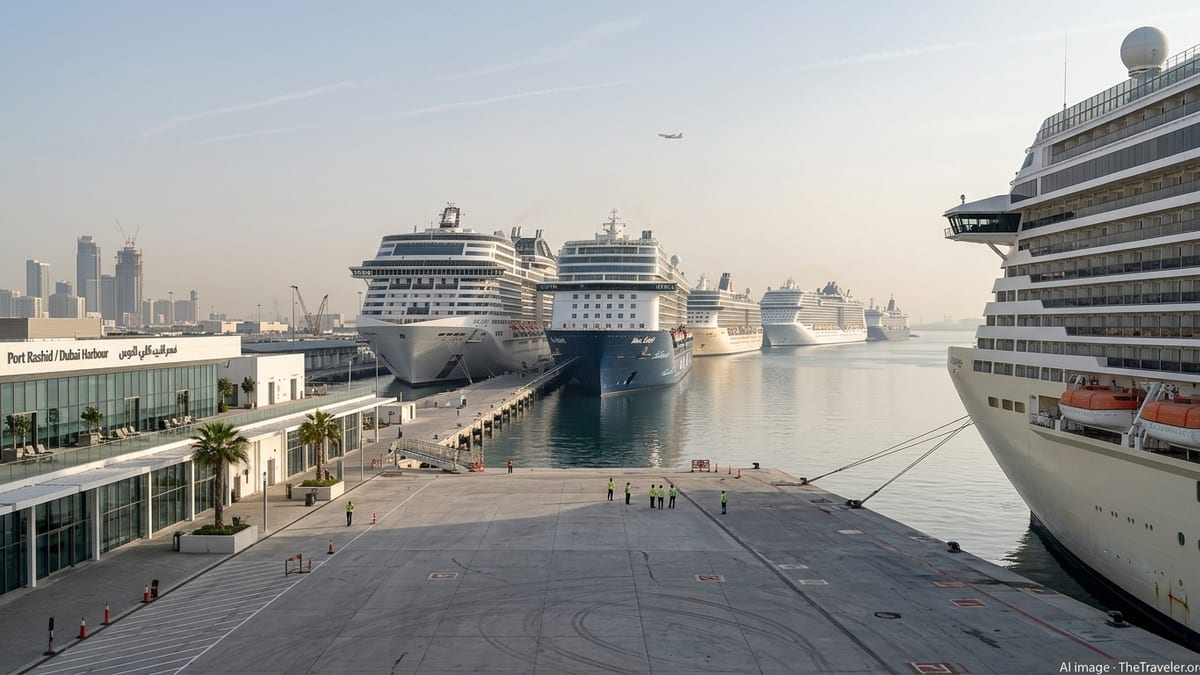
Six Ships Held in Key Gulf Ports as Strait of Hormuz Traffic Plunges
Publicly available maritime and cruise industry reports indicate that at least six large cruise vessels are currently unable to exit the Arabian Gulf, following a sharp deterioration in security conditions around the Strait of Hormuz in late February 2026. The chokepoint has seen mounting naval activity, new insurance restrictions and warnings that have effectively halted routine passenger ship movements.
According to recent coverage of the 2026 Strait of Hormuz crisis, the ships affected include MSC Euribia and Saudi-backed Aroya, both in Dubai, as well as Celestyal Journey and Celestyal Discovery, also reported in Dubai or nearby Gulf ports. TUI Cruises’ Mein Schiff 4 is understood to be alongside in Abu Dhabi, while Mein Schiff 5 has been reported at berth in Doha. Together, they represent some of the largest contemporary vessels ever to be simultaneously stranded in the region.
Operational updates from port advisories and specialist shipping bulletins describe a wider picture in which many commercial vessels are choosing to avoid transiting the strait despite Gulf ports technically remaining open. Cruise operators, which are more exposed to passenger safety concerns and itinerary reliability, have been among the first to pause movements, opting to keep ships in port while they assess evolving security and insurance conditions.
Which Cruise Lines and Seasons Are Affected
The disruption comes on top of a series of cancellations and redeployments that had already reshaped the Middle East cruise market for winter 2025–2026 and beyond. Over recent months, lines such as Costa Cruises and AIDA Cruises had confirmed that they would not proceed with planned 2026–2027 Arabian Gulf deployments, shifting tonnage back to the Mediterranean and other regions instead.
More recent industry updates show that the current crisis has pushed additional operators to curtail or abandon their remaining Gulf programs for the 2025–2026 season. TUI Cruises has ended several sailings for Mein Schiff 4 and Mein Schiff 5, while Saudi-based Aroya Cruises has cancelled the rest of its winter Arabian Gulf season after only a brief period in operation. Greek operator Celestyal is also reported to have called off upcoming short Gulf cruises and early Eastern Mediterranean voyages because two of its ships remain in the region.
For many brands, the pause in Dubai, Abu Dhabi and Doha has a knock-on effect far beyond the Gulf. Ships that were scheduled to reposition to Europe for the summer now face uncertain departure dates, complicating tightly planned dry dock slots, charter commitments and the start of new seasons in the Mediterranean and Northern Europe.
What This Means for Booked and Prospective Passengers
For travelers with near-term bookings in or via the Arabian Gulf, the immediate impact is significant. Published cruise line advisories and media reports show that affected sailings in March and April 2026 are being cancelled or heavily modified, with guests offered a mix of full refunds, future cruise credits and rebooking onto alternative itineraries in other regions.
Because several of the paused ships were due to operate repositioning cruises between the Gulf and Europe, passengers booked on those voyages may also see their travel plans change. In many cases, lines are attempting to preserve the broader holiday by shifting guests to equivalent-length sailings in the Mediterranean, Canary Islands or Western Europe, while keeping the overall dates similar.
Air travel has become a further complication. Aviation and security briefings from late February and early March point to reduced or disrupted flight schedules into and out of some Gulf hubs during peak periods of the crisis. While major airports in the United Arab Emirates and Qatar remain open, capacity constraints and shifting advisories can affect how quickly cruise guests are able to fly home or reach alternative embarkation ports.
Safety, Insurance and Operational Drivers Behind the Pause
Although Gulf ports such as Dubai, Abu Dhabi and Doha largely remain operational, the combination of regional military activity, missile and drone incidents, and elevated war-risk premiums for vessels transiting the Strait of Hormuz has changed the economic and risk calculus for passenger shipping. Maritime risk consultancies note that, even without a formal closure of the waterway, many owners and insurers now regard nonessential transits as unacceptable for the time being.
Cruise itineraries are especially vulnerable to this type of disruption. Ships sailing round-trip from Dubai or Doha must pass through the strait to reposition, and many winter programs are built around smooth air–sea connections that can quickly be undermined by flight suspensions or restrictions. Publicly accessible cruise industry analysis suggests that the decision to hold ships in port is driven not only by direct security concerns, but also by the prospect of last-minute diversions, lengthy detours and stranded passengers if the situation worsens.
For the ports themselves, the pause in cruise movements is an abrupt reversal after years of investment in terminals and tourism infrastructure. Data cited in recent regional cruise coverage highlight that Dubai alone typically handles hundreds of cruise calls per season, a volume that has underpinned hotel, retail and excursion sectors across the wider Gulf.
Practical Advice for Travellers Considering Gulf Cruises
Travel and cruise industry observers are advising prospective passengers to treat Arabian Gulf itineraries for late 2026 and early 2027 as highly fluid until there is sustained improvement in the security outlook. Some lines have already pulled their programs entirely, while others continue to market future seasons but are closely monitoring developments.
For those already booked on cruises involving Dubai, Abu Dhabi or Doha, the most reliable information will be the official travel alerts and operational updates published by the cruise line and by government advisories in the traveler’s home country. Given the pace of change, travelers may wish to enable notifications from their cruise line, monitor airline schedules into Gulf hubs and confirm the flexibility of any independently booked flights or hotels.
Travel insurance is another key consideration. Policy wording on war, terrorism and known events can vary widely, and publicly available consumer guidance indicates that not all plans will cover cancellations or changes arising from geopolitical crises. Passengers are being encouraged by travel advisors to review coverage details carefully, and to keep receipts and documentation in case reimbursement claims are needed later.
Finally, anyone considering a cruise that transits or relies on embarkation in the Arabian Gulf in the coming months should be prepared for itinerary changes, replacement ports or complete redeployments to other regions. While cruise lines are generally offering financial protections and alternatives, the current environment means that flexibility and a willingness to adapt plans are likely to remain essential for Gulf-bound travelers through at least the remainder of 2026.