

Arizona’s culture is written into its sandstone cliffs, adobe walls, and desert skies. Across this wide Southwestern state, Indigenous homelands, Spanish missions, frontier towns, and fast-growing cities overlap in complex ways. Today’s Arizona is not just a place of spectacular landscapes but of living Native traditions, layered histories, and a creative scene that continues to evolve with each new arrival and generation.
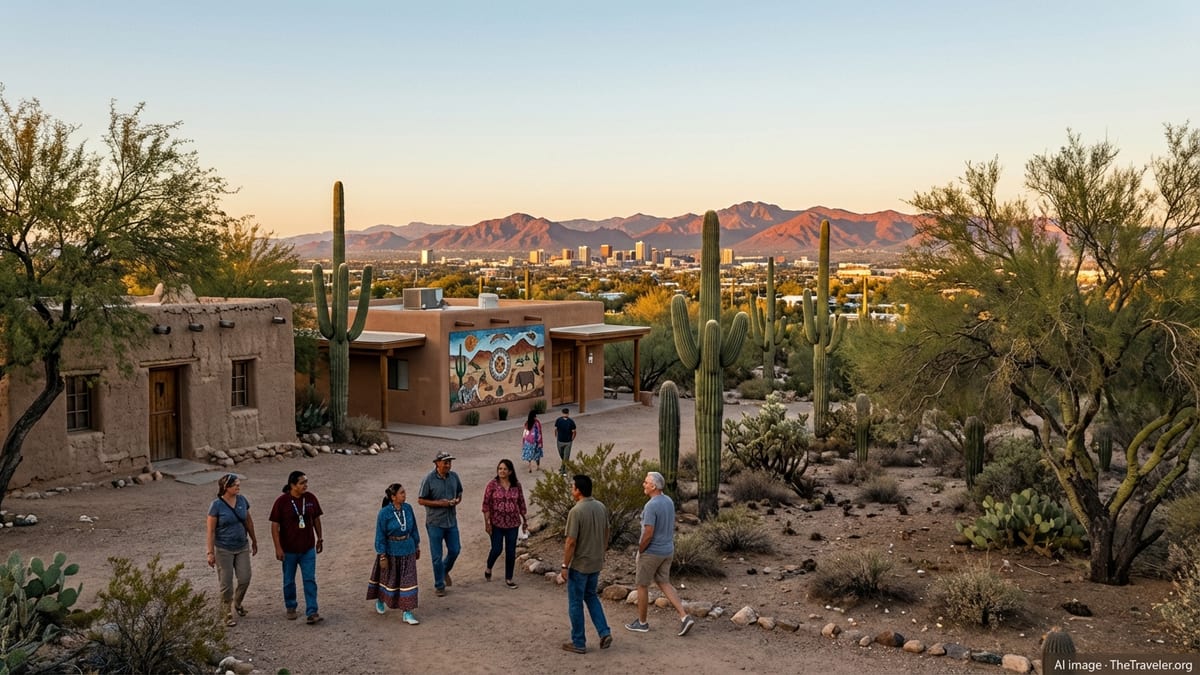
From Ancient Desert Civilizations to a Modern State
Long before Arizona appeared on any modern map, the region was home to highly organized Indigenous societies that engineered life in a difficult desert environment. Archaeological research has revealed intricate irrigation networks, terraced fields, and masonry villages that date back more than 2,000 years. Cultures often described by archaeologists as Hohokam, Ancestral Pueblo, Mogollon, Sinagua, Salado, Cohonina, and Patayan built durable settlements, traded across long distances, and adapted to varied landscapes from pine forests to arid basins.
These early desert farmers and village dwellers left behind impressive ruins and artifacts that still shape Arizona’s identity as a window into pre-contact North America. Pueblos, cliff dwellings, and petroglyph sites across the state testify to a deep relationship with water, stone, and sky. Rather than isolated outposts, these communities formed part of broader cultural networks that linked what is now Arizona to the wider Southwest and Mesoamerica through trade, ceremony, and ideas.
The arrival of nomadic Apache and Navajo groups between roughly the 12th and 15th centuries added new cultural layers to this Indigenous landscape. These Athabaskan-speaking peoples moved into the region from the north, eventually developing distinct languages, spiritual practices, and social systems that remain central to Arizona’s cultural fabric. Their presence underscores that Arizona’s history is not a single linear story but a mosaic of migrations, alliances, and changing homelands.
Spanish explorers and missionaries began arriving in the 16th century, driven by imperial competition, religious conversion, and the search for mineral wealth. Missions in what is now southern Arizona, especially in the Santa Cruz River valley, introduced European livestock, crops, and Catholicism to Indigenous communities. After Mexican independence in 1821, these mission communities were reshaped yet again, and eventually, through the Mexican-American War and the Gadsden Purchase of 1853, the land that would become Arizona shifted into United States control, setting the stage for statehood in 1912.
Native Nations and Living Heritage
Modern Arizona is home to one of the largest Indigenous populations in the United States, with 22 federally recognized tribes whose sovereign nations cover significant portions of the state. The Navajo Nation, whose reservation extends into New Mexico and Utah, is the largest by land area in the country. Nations such as the Hopi, Tohono O’odham, Yavapai-Apache, Pascua Yaqui, Gila River Indian Community, Salt River Pima-Maricopa, and many others maintain distinct languages, ceremonial practices, and governance systems that continue long-standing connections to their ancestral territories.
On the ground, this heritage is expressed in both everyday life and public institutions. The Navajo Nation Museum in Window Rock, for example, presents ethnographic collections, contemporary art, and language revitalization programs that center Navajo stories and worldviews. Nearby, the Navajo Nation Zoological and Botanical Park cares for native plants and animals considered culturally important, with exhibit labels in the Navajo language and a mission rooted in spiritual as well as ecological stewardship. These efforts demonstrate how museums and cultural centers can function as community spaces rather than solely tourist attractions.
The Tohono O’odham Nation, whose lands span from south of Casa Grande to the border with Sonora, Mexico, offers another window into living Indigenous culture. Visitors encounter the People of the Desert through seasonal events, a cultural center and museum, community celebrations, and traditional crafts such as basketry and pottery. Tribal cultural affairs offices work to protect sacred sites and cultural resources, review land use proposals, and navigate complex legal frameworks around repatriation and archaeological protection, reflecting the ongoing work behind the scenes to safeguard heritage in a rapidly changing state.
Across Arizona, public institutions increasingly collaborate with tribal communities to mark Native American Heritage Month each November and beyond. At sites such as Montezuma Castle and Tuzigoot National Monuments, programming often features Hopi, Zuni, Diné, Yavapai-Apache, and Tohono O’odham artists and performers sharing carving, silversmithing, textiles, dance, and music. For visitors, these events provide a rare chance to learn directly from culture bearers, while for Native participants they can be both a platform and a point of negotiation over representation and control of narrative.
Desert Cities, Migration, and Everyday Culture
Arizona’s cultural life today is strongly shaped by its cities, especially Phoenix and Tucson, which have grown into diverse metropolitan centers. Phoenix, one of the fastest-growing major cities in the United States, has invested heavily in its creative economy. Studies estimate billions in annual economic output tied to arts, culture, design, and media, with tens of thousands of related jobs. Public art programs, gallery districts, street murals, and festivals all help to weave creativity into everyday urban experience.
This urban culture sits at the crossroads of many migrations. Generations of Mexican and Mexican American families, retirees from across the United States, refugees, and recent arrivals from around the world all influence Arizona’s food, language, and neighborhood life. In the Phoenix area, you can hear Spanish, English, Navajo, and dozens of other languages on a single city block. Neighborhood panaderias, Sonoran hot dog stands, taco trucks, and contemporary Southwestern restaurants sit alongside coffee shops and farmer’s markets, reflecting a blending of traditions and tastes.
Tucson, with its university-town energy and deep Sonoran roots, has built a reputation as a creative and culinary hub. It has been recognized internationally for its food heritage, thanks in part to ingredients and agricultural knowledge drawn from Indigenous and Mexican traditions. Historic barrios with adobe streetscapes, mission churches, and vibrant murals coexist with music venues, museums, and contemporary art spaces. The conversion of a historic Benedictine monastery chapel into a live music venue in 2025 illustrates how Arizona’s cities often reimagine older religious or civic spaces as cultural gathering points, layering new uses atop historic foundations.
Everyday culture in Arizona is also shaped by the desert environment itself. Outdoor recreation is not just a pastime but part of the social fabric: early-morning hikes to beat the heat, sunset walks through saguaro forests, and evenings spent on patios under wide starscapes. For many residents, the rhythms of monsoon season, the scent of creosote after rain, and the changes in light over distant mountain ranges are as central to identity as any gallery or festival. This close relationship with place influences local art, photography, and storytelling in subtle but powerful ways.
Art, Museums, and Creative Expression
Arizona’s arts scene draws from its Indigenous roots, Western frontier mythology, and contemporary global culture. Major institutions such as the Tucson Museum of Art and Phoenix Art Museum anchor this landscape with collections that span modern and contemporary art, Latin American works, and art of the American West, including pieces by prominent Native American artists. Exhibitions often juxtapose historic objects with installations that question or reinterpret the Southwest’s familiar visual icons.
Contemporary Native artists from Arizona play an increasingly visible role on national and international stages. Artists of Tohono O’odham, Navajo, Hopi, and other backgrounds create work that bridges traditional materials and forms with new media, conceptual approaches, and large-scale installations. Many explore themes of land, sovereignty, environmental change, and survivance, challenging stereotypes about Indigenous art as primarily craft or artifact. Collaborations with major fashion and design brands, as well as residencies at leading museums, show how Arizona-rooted artists help shift global conversations about Indigenous representation.
Beyond flagship museums, smaller galleries, artist-run spaces, and community arts centers offer a more intimate perspective on local creativity. In Tucson, spaces dedicated to regional art highlight the Sonoran Desert as both subject and medium, while venues across Phoenix showcase everything from mural festivals to experimental performance. Public art programs commission works along light rail lines, in downtown plazas, and at airports, making art accessible to residents and travelers even outside formal gallery settings.
Cultural organizations also recognize the importance of including youth and underrepresented communities in Arizona’s creative future. Programs that pair Indigenous storytellers with young filmmakers, workshops in border communities that use art to discuss migration, and initiatives that highlight LGBTQ+ perspectives within Southwestern culture all show how the state’s arts ecosystem is broadening. For visitors, engaging with this contemporary work provides a richer, more nuanced understanding of Arizona than any postcard sunset could convey on its own.
Spiritual Landscapes, Missions, and Sacred Sites
Arizona’s spiritual geography is one of its defining cultural features. For Native nations, mountains, rivers, canyons, and even specific rock formations are deeply embedded in creation stories and ceremonial life. The red sandstone buttes of the north, the San Francisco Peaks, the Salt and Gila Rivers, and the vast Sonoran Desert all hold layered meanings that predate any imported religion. Travel through Arizona inevitably passes through or near places that are understood as living relatives or powerful beings rather than simple scenery.
Spanish missions introduced Catholic architecture and ritual to this landscape, leaving behind some of Arizona’s most recognizable historic landmarks. Whitewashed mission churches with baroque facades stand out against desert backdrops, bearing witness to centuries of cultural exchange, conflict, and adaptation. At sites near Tucson and along the Santa Cruz valley, mission complexes built in the 17th and 18th centuries remain active centers of worship while also drawing visitors interested in architecture and history. These spaces often host events that blend Catholicism with Indigenous traditions, reflecting centuries of intertwined identities.
Modern Arizona also includes a wide spectrum of spiritual and philosophical communities, from Buddhist temples and Sikh gurdwaras to evangelical megachurches and New Age centers drawn to the region’s dramatic landscapes. Some towns have become known for spiritual tourism, with businesses offering meditation retreats, energy healing, and nature-based wellness experiences that lean heavily on imagery of canyons and vortices. For travelers, it is important to distinguish between places that invite general visitors and those that are sacred Native sites where photography, hiking, or off-trail exploration may be restricted or inappropriate.
Land management agencies and tribes increasingly work together to protect and interpret cultural landscapes in ways that honor Native values. This can mean rerouting trails, limiting access to sensitive areas, or creating interpretive materials that acknowledge Indigenous stories alongside geological or ecological facts. As conversations about land acknowledgment and cultural respect grow nationwide, Arizona’s mix of public lands and tribal territories offers both examples and challenges for how to balance recreation, tourism, and sacredness.
Festivals, Food, and Seasonal Traditions
Arizona’s cultural calendar is dense with festivals that reflect both deep-rooted traditions and newer arrivals. In the Phoenix metropolitan area, spring in particular brings a surge of public events, from large-scale music festivals and art fairs to culinary celebrations and community gatherings. Some highlight Indigenous performers and artisans, while others focus on regional produce, Southwest fusion cuisine, or international cultures represented in the city’s growing population.
Tucson and smaller cities such as Flagstaff, Yuma, and Prescott add their own distinct seasonal rhythms. University events, rodeos, mariachi festivals, and local celebrations tied to harvests or historic anniversaries all help anchor community identity to particular times of year. In many places, these festivals are as much about gathering under clear desert skies after dusk as they are about the official program, with food vendors, craft stalls, and informal music creating a social atmosphere that blurs the lines between audience and performer.
Food is one of the most tangible ways visitors encounter Arizona’s cultural diversity. Menus might feature tepary beans, cholla buds, mesquite flour, and prickly pear syrup alongside carne asada, green chile, and flour tortillas. These ingredients reflect Indigenous agricultural practices, Spanish colonial influences, and modern borderland creativity. Food-focused events spotlight local farmers and seed keepers who work to revive drought-adapted crops, linking climate resilience with cultural revitalization.
For many Native and Mexican American communities, seasonal religious and family observances remain more central than any public festival. Ceremonies, feast days, and private gatherings may not appear on tourism calendars, yet they shape the emotional and spiritual life of communities across the state. Travelers who happen to visit during these times should follow local guidance, recognizing that not every celebration is intended as a performance for outsiders and that respectful distance can be a way of honoring the cultures that sustain Arizona’s distinct sense of place.
Traveling Responsibly Through Arizona’s Cultures
Exploring Arizona’s culture as a visitor involves more than moving between scenic overlooks and museum galleries. Responsible travel means understanding that many of the landscapes and communities you encounter carry ongoing histories of displacement, resilience, and negotiation. On tribal lands, sovereignty and self-determination are not abstract concepts but practical realities, influencing everything from photography rules and hiking permits to where tourism revenue flows and who tells the stories you hear.
One of the simplest yet most powerful steps travelers can take is to seek out Native- and locally owned businesses. Buying art directly from artists at markets or galleries that clearly credit makers, choosing restaurants that source regional ingredients, and joining tours led by community members all help keep cultural and economic benefits closer to the people whose histories define the place. This approach also tends to provide richer, more nuanced stories than generic packages focused only on scenery.
Respect for cultural protocols is equally important. On some reservations, certain areas, ceremonies, or times of year are closed to non-community members, while elsewhere photography may be limited at sacred sites, dances, or markets. Visitors can prepare by checking tribal tourism offices or visitor centers for current guidelines, remembering that rules may change in response to community needs or specific events. A willingness to accept limitation, to listen more than speak, and to ask permission rather than forgiveness goes a long way toward building positive connections.
Finally, it helps to remember that Arizona’s culture is not frozen in time. The people you meet may move fluidly between a traditional language and social media slang, between a family ranch and a tech job, between ceremony grounds and contemporary art studios. Approaching the state with curiosity about the present as well as the past, and resisting the urge to seek only “authentic” experiences defined by nostalgia, opens the door to a deeper understanding of how history, Native heritage, and modern life continue to shape each other in the desert.
The Takeaway
Arizona’s culture cannot be reduced to a single story. It is an intricate weave of Indigenous homelands, Spanish and Mexican legacies, frontier myths, and 21st-century urban experiments. Ancient irrigation canals and cliff dwellings coexist, at least symbolically, with light rail lines and creative economy reports, while mission churches and glass-walled museums share the same desert horizon.
For travelers, this complexity is an invitation rather than an obstacle. By stepping into museums run by tribal nations as well as large city institutions, tasting foods rooted in desert agriculture alongside contemporary border cuisines, and listening to local musicians and artists interpret their own surroundings, it becomes possible to glimpse Arizona as more than a backdrop for sunsets. It emerges instead as a living cultural region where history is continuously revisited, Native heritage remains foundational, and modern life keeps reshaping what it means to belong in the desert.
Traveling with care, curiosity, and a willingness to learn from the people who call this place home allows visitors to move beyond clichés and toward genuine connection. In doing so, they become part of an ongoing story that stretches from ancient desert civilizations to the evolving communities of today’s Arizona.
FAQ
Q1. How many Native nations are in Arizona, and can visitors go to their lands?
Arizona has 22 federally recognized tribes. Many welcome visitors in specific areas, such as museums, cultural centers, and certain events, but each nation sets its own access rules.
Q2. What are some respectful ways to experience Native culture in Arizona?
Visit tribally run museums and cultural centers, buy art directly from artists, attend public events, follow photography rules, and ask staff if you are unsure about local protocols.
Q3. Is it appropriate to visit historic mission churches on tribal or ancestral lands?
Yes in many cases, but these are active places of worship and layered cultural sites. Dress modestly, keep noise low, follow posted guidelines, and avoid entering restricted areas.
Q4. When is the best time of year to explore Arizona’s cultural sites?
Fall through early spring generally offer the most comfortable temperatures. Many festivals and outdoor events take place in March and April, as well as during Native American Heritage Month in November.
Q5. How can I tell if Indigenous art or crafts are authentic?
Look for clear artist attribution, tribally affiliated galleries, or markets organized with tribal involvement. When possible, buy directly from artists and ask about their materials and stories.
Q6. Are there cultural etiquette rules for photographing people or ceremonies?
Always ask permission before photographing individuals, especially at Indigenous events. Some ceremonies and markets prohibit photos entirely, and signs or announcements will usually make this clear.
Q7. What role do Phoenix and Tucson play in Arizona’s cultural landscape?
Phoenix is a major hub for arts, design, and creative industries, while Tucson combines deep Sonoran roots with a strong university and culinary scene. Both cities host museums, festivals, and neighborhoods that reflect Arizona’s diversity.
Q8. How does the desert environment influence Arizona’s culture?
The desert shapes everything from architecture and daily routines to art, food, and spirituality. Water scarcity, dramatic light, and seasonal monsoons all influence how communities live and how artists represent the region.
Q9. Are there opportunities to learn about traditional desert agriculture and foods?
Yes. Some cultural centers, farms, and botanical gardens offer tours or tastings featuring crops like tepary beans, squash, agave, and native fruits, often paired with education on Indigenous farming practices.
Q10. What should travelers keep in mind to support Arizona’s communities positively?
Spend money with local and tribally owned businesses, respect land-use and photography rules, learn basic context about the places you visit, and be open to listening to local perspectives on history and current issues.