

More news on this day
Sudden airspace closures and partial shutdowns at key Gulf airports have severed the world’s busiest aviation crossroads, forcing airlines to redraw the Asia–Europe map overnight and sending non-stop fares to record highs.
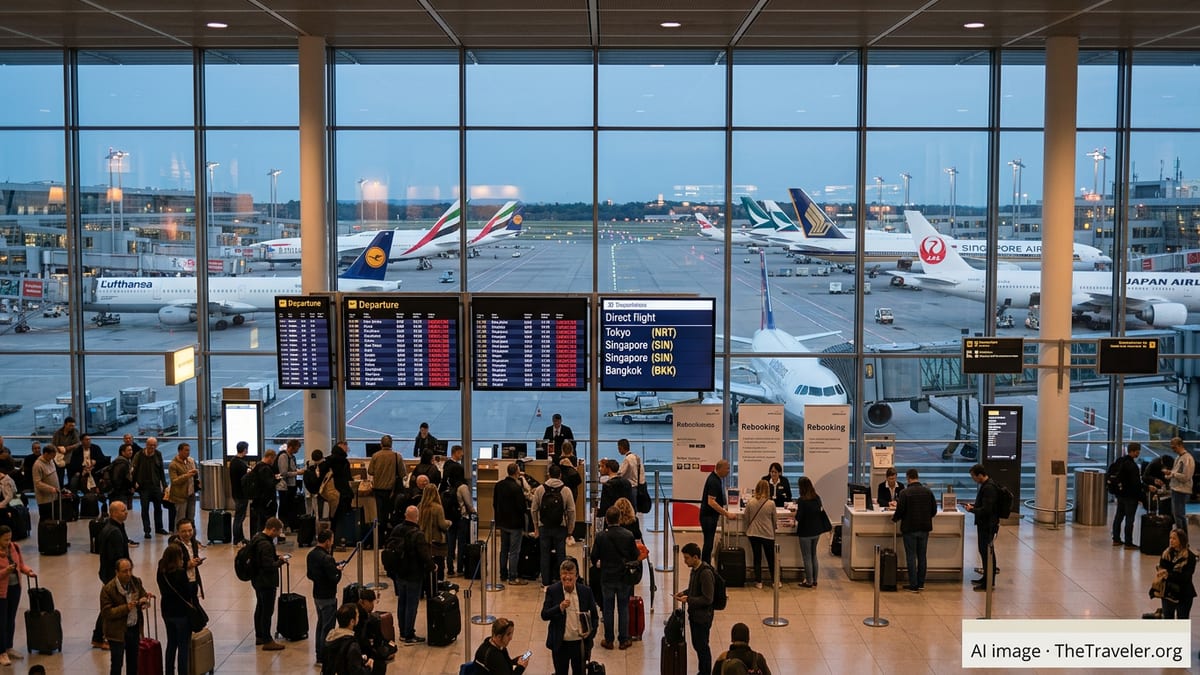
Gulf Mega-Hubs Crippled as Conflict Shuts Key Corridors
The latest escalation in the conflict involving Iran, Israel and the United States has triggered the most severe disruption to Middle East aviation in years, with airspace closures rippling across Iran, Iraq, Jordan, Qatar, Kuwait and parts of the United Arab Emirates. Dubai International, Doha’s Hamad International and Abu Dhabi’s Zayed International, normally among the world’s busiest long-haul hubs, have spent days operating at a fraction of normal capacity under tight safety corridors, or temporarily shutting to most civilian traffic.
For years, these hubs have acted as the central hinge between Europe and Asia, concentrating tens of millions of transfer passengers onto banks of connecting flights. Now, with airspace restrictions forcing cancellations and extreme rerouting, that hinge has effectively snapped. Aviation data providers estimate thousands of flights on Asia–Europe itineraries have been cancelled or heavily delayed since the first wave of closures, leaving terminals clogged with stranded travelers and aircraft scattered across diversion airports from Istanbul to Chennai.
Carriers based in the Gulf, including Emirates, Qatar Airways and Etihad Airways, have been forced to pare schedules dramatically, prioritising repatriation services and essential links while warning customers not to travel to the airport without confirmed seats. Regional authorities continue to advise airlines to avoid conflict-zone airspace until further notice, underscoring that the disruption is likely to extend well beyond the immediate security crisis.
The result is a sudden vacuum in east–west connectivity at precisely the point in the network where global traffic has been most concentrated. That vacuum is now being filled, imperfectly and at a much higher price, by a surge in direct services between Asian and European cities that previously relied heavily on one-stop Gulf connections.
Record-Breaking Nonstops Replace Once-Convenient Connections
With the traditional Gulf bridge effectively closed, European and Asian airlines have raced to add or upgauge non-stop services that bypass the region altogether. Full-service carriers from Germany, France and the Nordic countries are accelerating plans to restore long-haul routes to Southeast Asia, while Asian airlines are dusting off dormant Europe links and adding extra frequencies on trunk routes such as Singapore to London and Tokyo to Frankfurt.
Network planners are leaning heavily on a new generation of long-range aircraft to make these work. Ultra-long-range variants of the Airbus A350 and Boeing 787 are allowing airlines to stretch city pairs that previously stopped in the Gulf into full nonstops, even as detours add up to two hours of flying time to avoid restricted skies. Routes skirting south over the Arabian Sea or north via the Caucasus are now common on flight-tracking maps, redrawing the traditional great-circle arcs between Europe and Asia.
The reshuffle has also produced a handful of record-breaking services. Aviation analysts note that several airlines are quietly marketing extended nonstops between Northern Europe and North Asia as among the longest flights now in regular operation, with block times approaching 16 hours in one direction as prevailing winds and avoidance routes combine to stretch schedules. What began as an emergency response is rapidly hardening into a new competitive battleground for point-to-point premium traffic.
Secondary hubs are trying to seize the moment. Carriers based in Turkey, Central Asia and India are positioning their home airports as alternative transfer points, adding capacity on Europe and East Asia legs while their Gulf rivals remain constrained. Yet airspace restrictions and the sheer geography of the conflict mean even these workarounds often involve longer routings and tight operational margins.
Fares Surge as Capacity Vanishes and Detours Bite
The sudden rerouting of global traffic has had an immediate effect on ticket prices. With Gulf carriers slashing frequencies and many Asia–Europe journeys shifting from one-stop to nonstop configurations, capacity on key corridors has tightened sharply. Analysis released on Monday by London-based fare comparison site FlightsFinder.com found prices on some direct Europe–Asia routes had surged by nearly 300 percent compared with pre-crisis levels, with travellers paying as much as the equivalent of several thousand dollars more for the same economy seat.
Demand has collided with a series of cost shocks. Longer flying times mean higher fuel burn and additional crew costs at a moment when jet fuel prices are already elevated. Airlines are also juggling aircraft utilisation challenges, as extended detours tie up widebody jets for extra hours each day. Those pressures are being passed through to passengers in the form of sharply higher base fares, fuel surcharges and increasingly scarce reward-seat availability.
Reports from major Asian gateways describe economy cabins selling out days in advance on popular nonstop routes to Europe, pushing late bookers into premium cabins or inconvenient multi-stop routings via secondary hubs. Travel agencies in Hong Kong, Singapore and Mumbai report that clients who once expected competitive one-stop fares via Dubai or Doha are now facing nonrefundable quotes several times higher for direct flights, with limited flexibility to change dates without penalty.
Ironically, not all Gulf routes are seeing the same spike. Analysts note that prices on certain short-haul links into the region, including those serving Dubai itself, have remained relatively stable as airlines concentrate scarce capacity on maintaining strategic hub access. It is the long-haul east–west flows that are absorbing most of the financial shock, reinforcing a shift in pricing power toward carriers able to offer reliable nonstops that avoid the conflict zone.
Passengers Face Longer Journeys, Complex Rebookings and New Risks
For travellers, the upheaval is translating into confusion at departure boards and a steep learning curve in airline conditions of carriage. Thousands of passengers whose itineraries relied on Middle East connections have been forced to rebook onto fragmented routings, often involving overnight layovers in Europe or Asia and multiple carrier changes. Consumer advocates say many have struggled to understand whether they are entitled to refunds, rebooking or accommodation, particularly when trips involve mixed tickets or separate low-cost segments.
In Europe, passenger rights rules continue to apply on departures from EU airports, but airlines are invoking extraordinary circumstances exemptions tied to security-related airspace closures. That leaves compensation claims in a grey area, even as carriers stress they will honour refunds and free date changes where entire routes have been withdrawn. Outside the European Union, policies vary widely, with some Asian airlines offering flexible waivers while others insist on fare differences for rerouted itineraries.
Operationally, the new routings are also stretching airport infrastructure. Diversion points in India, Central Asia and Southern Europe have seen a spike in widebody arrivals during traditional off-peak hours as airlines build ad hoc schedules around available airspace windows. Ground handlers and border agencies are scrambling to cope with waves of unscheduled transfers and disrupted passengers seeking emergency visas, hotel rooms and onward options.
Safety regulators, meanwhile, are monitoring the dense flows of rerouted traffic above the Indian Ocean and through alternative corridors north of the conflict zone. Air navigation authorities have issued repeated advisories urging airlines to maintain wide buffers around restricted areas and to be prepared for further rapid changes in airspace availability, a reminder that even the new patterns could shift again with little warning.
Airlines Bet on a Longer-Term Shift in the Asia–Europe Network
Behind the immediate crisis response, many network planners are starting to treat the current Middle East disruption as a catalyst for longer-term change rather than a short-lived shock. European flag carriers that lost ground to Gulf rivals over the past decade now see an opportunity to reassert themselves on Asia routes by offering competitive nonstops from their home hubs. Several have already advanced launch dates for planned Asia services or upgraded equipment to larger, more efficient widebodies to capture displaced demand.
In Asia, full-service airlines are revisiting strategies that once assumed passengers would happily connect through Gulf hubs on the way to Europe. The early performance of newly added nonstops suggests there is robust appetite for direct services, especially among business travellers and high-spend leisure passengers willing to pay a premium for shorter total journey times and reduced disruption risk.
Industry analysts caution that rebuilding a diversified network will take time and capital. Many carriers only recently restored their long-haul fleets to pre-pandemic utilisation, and the aircraft and crews required to sustain an expanded web of ultra-long-haul flights are in limited supply. Aircraft manufacturers are also working through order backlogs, limiting airlines’ ability to pivot quickly to even more fuel-efficient models that could make marginal nonstop routes viable over the long term.
Yet few expect a simple return to the pre-crisis status quo. Even if Middle East hubs eventually resume full operations, their role as the default bridge between Asia and Europe has been questioned. The current wave of record-breaking nonstops and fast-rising fares is likely to accelerate a strategic shift toward greater redundancy in global air networks, with more direct options and more geographically diverse hubs sharing the load of connecting the world’s busiest long-haul corridor.