

More news on this day
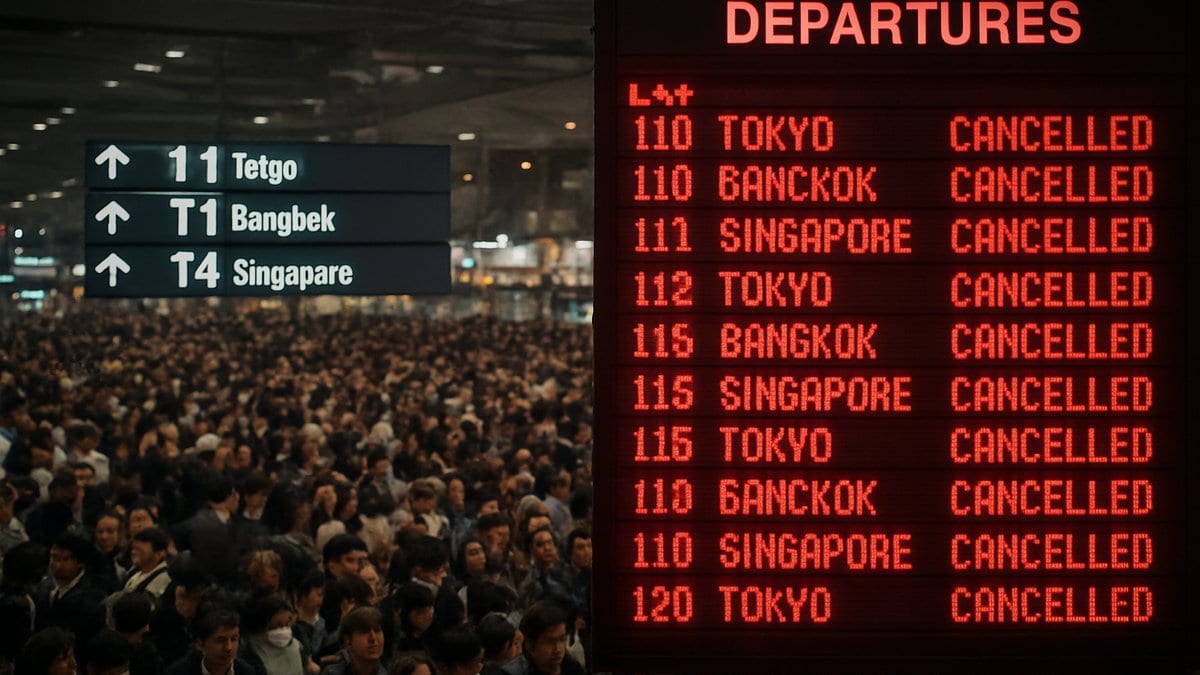
Asia’s tightly woven aviation network is facing another severe stress test this week, as widespread delays ripple across major transit hubs from Tokyo to Jakarta, stranding passengers and stretching airline operations already under pressure.
Get the latest news straight to your inbox!
Pressure Spikes at Asia’s Key Transit Gateways
Reports from flight tracking platforms and regional travel outlets indicate that hundreds of departures and arrivals across Asia have been pushed behind schedule in recent days, with Tokyo, Seoul, Singapore, Bangkok, and Jakarta emerging as critical pinch points. Disruptions linked to Middle East airspace closures and diversions have redirected long haul traffic into already congested Northeast and Southeast Asian hubs, magnifying the impact of even routine operational hiccups.
Tokyo’s airports, particularly Narita, are seeing heavier transfer flows as itineraries that once funneled through Gulf hubs shift toward Japan and other Asia Pacific gateways. Industry coverage notes that when a high volume hub like Tokyo experiences even a modest schedule disruption, knock-on effects can cascade across the region for days, affecting flights well beyond Japan’s borders.
In Southeast Asia, Jakarta and other Indonesian airports are absorbing additional traffic at the same time the domestic network remains sensitive to weather and infrastructure constraints. Publicly available information from regional aviation analyses suggests that the mix of diverted international services, growing local demand, and limited slack in airport capacity is leaving operations vulnerable to prolonged queues both in the air and on the ground.
Singapore and Bangkok, long established as alternative one-stop points between Europe and Asia, are also under strain as airlines and passengers look for routings that avoid conflict zones while still maintaining viable connection times. Observers note that these hubs have strong operational track records, but the abrupt redistribution of global flows has narrowed the margin for error.
Middle East Conflict and Rerouting Amplify Asia Bottlenecks
Published coverage on the evolving conflict in and around Iran shows that closures and restrictions in key Middle Eastern air corridors have forced airlines to redraw flight paths between Europe and Asia. Many long haul services that once relied on Dubai, Doha, or other Gulf hubs for smooth connections are now being rerouted over Central and South Asia or re-timed via East and Southeast Asian cities instead.
Analysts quoted in regional business media describe this as a structural shock to long established east–west traffic patterns. As carriers trim or suspend flights touching the Gulf, they are adding capacity into Asean and Northeast Asian hubs wherever possible, often on short notice and within infrastructure systems already running near capacity. That shift is sending more widebody arrivals into Tokyo, Seoul, Singapore, Bangkok, and Jakarta, compressing turnaround windows and saturating runway and gate availability.
Separate industry briefings highlight that Saudi Arabian airspace has become one of the few remaining primary east–west corridors fully open to scheduled traffic, creating chokepoints further along the network as rerouted flights converge on limited alternatives. With airlines facing higher fuel burn, extra crew hours, and complex scheduling workarounds, seemingly localized operational issues in Asia are translating into extended rotation delays and missed connections.
For travelers, this network realignment is visible in longer block times, extended layovers, and a higher probability that outbound legs from Asia will depart behind schedule as aircraft and crew arrive late from disrupted inbound segments. The result is a web of secondary and tertiary delays that can stretch across multiple days of operations.
Surging Demand Meets Fragile Capacity
Compounding the rerouting pressures, the latest data from airline and trade association updates show that passenger demand across Asia Pacific surged in early 2026, with international traffic out of major hubs climbing at a pace that outstrips some infrastructure upgrades. Routes linking Japan, South Korea, Southeast Asia, and Australia have seen particularly strong growth, while domestic markets in India and Indonesia continue to expand rapidly.
Airlines have responded by restoring and expanding networks, including additional frequencies and larger aircraft on trunk routes. However, airport terminals, air traffic management systems, and ground handling capacity have not always scaled at the same speed. Sector reports point to staffing tightness in critical roles, runway and taxiway congestion during peak banks, and limited overnight maintenance windows as factors that reduce resilience when disruptions strike.
In this context, Asia’s aviation system behaves like a tightly stretched elastic band: it can handle high volumes under stable conditions, but simultaneous shocks quickly erode punctuality. Weather disturbances over South and East Asia, localized technical incidents, and short-notice schedule changes triggered by external geopolitical factors are combining to create a level of volatility that many carriers had hoped was receding after the past two years of crises.
Financially, the delays and schedule adjustments carry real costs. Industry commentary suggests that rerouting around closed airspace and operating longer segments have added substantially to fuel and crew expenses, while airport-related charges and compensation obligations for delayed passengers further squeeze margins. For some carriers, especially in emerging markets, this comes on top of existing balance-sheet challenges.
Passenger Impact From Tokyo to Jakarta
For travelers navigating Asia this week, the mounting stress on the network is felt in check-in lines, departure boards filled with revised times, and crowded transit areas in key hubs. Travel and consumer advocacy outlets describe scenes of passengers facing missed connections, rebooked itineraries that bypass original routing points, and overnight stays in cities that were never part of their plans.
Tokyo’s role as both an origin-destination and transfer hub means that disruptions ripple across domestic and international services. A delay on an inbound long haul arrival from Europe can push back onward flights to Southeast Asia or Australasia, with travelers bound for Jakarta, Bali, Singapore, or Manila suddenly facing multi-hour waits. Similar patterns are emerging in reverse as disrupted flights from Southeast Asia arrive late into Japanese hubs.
In Jakarta, where domestic connectivity is critical for a vast archipelago, extended delays at the international gateway complicate links to secondary cities. Public accounts from recent disruptions in Indonesia illustrate how a late arrival into the capital can force travelers to overnight unexpectedly or abandon same-day connections to remote destinations, with knock-on effects for business travel, tourism, and family visits.
Regional travel forums and news features also note that many passengers are encountering confusing or rapidly changing information, as airlines update schedules, equipment types, and routings multiple times in response to evolving airspace constraints. This fluid situation makes pre-trip planning more difficult and raises the likelihood that even confirmed itineraries will shift close to departure.
Airlines and Airports Adjust, but Outlook Remains Uncertain
Publicly available statements and reporting show airlines across Asia and beyond adjusting schedules, redeploying aircraft, and fine-tuning connection banks in an effort to stabilize operations. Some carriers are trimming frequencies to heavily disrupted regions, while others are adding capacity on alternative routings through Southeast and Northeast Asia, effectively turning cities like Tokyo, Singapore, Bangkok, and Jakarta into pressure valves for the global system.
Airport operators in the region are accelerating capacity management measures where possible, including dynamic gate assignments, revised slot usage, and targeted infrastructure upgrades. However, many of these improvements are medium-term solutions that cannot fully offset the immediate operational strain caused by rerouted long haul traffic and surging demand.
Aviation analysts caution that as long as key Middle Eastern air corridors remain unstable and airlines continue to skirt conflict zones, Asia’s transit hubs are likely to remain vulnerable to waves of disruption. Seasonal weather patterns later in the year, along with ongoing cost pressures from fuel and currency movements, could further complicate efforts to restore on-time performance to pre-crisis levels.
For now, passengers flying between Europe, Asia, and the Pacific through hubs from Tokyo to Jakarta are being urged by travel advisers and consumer groups to allow more time for connections, monitor airline communications closely, and be prepared for itinerary changes even after check-in. While Asia’s aviation network has demonstrated resilience through successive crises, the current convergence of geopolitics, demand growth, and infrastructure limits underlines just how sensitive the system remains to sudden shocks.