

More news on this day
Hundreds of passengers across Asia are facing long queues, missed connections and unplanned overnight stays after 46 flights were canceled and around 600 delayed at major airports including Jakarta, Bali, Shanghai, Bangkok, Tokyo Narita, Yancheng and Mumbai, according to operational tracking data compiled for early April 2026.
Get the latest news straight to your inbox!
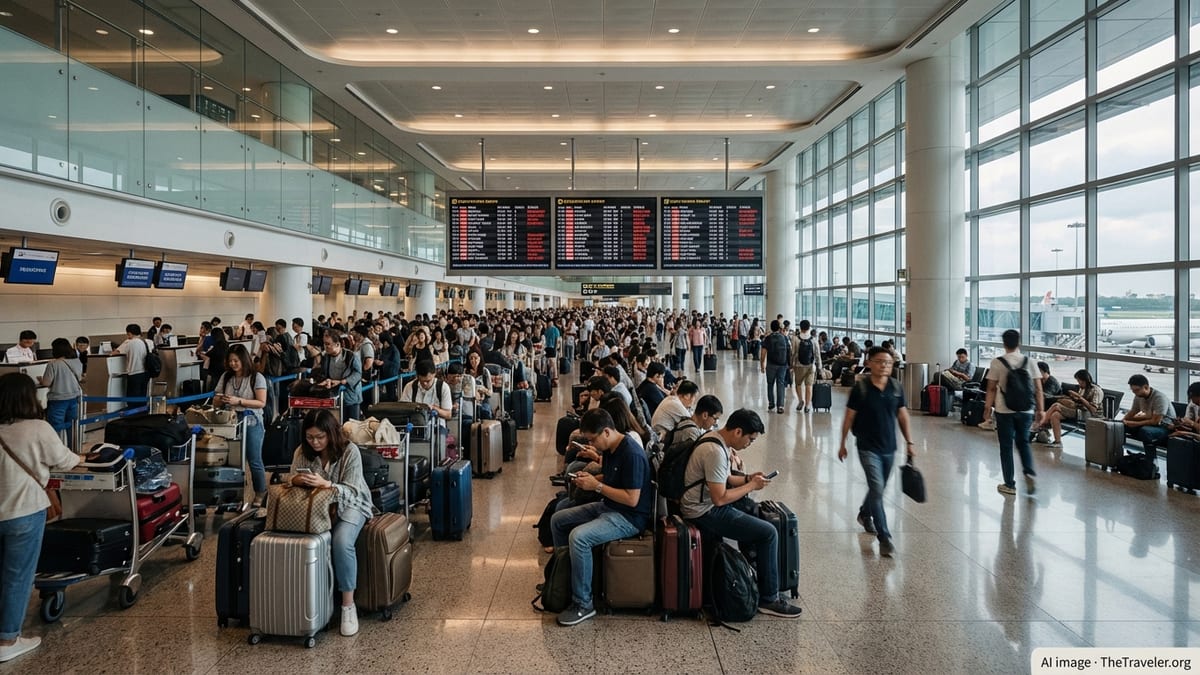
New Wave of Disruptions Hits Key Asian Gateways
Operational snapshots for early April indicate that the latest wave of disruption has rippled across a wide arc of Asia, affecting Indonesia, China, Thailand, Japan and India in a single operating window. Flight tracking platforms and aggregated schedule data point to clusters of delays and cancellations centered on Soekarno Hatta International Airport in Jakarta, Ngurah Rai International Airport in Bali, Shanghai Pudong, Bangkok Suvarnabhumi, Tokyo Narita, Yancheng Nanyang and Mumbai’s Chhatrapati Shivaji Maharaj International Airport.
Within this period, 46 scheduled services were recorded as canceled outright, while roughly 600 departures and arrivals were pushed into delay categories, many by more than an hour. The pattern mirrors a broader April trend in which specialist aviation outlets have documented hundreds of cancellations and thousands of late departures across Asia’s main hubs over several consecutive days.
Published coverage notes that Shanghai and surrounding Chinese airports have repeatedly appeared near the top of global delay rankings this month, with spillover effects along major routes linking Southeast Asia, Japan and India. Combined with already elevated disruption levels in the first week of April, the new figures highlight how quickly conditions can deteriorate when multiple hubs buckle at once.
Asia’s interconnected network means that a relatively modest number of cancellations at several airports can translate into widespread disruption for travelers far beyond the affected cities. Aircraft, crews and passengers caught up in one region can be out of position for onward flights, leading to rolling delays across subsequent rotations.
Weather, Airspace Detours and Infrastructure Strain Converge
Publicly available information for early April 2026 links the latest disruption to a combination of severe weather, airspace detours and local infrastructure strain. Storm systems over parts of East and Southeast Asia have triggered temporary ground stops and reduced arrival rates at airports such as Bangkok, Shanghai and Tokyo, forcing airlines to hold aircraft in the air or divert flights to alternative fields.
At the same time, lingering airspace restrictions connected to instability in parts of the Middle East are continuing to reshape long haul routings between Europe, Africa and Asia. Aviation and travel outlets report that longer flight times on these detours are reducing the number of daily rotations that individual aircraft can perform, narrowing the margin for recovery when fresh disruptions occur in Asia’s core markets.
In Indonesia, recent reports highlight how infrastructure challenges can amplify the impact of weather and congestion. A separate incident involving structural issues in one terminal at Jakarta’s Soekarno Hatta earlier this month led to altered boarding patterns and heightened crowding, and the airport has remained under close operational scrutiny as airlines attempt to maintain punctuality in a constrained environment.
Network wide, airlines are also contending with elevated jet fuel costs and tight fleet utilization, factors that have been tracked by industry analysts since late winter. When fuel prices rise and spare aircraft are limited, carriers may be more inclined to consolidate lightly booked services or cancel marginal flights rather than operate recovery rotations, which in turn leaves fewer options for reaccommodating stranded passengers.
Passengers Face Overnight Stays and Rising Costs
For travelers on the ground, the data translates into long lines at check in, crowded departure halls and uncertainty around missed onward connections. Across Jakarta, Bali, Bangkok and Mumbai, the latest disruption period has coincided with busy outbound travel days, particularly for regional leisure routes and corporate travel between financial centers.
Reports from travel industry bulletins suggest that many affected passengers have been forced into same day rebooking battles, with remaining seats on alternative flights selling out quickly or being offered at sharply higher prices. In some cases, travelers transiting through Bangkok or Narita have found themselves stranded far from home when upstream cancellations in Jakarta, Shanghai or Yancheng broke carefully timed itineraries.
Accommodation capacity near major hubs is also under strain. Hotel aggregators tracking airport area availability in cities such as Bangkok, Shanghai and Mumbai show tightening inventory during peak disruption days, a familiar pattern whenever large numbers of travelers need last minute rooms at short notice. This can leave some passengers attempting to sleep in terminals while waiting for space on the next available flight.
Consumer advocates in several markets have been reiterating guidance on compensation and rebooking rights where national or regional regulations apply, particularly for international itineraries touching jurisdictions with stronger passenger protection rules. However, because the disruption spans multiple countries with differing frameworks, travelers on complex multi segment journeys may encounter inconsistent support depending on the ticketing airline and point of departure.
Knock On Effects for Tourism and Regional Connectivity
The disruption has landed during an important period for Asia’s tourism and business travel sectors. Early April sits within a shoulder season for some destinations yet is increasingly popular for international visitors seeking to avoid peak holiday crowds in places such as Bali, Bangkok and coastal China. Industry reports suggest that repeated bouts of delays and cancellations during this window are complicating efforts by tourism boards and airlines to rebuild visitor confidence after recent years of volatility.
Destinations that rely heavily on smooth regional connectivity are particularly exposed. Travel analytics covering Asia in early April describe how delays at one or two primary hubs can quickly cascade to secondary and tertiary airports, including leisure gateways and emerging regional cities. Yancheng’s appearance in the latest disruption figures underscores how smaller airports can feel outsized effects when broader weather systems and network pressures pass through their airspace.
Japan and India are also watching the situation closely. Publicly available on time performance summaries for early April point to multiple days in which Tokyo area airports experienced elevated delay counts just as Indian hubs, including Mumbai, were managing their own schedule challenges linked to rerouted long haul traffic. When these patterns align, travelers flying between Northeast Asia, Southeast Asia and the Indian subcontinent face a heightened risk of missed onward links and extended ground time.
Travel planners warn that persistent irregular operations can influence how corporate travel managers and tour operators structure itineraries for the rest of the year, potentially shifting bookings away from hubs perceived as more vulnerable to cascading delays. That, in turn, could reconfigure traffic flows across the region if certain airports develop reputations for chronic congestion at particular times of year.
What Travelers Can Expect in the Coming Days
With weather systems still active over parts of East and Southeast Asia and airspace detours remaining in place, aviation analysts expect the risk of further disruption to persist in the near term. Historical patterns show that once schedules are significantly out of position, airlines can require several days of relatively stable operations to restore normality, particularly on complex networks stretching from Europe and the Middle East to Asia and onward to Oceania.
Travel and aviation outlets are advising passengers with upcoming departures from Jakarta, Bali, Shanghai, Bangkok, Narita, Yancheng, Mumbai and other regional hubs to allow extra time at the airport and to monitor flight status frequently in the 24 hours before departure. The potential for rolling delays means that a service listed as on time earlier in the day can shift into a later departure window if inbound aircraft arrive behind schedule or if new weather constraints develop.
Airlines are likely to continue using a mix of schedule thinning, aircraft swaps and selective cancellations to protect their highest demand routes while attempting to minimize crew duty violations and maintenance disruptions. For travelers, that makes flexibility increasingly valuable. Same day alternative routings, including longer connections through less congested hubs, may offer a better chance of reaching the final destination than insisting on the original non stop service when conditions are deteriorating.
Despite the current turbulence, industry commentary suggests that Asia’s aviation sector remains committed to growth, with new routes and capacity additions still planned for later in 2026. The latest episode of cancellations and delays is being viewed by many observers as another stress test of the region’s ability to manage mounting environmental, geopolitical and operational pressures while maintaining reliable connectivity for millions of travelers.