

More news on this day
Heavy disruption across Asian air corridors has stranded thousands of passengers after 104 flights were cancelled and 1,367 delayed at Guangzhou, Shenzhen, Chongqing, Shanghai, Jakarta and other international airports, according to real-time aviation data and local media coverage.
Get the latest news straight to your inbox!
Major Chinese Hubs Bear the Brunt of Disruption
China’s busiest aviation gateways reported some of the heaviest disruption, with Guangzhou Baiyun, Shenzhen Bao’an, Chongqing Jiangbei and Shanghai’s Pudong and Hongqiao airports all experiencing elevated cancellation and delay levels within a compressed operating window. Publicly available flight-tracking dashboards showed sharp spikes in late departures and rolling knock-on delays across domestic and regional routes serving these hubs.
In Shanghai, both Pudong and Hongqiao saw a build-up of delayed departures on routes linking the city with Guangzhou, Shenzhen and Chongqing, pointing to network strain along China’s dense east coast and central corridors. Flight-status boards indicated that many aircraft were leaving well behind schedule even when they were not formally cancelled, creating congestion on the ground as incoming passengers waited for gates and outbound travelers queued at security and check-in.
Guangzhou and Shenzhen, anchors of the manufacturing-heavy Pearl River Delta region, also faced operational stress as late-arriving aircraft disrupted carefully timed flight rotations. Reports indicated that short-haul services connecting these cities with Beijing, Shanghai and inland centers such as Chongqing were among the most affected, with some carriers posting significantly above-average delay rates over the course of the day.
Chongqing, a key inland hub linking western China with Southeast Asia and domestic trunk routes, experienced a similar pattern of cascading knock-on delays. As late departures rippled through the schedule, passengers connecting onward through coastal cities faced missed connections and extended waits in terminals already operating close to capacity.
Jakarta and Regional Gateways Feel Ripple Effects
The disruption was not confined to mainland China. In Indonesia, Jakarta’s Soekarno Hatta International Airport reported an uptick in delayed departures and arrivals, particularly on flights linking the capital with Chinese hubs and other major Asian cities. Public data suggested that several services were held on the ground awaiting connecting aircraft or crew, contributing to longer-than-usual turnaround times.
Regional coverage and traveler reports pointed to additional knock-on delays at other international gateways in Asia that are closely integrated with Chinese and Indonesian air networks. Airports in Singapore, Bangkok and Kuala Lumpur, which handle significant traffic to and from Guangzhou, Shenzhen, Shanghai, Chongqing and Jakarta, saw individual flights run late even where their own local conditions remained stable.
The interconnected nature of Asian aviation means that irregular operations at a handful of key hubs can quickly spread across borders. When aircraft scheduled for short-haul rotations depart late from one airport, their subsequent flights into neighboring countries tend to arrive behind schedule, leading to a rolling pattern of delays rather than isolated incidents.
Airlines operating tight schedules are particularly vulnerable to this type of ripple effect. Once the day’s first flights are disrupted, recovering normal operations without cancelling additional services becomes increasingly difficult, especially at airports already running near their maximum runway and gate capacity during peak periods.
Passengers Confront Long Queues and Uncertain Itineraries
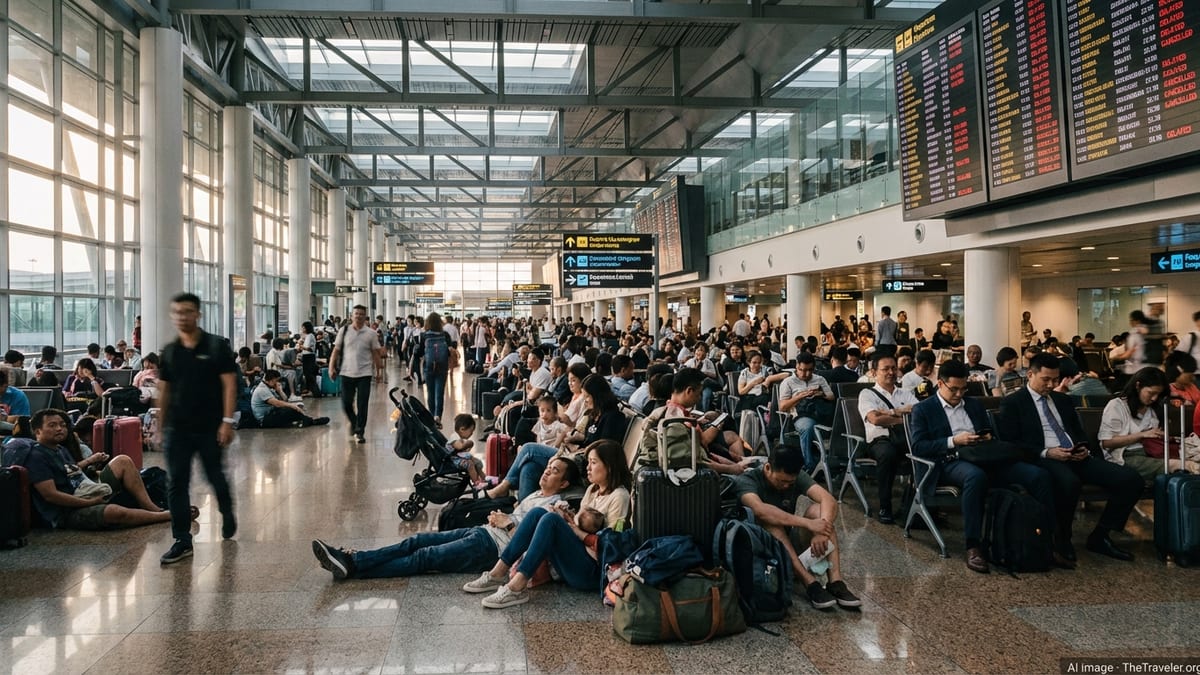
For passengers caught in the middle of the disruption, the most visible impact has been long queues at check-in counters, transfer desks and boarding gates, as well as crowded seating areas near charging points and information screens. With more than a hundred cancellations and over a thousand delays recorded across the region, travelers reported experiencing multiple rebookings, last-minute gate changes and extended waits for updated departure times.
In several hubs, local coverage described scenes of families and business travelers attempting to rearrange onward itineraries as missed connections accumulated through the day. While some passengers were able to secure seats on later flights or alternative routings, others faced overnight stays or significant detours, particularly those traveling on heavily booked routes between China and Southeast Asia.
The situation highlighted the importance for travelers of monitoring flight status in real time through airline apps and airport information channels. With schedules changing rapidly, relying solely on original booking details left some passengers unaware of cancellations or retimings until they reached the airport or attempted to check in.
Travelers with tight onward connections appeared to be among the hardest hit, especially those combining separate tickets on different carriers. Because many of the disrupted services were short-haul intra-Asian flights feeding into longer international legs, even a relatively modest delay on a domestic segment could make it impossible to board an onward long-haul departure.
Weather, Airspace Constraints and Capacity Pressures Intersect
A combination of factors appeared to contribute to the wave of disruption, including localized weather challenges, seasonal congestion and evolving airspace constraints over parts of East Asia. Public aviation notices and recent discussions among travelers have drawn attention to temporary airspace restrictions over the Yellow Sea and East China Sea, which can require rerouting or altitude adjustments for flights into and out of the Shanghai region.
When aircraft are forced to take longer routes or operate within narrower corridors, schedules built around tight separation between flights can come under strain. Even small delays can cascade when large hubs like Shanghai, Guangzhou and Shenzhen are handling dense banks of arrivals and departures in peak travel periods.
Seasonal weather patterns can further complicate operations. Thunderstorms, low visibility or strong winds in one part of the network can prompt holding patterns, diversions or ground stops that reverberate across a region already operating near capacity. When this coincides with busy travel days, airlines have limited flexibility to absorb disruptions without cancelling some flights outright.
Industry data over recent months has also pointed to increasing demand across Asian markets as international travel continues to recover, with some carriers adding routes and frequencies more quickly than ground infrastructure and staffing levels can scale. The latest disruption underscores how quickly this fragile balance can be upset when multiple stressors converge.
What Travelers Can Do as Disruption Continues
With irregular operations still being reported at several major airports across Asia, publicly available guidance from aviation and consumer groups suggests a number of practical steps for affected passengers. Travelers are generally advised to check flight status repeatedly in the 24 hours before departure, use mobile notifications where possible, and allow generous connection times when routing through heavily impacted hubs such as Guangzhou, Shenzhen, Chongqing, Shanghai and Jakarta.
Keeping essential items in carry-on baggage, including medications, chargers, a change of clothes and basic toiletries, can help mitigate the discomfort of unexpected overnight stays or long delays on the ground. Passengers on separate tickets for connecting journeys may wish to allow extra buffer time or consider consolidating segments under a single booking to improve rebooking options if a flight is cancelled or significantly delayed.
Public information from regulators and consumer advocates also stresses the value of retaining documentation such as boarding passes, delay notifications and receipts for meals or accommodation in case passengers are eligible to seek assistance or reimbursement under local regulations, airline policies or travel insurance coverage. Rules differ widely across jurisdictions, but clear records can make it easier to file a claim where entitlements exist.
As airlines and airports work to clear backlogs and restore normal operations, observers note that the latest round of cancellations and delays serves as a reminder of the continued sensitivity of Asian air travel to weather, airspace and capacity pressures. For now, travelers planning to pass through the region’s busiest hubs are being urged by publicly available guidance to build flexibility into their itineraries and be prepared for conditions to change with limited notice.