

More news on this day
Thousands of passengers across Asia were left stranded on Thursday as a fresh wave of more than 80 flight cancellations rippled through Indonesia, Malaysia, Laos, Taiwan and Hong Kong, disrupting busy routes to San Francisco, New York, Jakarta, Bali, Kuala Lumpur, Taipei, Bangkok and other key destinations.
New Cancellations Deepen Ongoing Asian Disruptions
The latest round of cancellations, recorded on February 26, follows weeks of mounting operational strain at major Asian hubs, where a mix of severe weather, congestion and aircraft availability issues has repeatedly upended travel plans. Data from regional aviation trackers and airport authorities shows dozens of flights scrubbed at short notice, affecting both domestic links and long-haul departures to North America and Europe.
Garuda Indonesia and Batik Air were among the hardest-hit carriers in Indonesia, where Jakarta’s Soekarno Hatta International Airport once again reported disruption across several terminals after earlier mass cancellations and diversions linked to heavy rain in recent days. Local media and industry reports indicate that knock-on effects have extended well beyond the capital, touching onward connections to Bali and secondary Indonesian cities.
In Malaysia, Kuala Lumpur International Airport saw further cancellations layered onto a day already marked by hundreds of delays to regional and international services. Malaysia Airlines and several low-cost operators struggled to re-accommodate passengers as aircraft and crews were left out of position by earlier disruptions across the regional network.
In Taiwan and Hong Kong, the cancellations added to a volatile February for air travel. Taiwan Taoyuan had already been grappling with weather-related delays and capacity pressure following the Lunar New Year rush, while Hong Kong International Airport continues to see periodic schedule reshuffles as airlines juggle regional demand and aircraft rotations.
Garuda Indonesia, Batik Air and Cathay Pacific Among Affected Carriers
While a wide range of airlines have been touched by Thursday’s cancellations, regional flag carriers and key Asian brands feature prominently. Garuda Indonesia reportedly trimmed multiple departures linking Jakarta with other Southeast Asian and Australasian cities, with some services rerouted or consolidated as it sought to stabilize its schedule.
Batik Air, already under scrutiny this month after operational incidents and a series of cancellations in Indonesia, cut additional services out of Jakarta and other Indonesian hubs. The carrier has been one of the region’s most cancellation-heavy airlines in several recent disruption events, prompting calls from consumer advocates for clearer communication and more robust contingency planning.
Cathay Pacific and other Hong Kong-based operators also adjusted flights, including services connecting Hong Kong with North America and major Southeast Asian capitals such as Bangkok and Jakarta. Industry analysts note that even a limited number of cancellations on these long-haul sectors can strand large numbers of travelers, given the higher seat counts and reliance on tight connections onward to the United States and Europe.
Other regional and international airlines, including Malaysian and Taiwanese carriers, reduced frequencies on select routes or combined services where demand and aircraft type allowed. With aircraft scattered across multiple disrupted hubs, several airlines prioritized maintaining core trunk routes while trimming secondary or off-peak frequencies.
North American Links to San Francisco and New York Hit
The cascading disruption has been particularly painful for travelers relying on key Asia–North America corridors. Flights connecting major Asian gateways with San Francisco and New York were among those affected, as cancellations and delays in Asia collided with an already fragile winter schedule in the United States, where recent storms have repeatedly disrupted operations on the East Coast.
Passengers booked on itineraries linking Jakarta, Bali, Kuala Lumpur, Taipei, Bangkok, Hong Kong and Singapore with San Francisco or New York faced missed connections, last-minute reroutes through alternative hubs, or overnight stays as airlines struggled to find available seats. Travel agents reported a spike in rebooking requests, with some customers opting to postpone trips altogether amid uncertainty over when schedules would normalize.
Industry observers say the latest wave of cancellations underscores how sensitive transpacific networks remain to disruptions on either side of the ocean. When aircraft are delayed getting out of Asia, rotations into long-haul services are quickly affected, leading carriers to preemptively cancel or combine flights rather than risk extended knock-on delays across multiple continents.
The result has been a patchwork of revised schedules that can change multiple times in a single day. Passengers on multi-leg itineraries involving U.S. gateways such as San Francisco, New York and Los Angeles are being urged to monitor airline apps and airport departure boards closely and to allow extra time for potential disruptions.
Stranded Passengers Face Long Queues and Limited Options
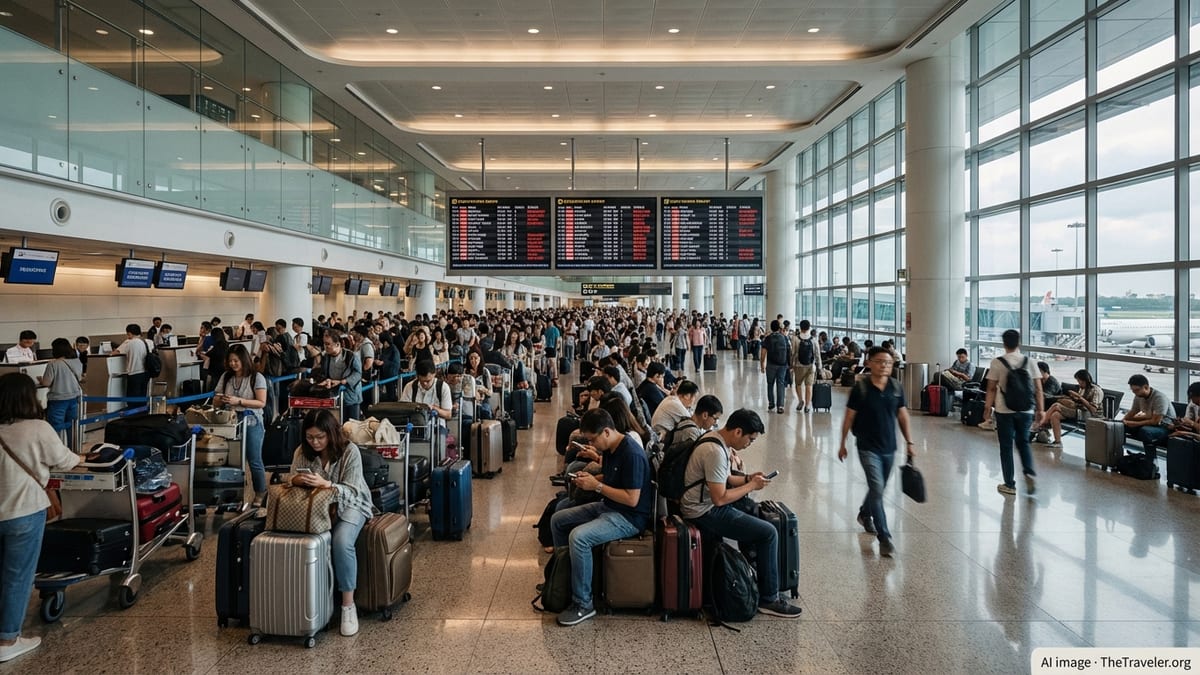
At airports from Jakarta and Denpasar to Kuala Lumpur, Taipei and Hong Kong, the human impact of the cancellations was immediately visible. Terminal concourses filled with passengers sprawled across the floor near power outlets, while queues for rebooking and customer service stretched deep into check-in halls.
Travelers reported waiting hours to speak with airline agents as call centers and airport desks were overwhelmed. In some cases, carriers offered hotel vouchers and meal coupons, but supplies were quickly exhausted at particularly hard-hit hubs, leaving many to make their own arrangements in nearby airport districts.
In Laos and regional secondary airports feeding into Bangkok and other hubs, limited flight frequencies left stranded passengers with few short-term options. Some travelers turned to buses and ferries to reach alternative airports in neighboring countries, hoping to secure last-minute seats from less congested gateways.
Families returning from holidays in Bali and other resort destinations faced particular challenges as school and work commitments loomed. Social media posts from affected travelers described missed job interviews, medical appointments and connecting cruises, highlighting the broader ripple effects of what might appear on paper as a relatively small number of cancellations.
Airlines and Airports Race to Restore Stability
Airlines across the region moved quickly on Thursday to put recovery plans in place, prioritizing stranded passengers and high-demand corridors. Many carriers announced flexible rebooking and waiver policies, allowing ticket changes without fees for affected flights, and some signaled that additional services or upgauged aircraft would be deployed in the coming days where slots and crew availability permit.
Airport operators in Indonesia, Malaysia, Taiwan, Hong Kong and Thailand said they were coordinating closely with airlines to manage gate assignments, ground handling resources and passenger flows. Extra staff were dispatched to information counters and security lanes at several hubs to help ease bottlenecks and direct travelers to alternative check-in areas when flights were reassigned at short notice.
However, aviation analysts warned that it could take several days for schedules to fully stabilize, particularly on long-haul routes where aircraft and crew rotations are complex. With February already marked by multiple weather-related disruptions and high seasonal demand in parts of Asia, airlines have limited spare capacity to deploy as backup.
For now, frequent travelers are being advised to build more slack into their itineraries, avoid tight self-made connections across different tickets, and keep documentation handy in case of claims for accommodation or expenses. As Asia’s interconnected air network continues to grow, this latest episode of mass cancellations offers a stark reminder of how quickly local shocks can escalate into global travel headaches.