

More news on this day
Thousands of passengers were left stranded across Asia today as airports in Thailand, Japan, Singapore, Malaysia, China, and Indonesia reported 2,880 delayed flights and 139 cancellations, disrupting operations for carriers including AirAsia, Batik Air, All Nippon Airways, Japan Airlines, China Eastern, and several others.
Get the latest news straight to your inbox!
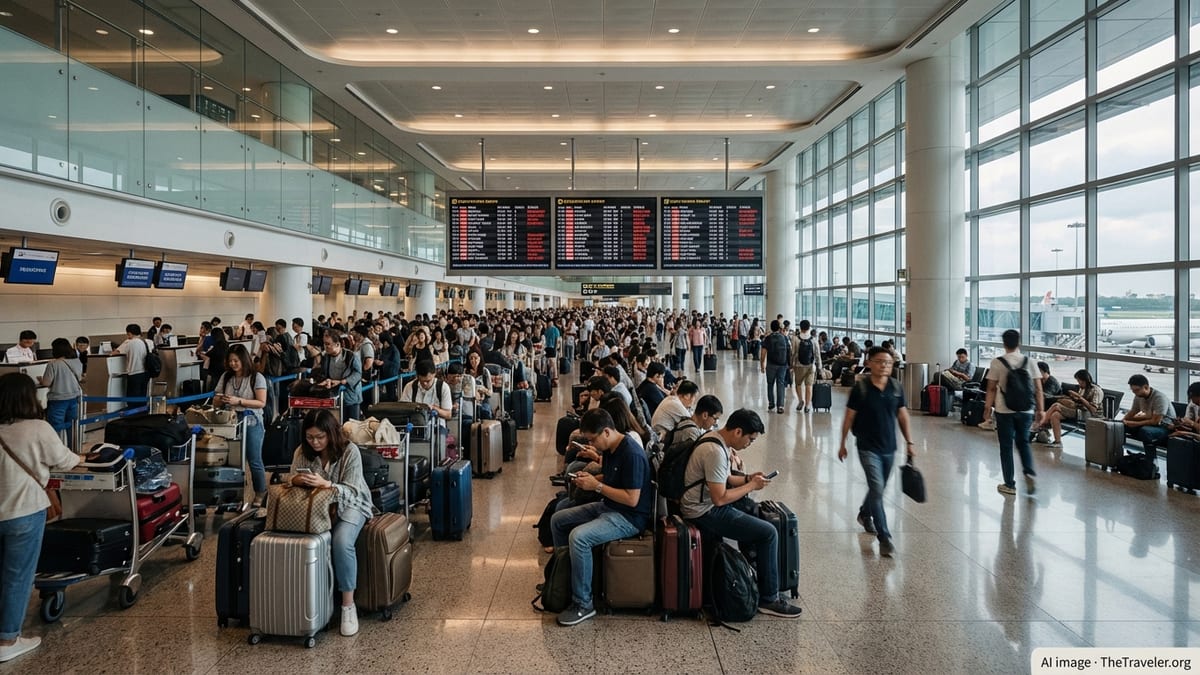
Major Hubs Across Asia Buckle Under Strain
Publicly available airport and flight-tracking data for April 5 indicate that disruption is concentrated at some of Asia’s busiest international gateways, with knock-on effects spreading across regional and long-haul networks. The largest clusters of delays are being reported at Tokyo’s Haneda and Narita airports, Bangkok’s Suvarnabhumi and Don Mueang, Kuala Lumpur International, Singapore Changi, Jakarta Soekarno Hatta, and major mainland Chinese hubs including Guangzhou, Shenzhen, and Shanghai Pudong.
Figures compiled by industry-focused outlets show that Tokyo Haneda alone has logged more than 300 delayed departures and arrivals today, with additional disruption at Narita. In Southeast Asia, Kuala Lumpur International and Jakarta Soekarno Hatta are among the hardest hit, with each airport seeing well over 250 delayed flights and several cancellations. Singapore Changi and Bangkok Suvarnabhumi are also recording triple-digit delays, underscoring the breadth of the operational strain.
In southern China, Guangzhou Baiyun, Shenzhen Bao’an, and Shanghai Pudong have collectively added several hundred more delays and dozens of cancellations to the regional tally. When combined with disruption at secondary airports in Thailand and Japan, the total reaches 2,880 delayed flights and 139 cancellations across the six countries, leaving departure boards filled with rolling time changes and “cancelled” notices.
Travel and aviation monitoring platforms describe the situation as one of the most concentrated single-day disruptions in the region so far this year, with Asia’s interconnected route networks magnifying the impact of any local bottleneck into a wider regional event.
Low-Cost and Full-Service Carriers Equally Affected
The operational turmoil is cutting across business models, with both low-cost and full-service airlines heavily affected. AirAsia and Batik Air, which depend on fast aircraft turnarounds at hubs in Bangkok, Kuala Lumpur, and Jakarta, are facing widespread knock-on delays as aircraft and crews fall out of position. Even a relatively small number of outright cancellations can disrupt subsequent rotations, multiplying the number of passengers affected.
On trunk routes between Japan and Southeast Asia, full-service carriers such as All Nippon Airways and Japan Airlines are also contending with extended ground times and schedule adjustments, particularly at Tokyo’s two main airports. Their networks link Japan to major cities in Thailand, Singapore, Malaysia, and Indonesia, meaning issues at one end of the route quickly reverberate through connecting services.
Mainland Chinese airlines, including China Eastern, are seeing similar challenges at Guangzhou, Shenzhen, and Shanghai. With many of these operations structured around tight banked departure waves and heavy reliance on connecting traffic, any disruption in one wave can propagate across several subsequent banks, affecting flights well beyond the original problem period.
Regional observers note that today’s pattern of disruption does not appear limited to a single airline or alliance, suggesting that common external factors and wider airspace or capacity constraints are playing a central role in the day’s operational performance.
Passengers Confront Long Queues, Missed Connections, and Limited Options
For travelers, the operational statistics translate into long check-in and rebooking lines, fully booked alternative departures, and uncertainty about when they will reach their destinations. Airport-status dashboards across Bangkok, Kuala Lumpur, Singapore, Tokyo, Jakarta, and key Chinese hubs show waves of flights pushed back by an hour or more, with some services slipping into multi-hour delays.
Passengers on multi-leg itineraries are particularly exposed, as delays on short-haul sectors within Southeast Asia or between China and Japan can cause missed long-haul connections to Europe, North America, or the Middle East. Travel-industry commentary circulating today highlights cases where travelers have been forced to overnight in hub cities after losing onward connections, with hotel availability in some airport districts tightening as the day progresses.
Publicly available guidance from consumer groups and travel-insurance providers stresses the importance of documenting delay times, retaining boarding passes, and keeping receipts for meals and accommodation in case of reimbursement claims. Travelers are also being urged to monitor airline apps and airport displays frequently, as departure times are shifting repeatedly while carriers attempt to re-sequence aircraft and crews.
With spare capacity already limited on many regional routes, especially during busy spring travel periods, some stranded passengers are reportedly facing waits of 24 hours or more for the next available seat to their intended destination, particularly on popular leisure and visiting-friends-and-relatives routes.
Operational and Weather Pressures Converge on Regional Networks
While precise causes vary by airport, aviation analytics and regional news coverage point to a familiar mix of operational, weather, and airspace pressures behind today’s disruption. Intermittent thunderstorms and low-visibility conditions around several hubs have forced temporary runway slowdowns, while air traffic control flow restrictions have reduced the number of aircraft that can take off or land per hour at peak times.
At the same time, staffing and equipment constraints in ground handling and security screening are continuing to challenge airport throughput in parts of the region. Even modest bottlenecks in baggage loading, refueling, or crew scheduling can have outsized effects on high-frequency narrowbody operations, particularly for low-cost carriers that operate with tight turnaround windows.
Sector analysts note that Asia’s major hubs are still adapting to a rapid rebound in demand after years of uneven recovery. Flight volumes have risen faster than some infrastructure and staffing levels, leaving smaller margins for absorbing disruptions. When several hubs across different countries simultaneously face weather or airspace restrictions, the result can be a cascade of delays across intertwined regional route networks.
The broader global backdrop also remains unsettled, with recent conflicts, rerouted long-haul services, and pockets of airspace closure outside Asia contributing to more complex flight planning. These macro factors can limit the availability of alternative routings when conditions deteriorate locally, increasing the likelihood that delays will turn into cancellations for certain services.
What Travelers Need to Know If Flying Through Affected Hubs
Travel specialists tracking today’s figures advise passengers planning to transit Bangkok, Kuala Lumpur, Singapore, Tokyo, Jakarta, Guangzhou, Shenzhen, or Shanghai to expect residual disruption into the evening and potentially into tomorrow’s early bank of departures. Aircraft and crews displaced by today’s schedule changes often take several rotations to fully return to planned positions.
Industry guidance recommends that travelers build in longer connection times than usual when routing through the hardest-hit hubs, especially if combining separate tickets or mixing low-cost and full-service airlines. Those with flexible plans may find it worthwhile to explore rebooking via less congested hubs in the region or on alternative dates, rather than risk tight same-day connections.
For passengers already caught up in today’s disruption, publicly available advice from consumer advocates emphasizes keeping all documentation organized, checking airline communication channels frequently for rebooking options, and considering digital channels such as apps and chat where available, in addition to airport service desks that are experiencing heavy queues.
With Asia’s peak travel season approaching and wider geopolitical and weather-related uncertainties persisting, today’s events highlight how quickly strain at a handful of major airports can ripple through the broader network, affecting carriers from low-cost specialists such as AirAsia and Batik Air to global brands including ANA, Japan Airlines, and China Eastern.