

More news on this day
Travelers across Indonesia, China and Japan are facing mounting disruption as operational data points to at least 51 cancellations and 143 delays linked to Batik Air, Chengdu Airlines and ANA Wings at the key hubs of Jakarta Soekarno-Hatta, Chengdu and Tokyo, stranding passengers and rippling through regional and long-haul networks.
Get the latest news straight to your inbox!
Jakarta, Chengdu and Tokyo Emerge as Disruption Hotspots
Aggregated flight tracking and schedule data for early April indicate that Jakarta’s Soekarno-Hatta International Airport, Chengdu’s main airport system and Tokyo’s dual-airport gateway have become focal points for a new wave of disruptions affecting regional connections across Asia and beyond. These airports serve as critical transfer nodes for domestic and international itineraries, so even modest spikes in irregular operations translate quickly into missed onward flights and overcrowded terminals.
Publicly available operational summaries show that services operated by Indonesia’s Batik Air, China’s Chengdu Airlines and Japan-based ANA Wings account for a notable share of today’s disruption tally, with at least 51 flights cancelled and 143 delayed across their combined networks. While those numbers represent a fraction of total daily operations at the three hubs, their concentration during peak travel periods has amplified the impact on travelers attempting to connect across multiple countries.
Reports from aviation data providers describe rolling knock-on effects as aircraft and crews fall out of position, particularly where narrow turnaround windows leave little margin for recovery. At Jakarta, which already handles one of Southeast Asia’s heaviest domestic schedules, minor delays in the morning have been cascading into longer waits for afternoon and evening departures, affecting not only Batik Air but also partner and competitor carriers sharing the same infrastructure.
In China, the disruption centered on Chengdu has intersected with busy domestic flows and international links into Southeast Asia, Europe and the Middle East. In Japan, ANA Wings operations feeding Tokyo’s Haneda and Narita airports have experienced punctuality challenges that, according to published coverage, are feeding into the broader network of All Nippon Airways and other regional airlines, further complicating recovery efforts.
Weather, Congestion and Tight Turnarounds Drive the Latest Wave
Although no single trigger has been identified as the sole cause of the latest spike, weather-related constraints, airport congestion and tight aircraft turnarounds appear to be central factors. Recent regional coverage has highlighted bands of poor weather sweeping across parts of East and Southeast Asia, periodically reducing runway capacity and forcing temporary ground stops or holding patterns at several major airports.
At Jakarta Soekarno-Hatta, where Batik Air is a significant operator, heavy traffic combined with intermittent thunderstorms has repeatedly slowed arrivals and departures on some days, limiting the ability of airlines to recover from earlier delays. Industry analysts note that as carriers squeeze more rotations into each aircraft’s daily schedule, any weather disruption in the morning can lead to substantial knock-on delays later in the day.
Chengdu’s airport system, which serves as a major domestic and international hub for western China, faces similar pressures. When storms or low visibility conditions reduce available capacity, carriers such as Chengdu Airlines must juggle packed domestic routes with international services that are tightly linked to onward connections in Beijing, Shanghai, Southeast Asia and Europe. The recent pattern of cancellations and lengthy delays suggests that some flights are being proactively cut to stabilize schedules.
Tokyo’s Haneda and Narita airports have also contended with high demand and intermittent weather issues. Operational data and media reporting indicate that ANA Wings and other domestic operators have absorbed much of the strain, as delays to short-haul sectors feeding the capital disrupt tightly timed connections for travelers heading to regional cities or international gateways. This has resulted in some passengers missing onward flights despite arriving within the airport perimeter with what would normally be considered safe connection windows.
Passengers Confront Long Queues, Missed Connections and Limited Options
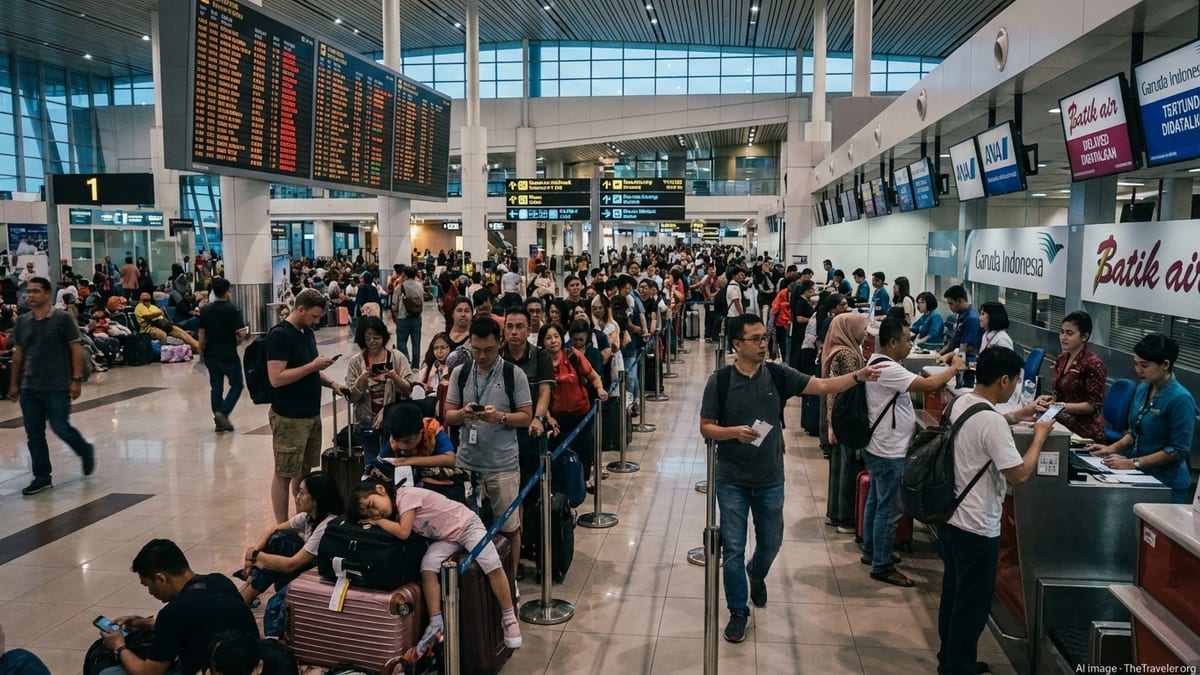
For travelers caught up in the wave of disruptions, the operational statistics translate into missed holidays, delayed business trips and unexpected overnight stays. Social media posts and local coverage from Jakarta, Chengdu and Tokyo describe long queues at airline service counters as passengers seek rebooking options after last-minute cancellations or extended delays.
In Indonesia, travelers on Batik Air services connecting through Jakarta to secondary cities have reported being re-routed onto later flights or alternative domestic carriers where capacity allows. However, reports also indicate that some passengers bound for international destinations through Jakarta are facing more complex rebooking scenarios, particularly when downstream long-haul sectors operate only once daily or several times a week.
Across China, cancellations and delays involving Chengdu Airlines have contributed to broader crowding at Chengdu’s main terminals, according to recent domestic reporting. With many Chinese domestic routes running near capacity, same-day alternatives can be scarce, leaving travelers to accept long waits or overnight stays before continuing their journeys. Those with separate tickets for onward international flights are especially vulnerable, as protection and rebooking options are more limited.
In Japan, ANA Wings’ role as a feeder carrier into Tokyo means that schedule disruptions often spill over into long-haul itineraries. Travelers attempting to connect from regional cities through Haneda or Narita to North America, Europe or Southeast Asia have reported missed flights and hurried race-through-terminal experiences as boarding times advance while incoming domestic flights remain on the ground. In some cases, publicly available information suggests travelers have been rebooked onto next-day departures when seats on same-day alternatives are unavailable.
What Travelers Can Do If Their Flight Is Affected
Aviation and consumer travel guidance emerging in response to the current disruption wave emphasizes preparation and flexibility for anyone flying through Jakarta, Chengdu or Tokyo in the coming days. Travel portals and specialist commentators are advising passengers to monitor flight status closely from 24 hours before departure and to confirm not only their initial leg but also any connecting segments, particularly when traveling on separate tickets or with a mix of low-cost and full-service carriers.
Travel advisors also highlight the importance of understanding each airline’s policies on delays and cancellations, which are typically detailed in contract-of-carriage documents and customer service plans. While regulations differ by country and region, many carriers outline when travelers may be entitled to rebooking, meal vouchers or hotel accommodation in the event of extended disruption. Passengers are being encouraged to keep boarding passes, receipts and written confirmations of any schedule changes, as these records can be useful when seeking refunds or reimbursements.
For those yet to book, publicly available recommendations suggest building longer connection times into itineraries that pass through high-risk hubs such as Jakarta Soekarno-Hatta, Chengdu and Tokyo’s airports during periods of elevated disruption. Selecting earlier flights in the day, where possible, can provide additional recovery options if a delay or cancellation occurs, while avoiding tight self-connecting itineraries can reduce the risk of missed onward travel.
Insurance providers and travel retailers are also underscoring the role of comprehensive travel insurance that explicitly covers delays, missed connections and trip interruptions. Policy details vary widely, but some products may help offset the cost of unexpected hotel stays, meals or replacement tickets when disruptions fall within covered scenarios. Analysts caution, however, that travelers should read policy conditions carefully so they understand any exclusions related to weather, operational decisions or air traffic control constraints.
Lingering Operational Fragility Across the Wider Asian Network
The latest problems at Jakarta, Chengdu and Tokyo reinforce a broader theme of operational fragility across parts of the Asian air travel network. Recent regional analysis compiled by aviation data firms and media outlets has highlighted rising delay rates at major hubs in China, Japan, South Korea, India and Southeast Asia as airlines rebuild capacity and adjust to shifting demand patterns.
According to this coverage, congestion at some airports, crew and aircraft positioning challenges and the complex interdependence of long-haul and regional operations continue to limit the resilience of airline schedules. When one hub experiences severe constraints, knock-on effects can quickly spread to neighboring countries as aircraft and crews arrive late or are reassigned to cover gaps, leading to last-minute timetable changes.
Industry observers note that carriers such as Batik Air, Chengdu Airlines and ANA Wings, which operate dense domestic or short-haul regional networks through a small number of primary hubs, are particularly exposed to such ripple effects. Their performance today at Jakarta, Chengdu and Tokyo illustrates how a cluster of cancellations and delays at a single airport can impact thousands of travelers as disrupted flights feed into already busy systems.
With forecasts suggesting continued strong demand for air travel across Asia in the coming months, analysts expect airlines and airports to face ongoing pressure to improve punctuality and strengthen contingency planning. For passengers, the latest disruption wave serves as a reminder that even as global aviation recovers in scale, schedule reliability remains volatile, especially during periods of adverse weather and heavy traffic at key regional gateways.