

More news on this day
Thousands of passengers across Asia faced fresh delays on April 8 as a new wave of disrupted departures rippled through major hubs, underscoring how rising costs and operational shocks are eroding already razor thin airline profit margins in the region.
Get the latest news straight to your inbox!
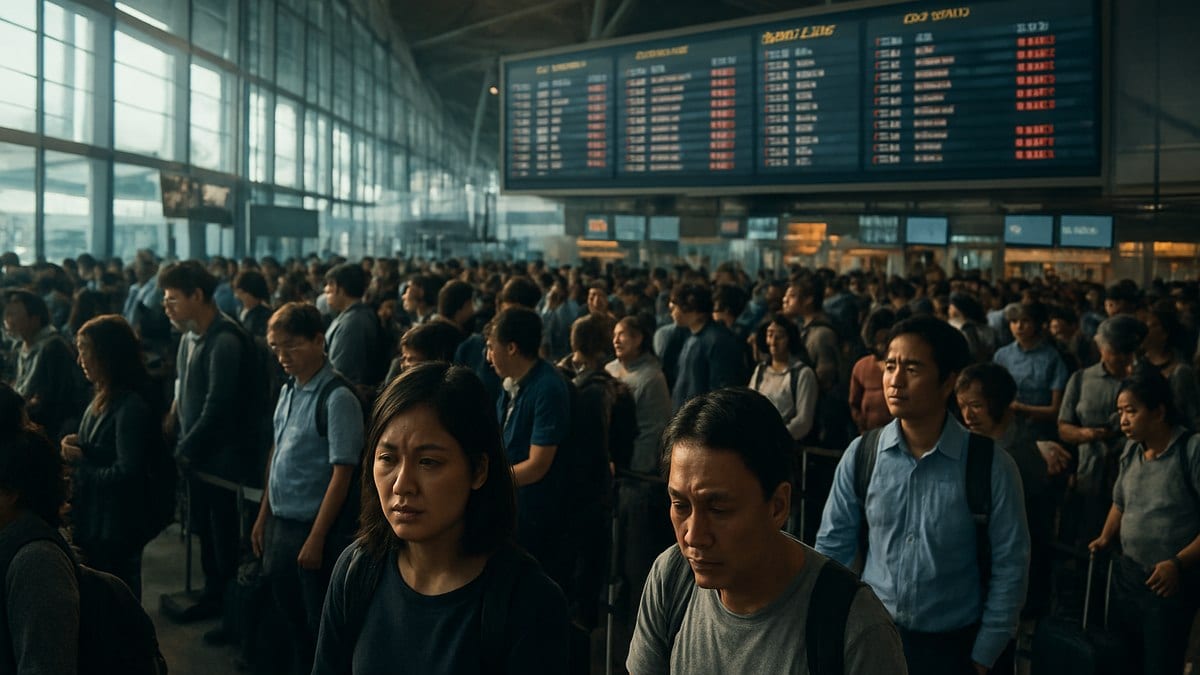
New Wave of Disruptions Across Asian Hubs
Data from regional tracking platforms and airport departure boards indicate that Asia’s flight operations entered a new round of turbulence in early April, with delays and cancellations mounting on April 6 and 7 and spilling into April 8. Coverage compiled by aviation and travel outlets shows that airports in Japan, South Korea, mainland China, Hong Kong, the Philippines and Singapore have seen several thousand delays and hundreds of cancellations over the past 48 hours, leaving terminals congested and crews out of position.
Reports from Travel and Tour World for April 7 describe 3,829 delayed flights and 264 cancellations across Asia, affecting carriers from Batik Air and IndiGo to Air China and FlyDubai and hitting routes from Tokyo and Shanghai to Kolkata and Abu Dhabi. A separate breakdown for April 6 highlighted 3,072 delays and 154 cancellations across a similar group of airports, including Tokyo Haneda, Hong Kong, Guangzhou, Incheon, Manila and Singapore. Those back to back disruptions set the stage for further irregular operations on April 8 as airlines attempted to recover aircraft and crew rotations.
At several hubs, delays have been driven by a mix of localized weather, air traffic congestion and knock on effects from earlier cancellations. Publicly available tracking data suggests that when high volume gateways such as Haneda, Hong Kong or Guangzhou fall even slightly behind schedule, tightly timed turnarounds quickly unravel, forcing airlines either to stack up delays across the day or cancel entire rotations to reset their operations.
The pattern mirrors disruption seen on March 11, when analysis by aviation observers recorded more than 2,100 delays and over 700 cancellations in a single day across the Asia Pacific region. In that case, operational reviews pointed to converging weather systems, airspace constraints and aircraft rotation failures as key triggers, illustrating how little slack remains in regional networks.
Geopolitics and Fuel Prices Squeeze Operations
The operational strains hitting Asian schedules in April are unfolding against a backdrop of severe geopolitical and energy shocks that have pushed airline costs sharply higher. Since late February, the conflict in West Asia has prompted airspace restrictions and routing changes on corridors linking India, the Gulf, Europe and North America. Indian media reports on April 8 indicate that more than 10,000 flights involving Indian carriers have been cancelled since the crisis escalated, with long haul routes to Europe and North America particularly affected.
The conflict has amplified an existing fuel price surge. Industry trackers and specialist aviation outlets report that jet fuel prices have risen dramatically since February, in some analyses by well over 50 percent, with related refinery margins and insurance costs also increasing. Commentaries on the 2026 Iran war fuel crisis note that much of Asia is highly exposed to energy flows through the Strait of Hormuz, meaning disruptions there translate quickly into higher operating costs for airlines across China, India, Japan, South Korea and Southeast Asia.
In response, airlines around the region have been raising fuel surcharges and reviewing route economics. Coverage from Air Traveler Club and other aviation news providers in March detailed how carriers including Air India, IndiGo and Air New Zealand introduced or increased fuel surcharges after aviation turbine fuel prices spiked. In Hong Kong, local reporting and online discussion forums have highlighted a 34 percent increase in Cathay Pacific’s fuel surcharge from April, the second rise in a matter of weeks, as the airline cited mounting pressure from higher oil prices.
These surcharges may help recover part of the additional fuel bill, but they also risk dampening demand in price sensitive Asian markets. At the same time, rerouting around conflict zones adds flying time on many long haul services, burning more fuel and tying up aircraft and crews for longer cycles, which further constrains the system’s ability to absorb shocks such as those seen on April 8.
Numbers Reveal Just How Thin Margins Are
Behind the visible queues at check in counters and departure gates, the financial buffer available to Asian airlines remains slim. The International Air Transport Association has projected global net profit margins for airlines of about 3.9 percent in 2026, equivalent to several dollars of profit per passenger. Regional analyses presented to Asia Pacific regulators indicate that the picture is even tighter for local carriers, with net profit margins for the Asia Pacific segment closer to 2 percent and net profit per passenger of only a few dollars.
In practical terms, this means that modest cost shocks ranging from a short spike in fuel prices to an unplanned diversion around a conflict zone can erase a meaningful share of annual earnings. Reports examining industry economics note that even in relatively strong years, the buffer between profit and loss for airlines is small compared with other sectors, leaving little room to absorb repeated operational crises like those now affecting Asian routes.
Corporate and investor research released in early 2026 has also warned that previously benign fuel conditions are unlikely to return quickly while the current geopolitical strains persist. As energy costs rise and volatility increases, carriers that did not extensively hedge their fuel exposure, or that hedged only parts of the fuel price such as the crude component but not refining margins, are facing a sudden jump in unit costs.
At the same time, regulatory and infrastructure charges at airports across Asia continue to edge higher, and wage pressures are building as airlines compete for skilled technicians, pilots and cabin crew. Combined, these trends leave operators with limited flexibility when disruption forces aircraft to sit on the tarmac generating no revenue, as occurred across dozens of airports going into April 8.
Infrastructure Running Close to Capacity
The recent waves of delay have also drawn attention to how closely many Asian hubs are running to capacity. Analyses of the March and early April disruptions by aviation data firms point to a recurring pattern in which a relatively contained weather or airspace event produces outsized knock on effects because there is little spare runway, gate or staffing capacity to absorb it.
Commentary on the March 11 Asia Pacific disruption noted that a single cancelled domestic flight in Shanghai could cascade into a blocked international departure to Dubai or Bangkok several hours later, because the same aircraft and crew were scheduled across both legs. Once that rotation breaks, follow on flights across the network face either extended delays or cancellation. Similar dynamics appear to be at work in early April as operators juggle equipment between short haul regional services and long haul sectors into the Middle East and Europe.
Publicly available charts of slot allocations and movement counts for airports in Tokyo, Hong Kong, Guangzhou, Seoul and Singapore show that many of these facilities are operating near or at declared capacity during peak hours. When a thunderstorm cell, fuel stop requirement or air traffic control restriction reduces throughput, airlines have few options other than compressing turn times or cancelling later services to restore order.
Industry presentations to Asia Pacific regulators in late 2025 underscored this vulnerability, warning that without increased investment in runway, terminal and air traffic management infrastructure, the region’s ambitious growth forecasts could be undermined by recurring bouts of congestion and disruption. The experience of April 8 offers a fresh illustration of those concerns, with passengers bearing the immediate impact through missed connections and extended waits.
Passengers Pay More for Less Reliability
For travellers, the combination of rising fares and deteriorating reliability is increasingly visible. Published coverage across Asian and Middle Eastern outlets indicates that base fares and surcharges on many intra Asian and long haul routes have climbed sharply since February, in some cases by several hundred percent, while on time performance has weakened.
In the Philippines, the ongoing energy crunch and higher fuel prices have already prompted Cebu Pacific and Philippine Airlines to trim selected domestic and international routes, according to local reporting and official energy sector briefings. In India, airlines are not only coping with higher jet fuel costs and longer routings but also with lingering airspace limitations in neighboring countries, which further constrain scheduling flexibility.
Consumer advocacy groups and travel forums across the region are recording a steady rise in complaints about last minute schedule changes, rolling delays and complex rebooking processes, particularly on journeys requiring connections through the Gulf or major Northeast Asian hubs. Many of the passengers caught up in the April 8 disruptions are facing rebookings over several days rather than hours, as full flights and reduced frequencies limit the availability of alternative seats.
For now, the industry’s response remains focused on incremental adjustments such as surcharge increases, selective capacity cuts and tighter cost control. The events surrounding April 8 highlight how, as long as margins remain thin and infrastructure stretched, even a single day of heavy delays can expose the fragility built into Asia’s fast growing but financially delicate airline networks.