

More news on this day
Thousands of passengers were stranded at airports across Asia today as widespread operational disruption led to 2,880 flight delays and 139 cancellations across Thailand, Japan, Singapore, Malaysia, China and Indonesia, snarling schedules for carriers including AirAsia, Batik Air, All Nippon Airways, Japan Airlines, China Eastern and others at key hubs such as Bangkok and Kuala Lumpur.
Get the latest news straight to your inbox!
Regional Hubs Buckle Under Concentrated Disruption
Publicly available aviation data and aggregated flight-tracking figures for April 5, 2026, indicate that the latest wave of irregular operations is heavily concentrated in a dense network of Asian hubs. Airports serving Bangkok, Kuala Lumpur, Singapore, major Chinese cities and leading Japanese and Indonesian gateways have collectively recorded 2,880 delays alongside 139 outright cancellations, creating a cascading backlog that is rippling through the day’s schedules.
Bangkok and Kuala Lumpur appear among the hardest hit in Southeast Asia, with outbound and inbound rotations disrupted as delayed arrivals leave aircraft and crews out of position for subsequent departures. Singapore Changi has also reported elevated delays, though far fewer same-day cancellations compared with some North Asian and Chinese counterparts, according to compiled airport departure boards and third-party flight-status platforms.
In North Asia, Japanese gateways such as Tokyo Haneda and Narita, as well as regional airports including Naha and New Chitose, have logged significant late departures that are pushing knock-on delays into evening banks of flights. Chinese hubs including Beijing, Shanghai and several large secondary cities are experiencing a similar pattern, with congestion building at check in, security and rebooking counters as passengers attempt to rearrange onward travel.
Jakarta and other Indonesian airports have added to the regional strain, particularly where domestic connections feed into international departures bound for Thailand, Malaysia, Singapore and China. The interplay between these hubs means that an aircraft delayed in one market is often scheduled to operate subsequent legs elsewhere in the region, amplifying disruption across multiple countries when irregular operations take hold.
Major Carriers From Low Cost To Full Service Affected
The disruption has cut across airline business models, affecting both low cost and full service carriers. Regional data collated by aviation trackers and industry coverage show AirAsia and Batik Air featuring prominently in delay statistics tied to Kuala Lumpur, Jakarta and other Southeast Asian gateways. With dense point to point networks and tight aircraft turnarounds, even a modest initial delay can quickly expand into multi-hour setbacks when several rotations are affected in succession.
Among Japanese operators, All Nippon Airways and Japan Airlines are contending with rolling schedule adjustments on domestic and regional routes, particularly those feeding Tokyo’s primary hubs. Some services have been retimed or consolidated as airlines attempt to restore schedule integrity while working within crew duty limits and available aircraft. Regional subsidiaries such as ANA Wings are also visible in operational tallies, reflecting the strain on high-frequency domestic corridors.
Chinese airlines, including China Eastern, are similarly represented in delay figures, particularly at large coastal hubs and fast-growing inland gateways. The mix of domestic and international services has meant that disruptions on intra-China sectors are feeding into long haul departures to Southeast Asia and beyond, leaving passengers on connecting itineraries facing missed connections and unplanned overnight stays in intermediate cities.
While headline numbers focus on the largest brands, smaller and regional carriers are also affected as they share runway slots, airspace and ground-handling resources with bigger competitors. For travelers, the practical impact is often similar irrespective of airline: extended waits at gates, rolling boarding-time revisions and uncertainty over the timing of onward connections.
Underlying Pressures: Weather, Congestion And Tight Spring Schedules
Recent reporting across the region points to a combination of adverse weather, airspace constraints and heavy seasonal demand as key ingredients in today’s disruption. Earlier in the week, storms and unstable weather patterns around parts of East and Southeast Asia contributed to flow-control measures and temporary ground stops at several major hubs, leaving airlines with little margin to recover before the next wave of departures.
Spring travel demand, including regional holidays and school breaks in multiple markets, has kept load factors high and schedules dense. Publicly available timetables show minimal slack in peak-hour operations at large airports, meaning that even short-lived interruptions can lead to extended queues for takeoff slots as air traffic control works through accumulated backlogs.
Operational resilience is further tested by ongoing crew and fleet balancing challenges that have persisted since the broader post-pandemic recovery in Asian aviation. When aircraft and flight crews are displaced by earlier delays, airlines must navigate complex duty-time regulations and limited spare capacity to rebuild rotations, a process that can take several days when disruptions span multiple hubs and time zones.
Industry analyses published in recent months have highlighted how this combination of strong demand, constrained capacity and weather-sensitive routings has made Asia’s interconnected hub system particularly vulnerable to rolling waves of disruption. Today’s figures for delays and cancellations sit within a broader pattern of repeated operational stress episodes observed across the region since early 2026.
Knock-On Effects For Passengers And Regional Connectivity
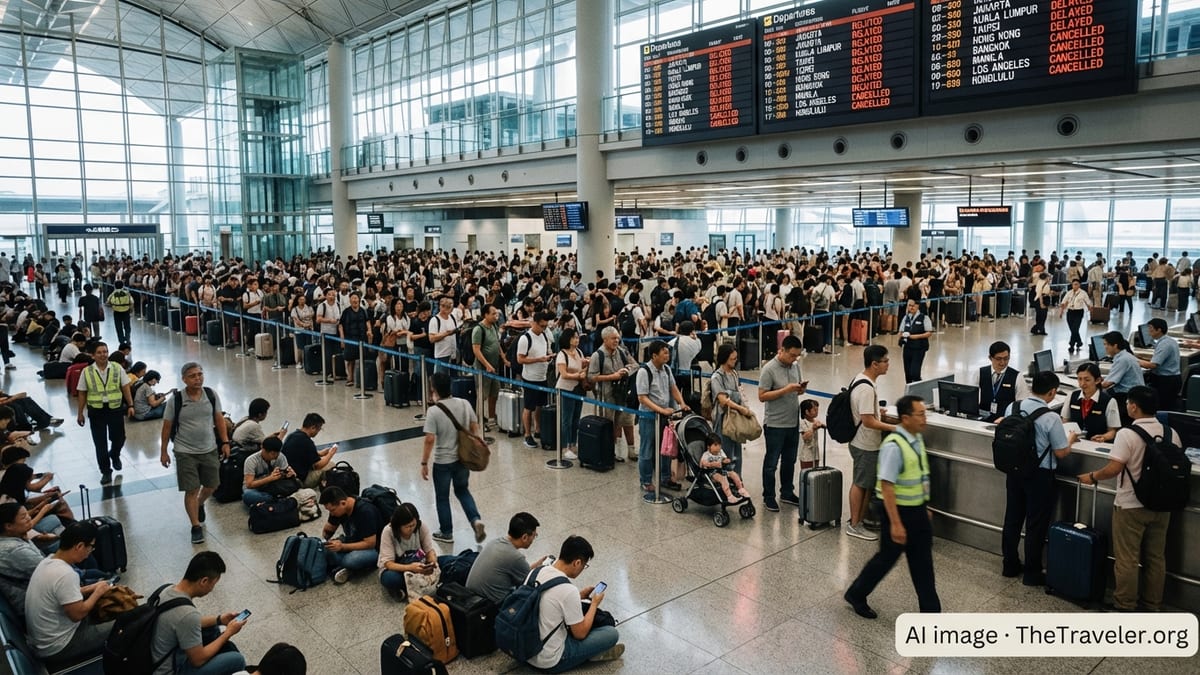
For travelers on affected routes, the immediate impact is being felt in longer-than-expected airport stays, missed onward connections and last-minute changes to itineraries. Images and local coverage from several hubs today describe crowded departure halls, queues at airline service desks and passengers attempting to rebook on limited remaining seats across regional networks already operating near capacity.
The concentration of delays and cancellations at key connecting points has also affected regional business and leisure travel beyond the directly impacted airports. Itineraries involving same-day connections through Bangkok, Kuala Lumpur, Singapore, Tokyo, Beijing, Shanghai and Jakarta are particularly exposed to missed minimum connection windows, leading to unplanned stopovers and rerouting through alternative hubs where seats are available.
Travel industry reports note that some passengers have turned to rail or short-haul ferry services on domestic and near-regional legs where such options exist, in an effort to bypass congested air corridors. However, for longer-distance itineraries within and beyond Asia, flying remains the only practical mode, leaving many travelers dependent on airline rebooking policies and any flexibility offered by travel insurers.
Tourism stakeholders are monitoring the situation closely, as repeated disruption across Asia’s aviation system can weigh on traveler confidence, particularly among those planning tightly scheduled itineraries or multi-country trips. With several major Asian destinations relying heavily on air connectivity to sustain visitor arrivals, prolonged operational volatility can have knock-on effects for hotels, tour operators and broader local economies.
What Travelers Can Expect In The Coming Days
Based on recent disruption patterns across Asia, industry observers suggest that operational aftershocks from today’s delays and cancellations could continue into subsequent days, even if weather and airspace conditions stabilize. Aircraft and crews displaced by today’s events will need time to cycle back into position, and some late-night and early-morning rotations may be especially vulnerable to additional retiming or consolidation.
Publicly available guidance from airlines and airports around the region consistently emphasizes the importance of checking flight status frequently on the day of travel, arriving early for departures and allowing generous buffers for self-planned connections between separate tickets. This is particularly relevant at large hubs where security and immigration queues can lengthen quickly during periods of irregular operations.
Travel advisers also point to the value of flexible booking arrangements during periods of elevated disruption, including tickets that permit changes at reasonable cost and accommodation plans that can be adjusted without heavy penalties. Some carriers in the region have introduced temporary waiver policies during recent disruption episodes, although the specifics vary by airline and are typically time-limited.
With Asia’s aviation network continuing to scale up capacity alongside robust demand, today’s figures on delays and cancellations underscore how quickly pressure can build when several major hubs experience irregular operations on the same day. Passengers planning journeys through Thailand, Japan, Singapore, Malaysia, China and Indonesia in the near term may wish to monitor conditions closely and factor additional resilience into their itineraries.