

More news on this day
Asia’s airlines are racing to rewrite their playbooks as a sudden spike in jet fuel prices, driven by the Iran war and disruptions in the Strait of Hormuz, sends operating costs soaring and airfares sharply higher, raising the risk of schedule cuts and widespread cancellations if the crisis drags on.
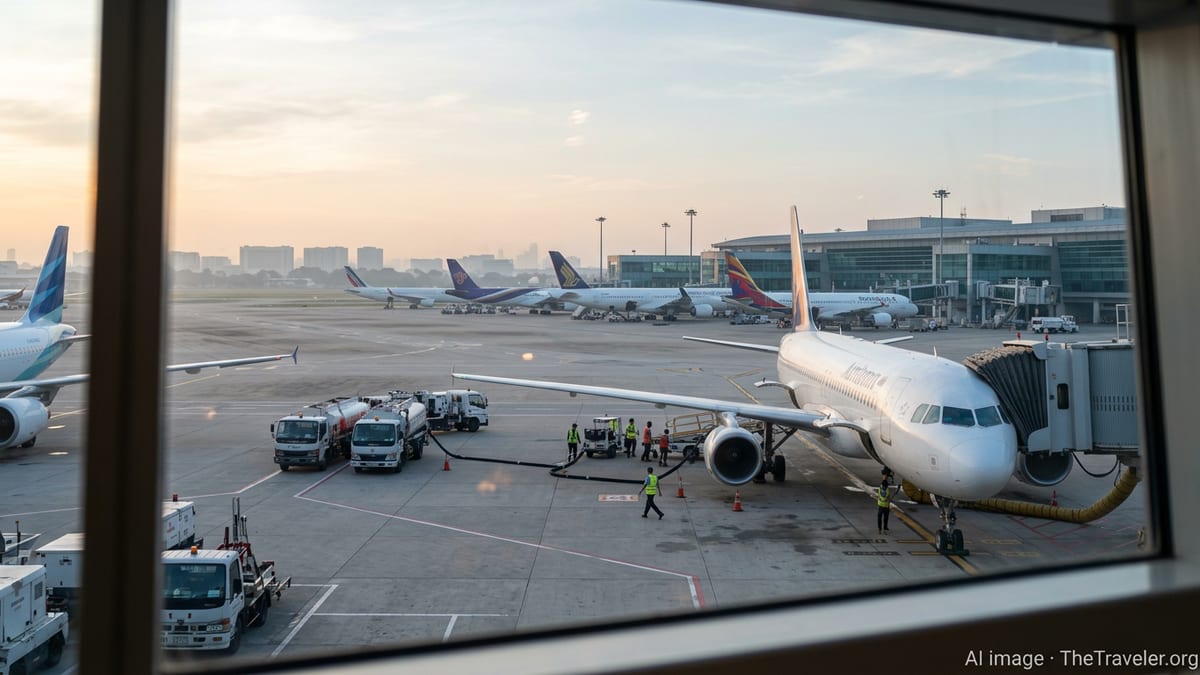
Jet Fuel Shock Hits Asia After Middle East Escalation
The regional fallout from the conflict in Iran is now squarely visible in Asia’s aviation markets. Jet fuel, which many carriers had budgeted at around the mid‑$80s per barrel for 2026, has surged in recent days to a range of roughly $150 to $200, according to airline and industry briefings. The jump follows oil market turmoil triggered by attacks around the Strait of Hormuz and the partial shutdown of key energy facilities in Qatar, a critical supplier of global liquefied natural gas.
Industry analysts note that airlines typically stop making consistent profits when fuel prices spend long periods above the low‑$70s per barrel. With current jet fuel benchmarks now far beyond that level, the fuel shock is erasing the benign cost outlook that underpinned optimistic profit forecasts published as recently as late 2025. For many Asian carriers, fuel has quickly swung from manageable line item to existential threat.
Asian governments are beginning to respond. Vietnam has confirmed that its airlines are facing fuel cost increases in the range of 60 to 70 percent, prompting proposals to waive environmental taxes on aviation fuel, cut value‑added tax and even loosen domestic fare caps if needed. Regulators in Thailand have likewise warned that further fuel spikes linked to the Middle East war could force carriers to raise fares and potentially trim capacity on unprofitable routes.
Airfares Climb as Carriers Pass Costs to Travelers
For passengers across Asia, the most immediate impact of the fuel shock is visible on ticket prices. Carriers from low‑cost players to full‑service flag airlines are quietly lifting base fares and fuel surcharges, often in small increments spread across domestic, regional and long‑haul routes. Over the past week, several airlines serving Asia–Middle East and Asia–Europe markets have signaled that higher prices are unavoidable if fuel remains at current levels.
In India, travel data show average fares on some India–West Asia routes rising by double digits in early March, even as most scheduled flights continue to operate. Travel agencies report that war‑risk insurance charges and longer routings to avoid sensitive airspace are being folded into all‑in fares, particularly in premium cabins. At the same time, budget‑conscious leisure travelers booking to the Gulf for work trips or family visits are seeing fewer promotional deals and higher minimum prices.
Elsewhere in the region, airlines are moving more overtly. Air New Zealand, a bellwether for Asia–Pacific long‑haul travel, has raised fares across its domestic, short‑haul and long‑haul networks and suspended its financial outlook for 2026, citing unprecedented volatility in jet fuel markets. Low‑cost giant AirAsia has introduced temporary adjustments to fares and surcharges throughout its network, with executives warning that further steps may be necessary if current fuel levels persist.
Longer Routes, Tighter Capacity and the Risk of Cancellations
Beyond higher prices, the Iran war is also forcing significant operational changes that could translate into more frequent delays and cancellations for Asia‑bound travelers. Airspace closures and restrictions across parts of the Gulf have disrupted traditional corridors between Europe and Asia, pushing airlines onto longer northern arcs over the Caucasus or southern diversions that skirt the Arabian Peninsula. Each additional hour in the air not only consumes more fuel but also ties up aircraft and crew, reducing schedule flexibility.
Hubs in the Middle East that once funneled large volumes of passengers between Europe and Asia continue to see irregular operations, with thousands of flights cancelled or rerouted since late February. That has created a surge of demand onto Asian and European carriers that still have viable routings, driving up load factors and limiting spare capacity to absorb further shocks. On some busy city pairs, last‑minute seats are becoming harder to find, and schedule changes are being pushed out to passengers with shorter notice.
Industry modeling suggests that if jet fuel remains near current levels for more than a month or two, airlines will be forced to go beyond fare increases and selectively trim weaker routes. Leisure‑heavy services with thin profit margins, secondary regional links and overnight long‑hauls that require extra fuel to avoid restricted zones are all candidates for future cuts. While no major Asian carrier has launched a sweeping cancellation program yet, several have flagged the possibility of network and schedule revisions if current conditions extend into the second quarter.
Governments and Regulators Scramble to Contain the Shock
Faced with the prospect of a fragile recovery in air travel being derailed by a fuel‑price crisis, policymakers in Asia are exploring ways to cushion both airlines and consumers. Vietnam’s proposals to temporarily suspend environmental taxes on jet fuel and lower value‑added tax are among the most aggressive, explicitly framed as emergency support to keep national carriers flying and prevent runaway fare inflation on key domestic and regional routes.
The Civil Aviation Authority of Thailand has taken a different tack, focusing on fuel market behavior. Officials have warned local suppliers not to use existing stockpiles as an excuse for disproportionate price hikes, urging that any increases remain closely aligned with global benchmarks rather than speculative premiums. At the same time, regulators acknowledge that if fuel remains near its current highs, airlines will be given more latitude to adjust fares to stay solvent.
Singapore, meanwhile, is pushing ahead with its plan to fund the use of cleaner jet fuel through a dedicated levy on tickets from Changi Airport, even as conventional fuel prices spike. The scheme, due to start later this year, will add a modest surcharge per ticket to support sustainable aviation fuel usage, highlighting the difficult balance governments face between decarbonization goals and near‑term affordability pressures. For travelers, it means that environmental charges and war‑driven fuel spikes could overlap on itineraries through key Asian hubs.
What Asia‑Bound Travelers Should Watch in the Weeks Ahead
For now, most flights within Asia and between Asia and other regions are still operating, and major airlines insist that widespread cancellations are a last resort. Yet the speed and scale of the fuel price spike, combined with rerouting pressures and a still‑uncertain geopolitical outlook, mean conditions could change quickly. Airlines are updating guidance and schedules in short cycles, sometimes adjusting fares and capacity on a week‑by‑week basis.
Travel advisers say passengers planning trips involving the Middle East, or long‑haul journeys between Europe and Asia, should build in more time for connections, monitor their bookings closely and be prepared for schedule changes. Higher fares appear likely to persist in the near term, especially in markets that rely heavily on wide‑body jets and longer flying times. Some analysts warn that if demand softens in response to sticker shock, airlines may be forced into a painful mix of price incentives and capacity cuts later in the year.
The longer the conflict and fuel volatility last, the more stress Asia’s airlines will face. Well‑hedged, well‑capitalized carriers may ride out the storm with thinner margins and selective cuts, while smaller and more indebted operators could find themselves closer to the brink. For travelers, the coming months in Asia’s skies will be defined by higher costs, tighter capacity and a lingering question mark over just how resilient the region’s airlines really are.