

More news on this day
Flight operations across the United States have come under renewed strain as a fresh wave of disruptions centered on Atlanta’s Hartsfield-Jackson International Airport ripples through already stretched airline networks, snarling spring travel during one of the busiest periods of the year.
Get the latest news straight to your inbox!
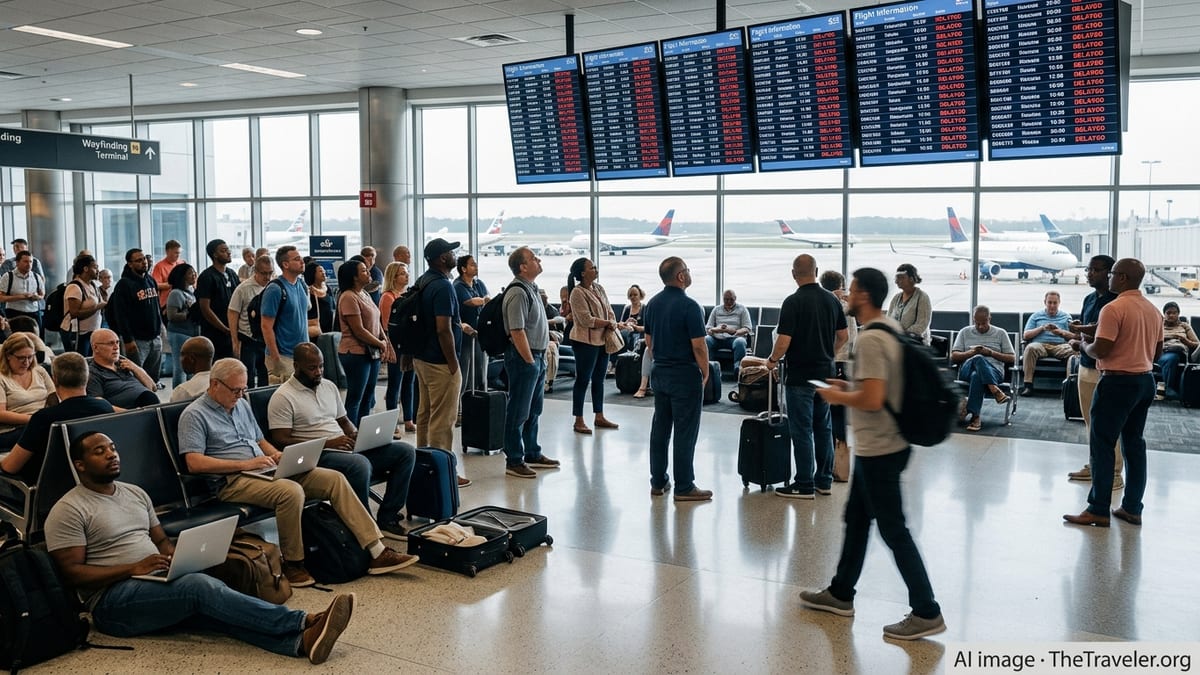
Storm Systems and Holiday Crowds Converge on a Key Hub
Recent storm systems moving through the Southeast and Midwest, combined with heavy Easter and early spring-break traffic, have left Atlanta struggling to keep flights on schedule. Published coverage indicates that between early April weather fronts and the Easter weekend rush, thousands of flights nationwide were delayed or canceled, with Atlanta repeatedly appearing among the hardest-hit airports.
Travel industry outlets report that on several days in early April, Atlanta recorded disruption totals ranging from well over 150 to more than 300 impacted departures and arrivals in a single day, including dozens of outright cancellations. Those figures placed Hartsfield-Jackson near the top of national disruption tables alongside hubs in New York, Chicago, Houston and Orlando, underscoring how quickly conditions in Atlanta can translate into national gridlock.
The surge came on top of a March blizzard in the Upper Midwest and High Plains that had already pushed airlines and air traffic control to their limits. As schedules remained tightly packed, even brief ground stops or weather holds in Atlanta had outsized consequences for routes that connect through the city to smaller markets across the South and East Coast.
Reports from aviation trackers and flight-data aggregators show that the pattern has repeated over multiple weekends, with Atlanta’s peaks in delay minutes typically coinciding with thunderstorms in the Southeast or storm remnants drifting east from the central United States.
Network Effects Push Delays Far Beyond Georgia
Because Atlanta is one of the world’s busiest connecting hubs, disruptions there rarely stay local. National flight statistics from early April highlight how problems at Hartsfield-Jackson contributed to widespread knock-on delays at airports including New York’s LaGuardia and JFK, Chicago O’Hare, Boston, Orlando and Seattle, as aircraft and crews struggled to return to position.
Publicly available data from airline networks show that many flights departing secondary airports were delayed primarily because their inbound aircraft had been held up in Atlanta. Once those aircraft missed their departure slots, congestion propagated along trunk routes, turning what began as a regional weather event into a nationwide scheduling tangle.
Travel analysis published over Easter weekend described a “domino effect” in which a single multi-hour ground stop at a hub such as Atlanta or Chicago can cascade through evening banked departures. When load factors are high, as they have been this spring, there is little spare capacity to rebook passengers, leaving travelers stuck overnight or forced into multi-stop itineraries that can add many hours to domestic journeys.
Observers note that the U.S. air traffic system has become increasingly sensitive to disruptions at a handful of mega-hubs. Previous government and academic reviews of delay data have pointed to Atlanta, Chicago O’Hare and several New York airports as key pressure points where local constraints can rapidly transform into national congestion.
Staffing Strains and Security Bottlenecks Add to the Pressure
Weather has not been the only factor behind Atlanta’s recent struggles. Checkpoint wait times at Hartsfield-Jackson and other major hubs have lengthened in tandem with the travel surge, with data cited in recent travel-industry briefings showing average security waits in Atlanta pushing close to an hour during peak periods in March.
According to publicly available information on federal staffing and the ongoing partial shutdown of some security functions, the Transportation Security Administration has been operating under sustained resource constraints. Some airport advisories have urged passengers to arrive at least three hours before departure, particularly during early-morning and late-afternoon peaks when checkpoint queues regularly spill into terminal corridors.
The staffing squeeze reaches beyond security. Airline operations teams have had to juggle crew schedules tightly in recent weeks. Weather-driven delays in and out of Atlanta have pushed some pilots and flight attendants up against federally mandated duty limits, forcing last-minute crew swaps or cancellations when replacement staff were not immediately available in the right city.
Industry commentary indicates that these overlapping pressures reduce the system’s ability to recover after a disruption. A schedule that might once have recovered overnight can now take several days to normalize, particularly when storms arrive in rapid succession or coincide with holiday or school-break peaks.
Travelers Across the Country Feel the Impact
The operational turmoil at Atlanta has been acutely felt by travelers far from Georgia. Reports from passenger-advocacy groups and travel forums over the past month describe long tarmac waits, rolling gate changes, and missed connections at airports as varied as Dallas, Denver, Detroit, Boston and smaller regional fields that rely heavily on Atlanta feed.
On social media and discussion boards, travelers connecting through Atlanta in March and early April have recounted multi-hour delays and missed onward flights to cities such as New York, Miami, Seattle and numerous smaller Southeastern destinations. Many describe having to rebook two or three times in a single day as cascading delays forced airlines to reshuffle aircraft and crew.
Domestic and transatlantic passengers have also been affected. Published coverage notes that outbound flights from Atlanta to European gateways, including London and Paris, have departed late or with tight connection windows for inbound passengers from other U.S. cities. When domestic legs into Atlanta run late, travelers bound for overseas flights often face stressful sprints through concourses or unplanned overnight stays.
With overall demand for air travel running above last year’s levels, many disrupted travelers have found that same-day or even next-day alternatives are limited. High load factors on popular routes leave airlines with fewer empty seats, extending recovery times for those whose trips have been derailed by the Atlanta-centric delays.
Airlines Adjust Schedules as Summer Peak Looms
In response to the persistent turbulence in their networks, several major carriers operating at Atlanta have begun to make tactical adjustments. Public schedule data and carrier advisories indicate that airlines are adding buffer time to tightly timed connections, shifting some flights away from peak congestion banks, and selectively trimming frequencies on routes that have been most prone to repeated delays.
Some carriers have extended flexible travel waivers around recent storm systems affecting the Southeast and Midwest, allowing passengers booked through Atlanta to move their trips to earlier or later days without change fees. Airline communications have encouraged travelers to monitor mobile apps closely, track inbound aircraft, and consider longer connection times when itineraries route through Atlanta or other storm-prone hubs.
Airport planning documents and recent contract announcements for infrastructure upgrades in Atlanta, including work on airfield transport systems, suggest that local authorities and partners are preparing for sustained high traffic volumes in the years ahead. However, those longer-term improvements will not arrive in time to ease the immediate strain as airlines head into the summer season.
Analysts watching the situation note that the recent sequence of disruptions is likely to serve as a stress test for the broader U.S. aviation system. With spring storms already exposing vulnerabilities around Atlanta, the industry will be under pressure to bolster staffing, build more slack into schedules, and coordinate more closely with air traffic control before the peak summer travel wave arrives.