

More news on this day
Auckland Airport is riding a fresh wave of global travel demand, with visitors from Australia, the United States, China and the United Kingdom driving record international throughput and sending the company’s share price to a multi-month high.
Get the latest news straight to your inbox!
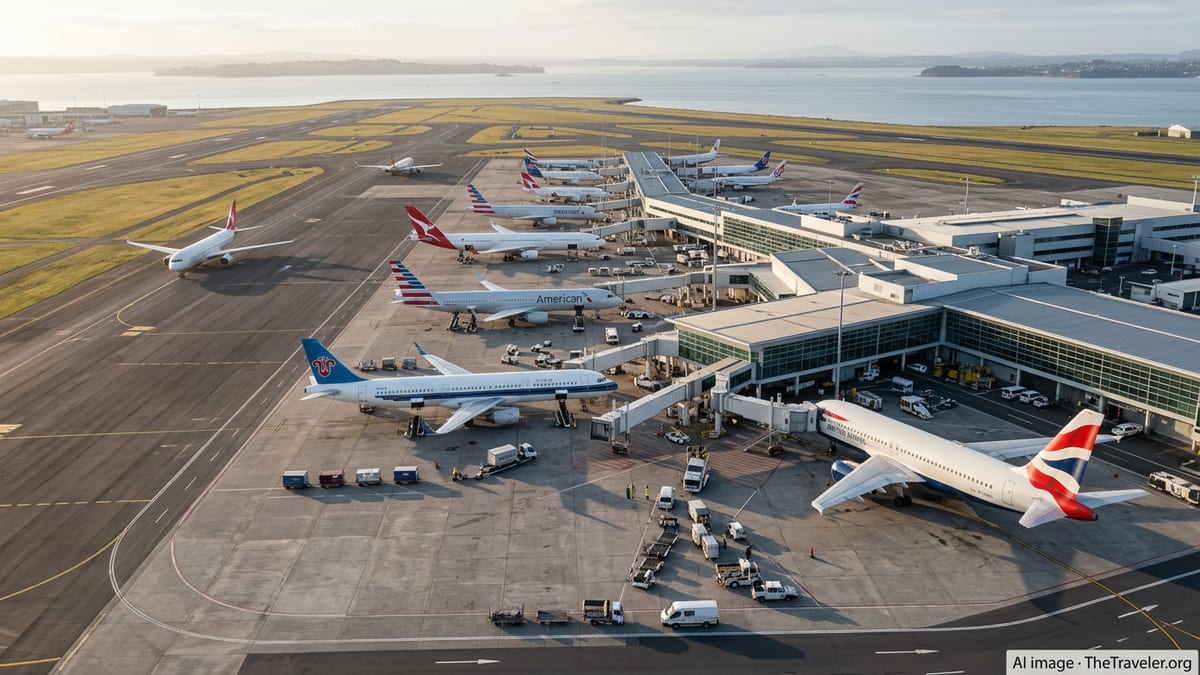
Record Passenger Volumes Cement Auckland’s Gateway Role
Recent traffic data and company results indicate that Auckland Airport has reached its highest international passenger volumes since before the pandemic, cementing its status as New Zealand’s primary global gateway. In the 12 months to the end of 2025, publicly available figures show total passenger numbers approaching 19 million, with international flows outpacing domestic traffic growth as long-haul and trans-Tasman networks rebuild.
For the six months to 31 December 2025, Auckland Airport reported international passenger numbers of about 5.27 million, including transits, a year-on-year rise that pushed volumes beyond already-strong 2024 levels. Domestic traffic also grew over the same period, but at a slower pace, underlining the central role of inbound tourism and outbound New Zealand travellers in the airport’s current performance.
Industry analysts note that the airport’s momentum reflects both pent-up travel demand and structural shifts in airline scheduling. Additional widebody capacity, the return of key Asian carriers and a greater use of Auckland as a connection point between the Pacific, Asia and North America have all contributed to the surge.
The latest figures place Auckland well ahead of other New Zealand airports in absolute visitor numbers, reinforcing its position as the main entry point for tourists and business travellers and a critical barometer for the broader tourism recovery.
Australia, United States, China and UK Lead Tourism Revival
Within this rebound, four markets stand out. Tourism and migration statistics for the year to December 2025 show that Australia remains by far New Zealand’s largest visitor source, with more than 1.5 million arrivals. The United States delivered around 385,000 visitors, while China contributed approximately 262,000. The United Kingdom continued to rank among the largest long-haul markets, supported by strong visiting-friends-and-relatives travel.
These trends are clearly visible at Auckland Airport, which handles the majority of international arrivals. Monthly traffic updates highlight robust flows on trans-Tasman routes linking Auckland with Sydney, Brisbane and Melbourne, supported by multiple carriers and high flight frequencies. Short-haul international routes to Australia have in many cases met or exceeded pre-2020 capacity, underpinning steady leisure and business travel.
On long-haul services, United States and United Kingdom demand is being channelled through connections to West Coast hubs and major European gateways. Increased frequencies to Los Angeles, San Francisco and other North American cities are helping funnel US-origin traffic through Auckland, while one-stop itineraries via Asia and the Middle East are supporting travel from Britain.
China’s contribution is also growing as carriers restore routes and additional seats are added for peak holiday periods. Monthly reports for recent northern summer and Chinese holiday periods show sharp year-on-year percentage increases in Chinese visitor numbers, from a comparatively low base after border restrictions, indicating that this market is once again becoming a significant driver of throughput.
Capacity Expansion and New Routes Support the Surge
The visitor upturn is being matched by a steady expansion in airline capacity. Auckland Airport has reported that international seat numbers for the 2025 to 2026 summer peak are about 4 percent higher than the previous year, adding more than 200,000 extra seats and taking total international capacity to roughly 5.8 million seats for the season.
Additional services are spread across key markets, including extra frequencies on Australia routes, boosted capacity to North American gateways and strengthened schedules to major Asian hubs. These changes are lifting load factors and improving connectivity for both inbound tourists and outbound New Zealand travellers, while also enhancing the airport’s role as a transfer hub between Asia, the Pacific and the Americas.
Infrastructure investment at Auckland Airport is another factor enabling the growth. The company has recently highlighted progress on terminal upgrades, new processing areas and roading improvements around the precinct, all designed to handle higher passenger volumes more efficiently and reduce bottlenecks during peak travel periods.
Industry commentary suggests that while airline fleets remain constrained globally by aircraft delivery delays and maintenance demands, Auckland is capturing a favourable share of available capacity. This is particularly evident in markets where New Zealand is marketed as a premium long-haul destination, such as the United States, China and the United Kingdom.
Share Price Climbs as Investors Back Tourism Recovery
Financial market data shows that Auckland International Airport’s share price has risen to a multi-month high in recent trading, reflecting investor confidence in the durability of the tourism rebound. The move follows the company’s latest half-year results, which reported higher aeronautical revenue on the back of increased international passenger volumes and improving non-aeronautical income from retail and parking.
Market commentary points to several drivers behind the recent share price strength. These include sustained visitor growth from core markets such as Australia, the United States, China and the United Kingdom, ongoing capacity additions for the 2025 to 2026 summer, and expectations that global travel demand will remain resilient despite economic headwinds and higher airfares.
Analysts also note that Auckland Airport’s earnings profile is becoming more diversified as retail, hospitality and commercial property income recovers alongside aviation revenue. Duty free, food and beverage and landside retail activity have all benefited from longer dwell times and rising passenger numbers, adding an additional layer of support to the company’s financial performance.
While some forecasters caution that capacity constraints and operational pressures could limit further rapid growth, consensus views in published research suggest that Auckland Airport is well positioned to benefit from continued recovery in Asia Pacific travel and stable demand from traditional Western markets.
Outlook: Strong Pipeline but Capacity and Cost Risks Remain
Looking ahead, guidance and independent analysis point to further incremental gains in passenger numbers through 2026, though likely at a more moderate pace than the initial rebound. Forecasts for the coming financial year indicate expected international throughput of around 10.6 million passengers, with domestic traffic edging higher to roughly 8.6 million as regional networks stabilise.
Key upside factors include the potential for additional services from Chinese and broader Asian carriers, further refinement of trans-Pacific schedules, and continued strength in Australian and US leisure travel. New Zealand’s positioning as a safe, high-value long-haul destination is expected to remain a powerful draw for travelers from North America, Europe and affluent parts of Asia.
However, industry observers emphasise several risks that could affect the pace of growth. Airline capacity remains constrained in some markets, operating costs are elevated, and global economic uncertainty could weigh on discretionary long-haul travel. Locally, congestion on access roads and pressure on border-processing infrastructure have been recurring concerns highlighted in public commentary from passengers and airlines alike.
Even so, the current trajectory suggests that Auckland Airport’s combination of rising visitor numbers from Australia, the United States, China and the United Kingdom, coupled with ongoing infrastructure upgrades and solid airline engagement, is likely to keep both terminals busy and investor sentiment broadly supportive in the months ahead.