

More news on this day
Austria has begun applying the European Union’s new biometric Entry/Exit System to non-EU travellers arriving and departing by road, rail and air, marking a major change to how trips into the Schengen Area are recorded and checked.
Get the latest news straight to your inbox!
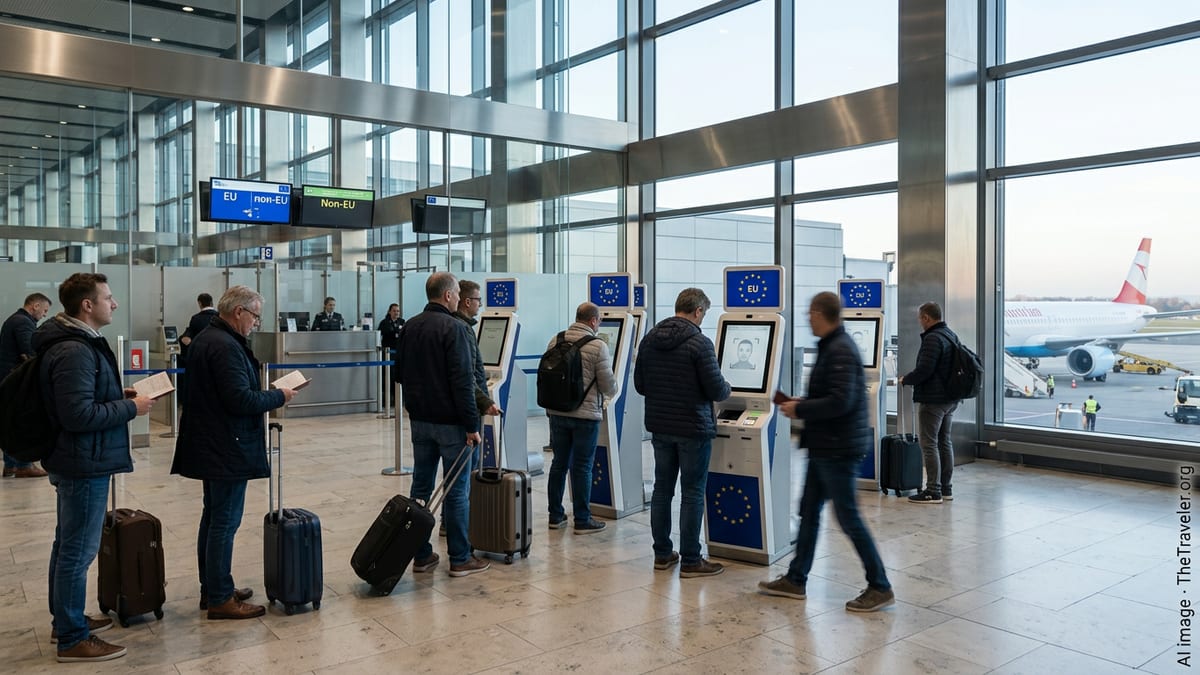
Part of an EU-Wide Shift to Biometric Border Controls
The Entry/Exit System, commonly referred to as EES, went live across the Schengen Area’s external borders on 12 October 2025, replacing manual passport stamps for most non-EU visitors with a centralised digital record. Publicly available information from EU institutions describes it as a cornerstone of the bloc’s “smart borders” strategy, intended to tighten enforcement of short-stay rules while streamlining identity checks.
Austria, as a Schengen member state, is progressively activating the system at its designated border-crossing points, from Vienna International Airport to major motorway crossings and key international rail hubs. Reports indicate that all participating countries are working toward full operational use of the system by 10 April 2026, following a phased rollout intended to ease pressure on border posts.
The new approach applies at external Schengen borders only. Once non-EU travellers have cleared EES checks on entry into the Schengen zone, onward movement inside the area typically remains border-free, even though some states, including Austria, continue to apply temporary internal checks on selected frontiers for security and migration-management reasons.
Austria’s implementation is shaped by EU-level rules that are directly applicable in member states. National authorities are responsible for installing dedicated kiosks, adapting manual counters and training staff so that the same core procedures apply whether a traveller arrives by plane, coach or international train.
Who Is Affected When Entering or Leaving Austria
The EES applies to non-EU and non-Schengen nationals entering the Schengen Area for a short stay of up to 90 days in any rolling 180-day period, including travellers who do not need a visa as well as those holding a Schengen visa. Citizens of EU member states and of Iceland, Liechtenstein, Norway and Switzerland are not processed through EES for their own travel, as they already benefit from free movement rules.
For many visitors, Austria functions as both a destination and a gateway. Travellers flying into Vienna from long-haul markets such as the United States, Canada or Asia, as well as those arriving overland from neighbouring non-Schengen countries such as Serbia or Bosnia and Herzegovina via road and rail, will now typically encounter EES procedures when they first cross into the Schengen zone.
The system records each entry and exit, the type and number of the travel document used, biometric identifiers and the authorised length of stay. According to information made available by the European Commission and associated agencies, EES automatically calculates days spent in the Schengen Area and flags possible overstays, which were previously tracked through manual passport stamps.
Austria’s participation means that non-EU travellers leaving the Schengen Area via the country’s airports, land crossings or international rail routes will also have their departure registered. This makes it harder for visitors to exit from a different country without a matching electronic record, enhancing the accuracy of overstay detection but also giving compliant travellers clearer proof that they left on time.
What Travellers Can Expect at Austrian Airports, Land Crossings and Rail Hubs
For most non-EU visitors, the main change will be an initial biometric registration at the first Schengen border they encounter. At Austrian airports, this is being handled through a mix of self-service kiosks and staffed counters. Travellers are typically asked to scan their passports, have a live facial image captured and, in many cases, provide four fingerprints, particularly if they are visa-exempt visitors entering Austria for the first time since EES went live.
On busy land borders, such as motorway crossings linking Austria with non-Schengen neighbours, reports from EU information campaigns suggest that dedicated EES lanes and portable equipment are being introduced. Coaches and private vehicles may be directed to specific booths where non-EU passengers disembark briefly to complete biometric capture, a process that border agencies estimate will take a few minutes per traveller once systems and staff are fully up to speed.
International rail traffic is also affected. Long-distance trains arriving from non-Schengen countries are expected to undergo checks at designated stations or at border stops, where mobile teams equipped with EES terminals verify passports and collect biometrics when required. Travellers may be asked to step off the train or be processed on board, depending on local operating arrangements.
During the transition period to April 2026, some crossing points are using a hybrid model, where EES registration is in place but traditional passport stamps are temporarily used as a back-up. Travellers are being advised, in public guidance, to allow extra time for border formalities, particularly at peak holiday periods and at smaller land posts where infrastructure upgrades are still being completed.
Data, Privacy and the Link with Future ETIAS Travel Authorisations
EES is designed as a large-scale information system run at EU level, with technical operations managed by eu-LISA, the agency responsible for several of the bloc’s key justice and home affairs databases. According to publicly available documentation, the system stores biometric data, basic identity details, travel document information and records of entries, exits and refusals of entry for prescribed retention periods, with stricter rules for individuals found to have overstayed.
The data is intended primarily for border management and migration-control purposes, but can also be accessed under defined conditions by law-enforcement authorities investigating serious crime or terrorism. EU sources state that the system is subject to detailed safeguards, including strict access logs, data-minimisation principles and oversight by national data protection authorities and the European Data Protection Supervisor.
For non-EU travellers, one practical consequence is the end of passport stamps as the main proof of time spent in the Schengen Area. Travellers will need to rely on electronic records if they are asked to demonstrate their compliance with the 90/180-day rule, although boarding passes and accommodation receipts may still be useful supporting evidence in case of disputes.
EES is also closely linked to the upcoming European Travel Information and Authorisation System, or ETIAS, which is expected to begin operating after EES is fully in place. ETIAS will require many visa-exempt travellers, including those heading to Austria for tourism or business, to obtain a paid electronic travel authorisation in advance. Once both systems are live, border checks will draw simultaneously on EES records and ETIAS approvals, further automating risk assessment at entry.
Practical Tips for Visiting Austria Under the New Rules
Public information from EU and national channels suggests that most travellers should continue to plan trips to Austria largely as before, while allowing more time for border procedures, especially on first entry under the new system. Arriving early at Vienna International Airport or at major land and rail crossings can help absorb any delays caused by biometric registration, which is generally expected to be slowest in the initial months.
Non-EU visitors are advised to ensure that their passports are valid for at least three months beyond the intended departure date and that they can demonstrate their itinerary and accommodation details if asked. While EES automates stay calculations, travellers remain responsible for respecting the 90 days in any 180-day limit across the whole Schengen Area, not just in Austria.
Those who frequently cross Austria’s borders for work, family visits or tourism may find that subsequent trips are faster once their biometric profile is stored in the system. In such cases, border checks should mainly involve verifying identity against existing records rather than repeating the full enrolment process each time, although random or risk-based questions may still be asked.
As the April 2026 milestone for full deployment approaches, additional guidance is expected to clarify how EES will interact in practice with carrier checks, advance passenger data and, later, ETIAS. For now, the core message to non-EU travellers bound for Austria is that border checks are becoming more digital, more biometric and more closely linked across all modes of transport, even as the country remains open for tourism, business travel and cultural exchange.