

More news on this day
Hundreds of British Airways passengers have been left stranded across the UK and the wider Middle East after the carrier scrapped hundreds of services in response to airspace closures, industrial unrest and spiralling regional conflict that is upending global travel networks.
Get the latest news straight to your inbox!
Middle East Airspace Closures Trigger Wave of BA Cancellations
British Airways has suspended flights to key Gulf destinations including Dubai, Abu Dhabi, Bahrain, Doha and Tel Aviv through at least 15 March, following a series of US and Israeli strikes on Iran and retaliatory attacks that have shut or severely restricted some of the Middle East’s busiest air corridors. Aviation data indicates that more than 200 UK-linked BA services on these routes have been cancelled since 8 March, with further adjustments expected as the security picture evolves.
The closures affect not just point to point trips between London and the Gulf but also onward journeys across Asia, Africa and Australia that rely on the region as a major transit bridge between Europe and the rest of the world. With Dubai, Doha and Abu Dhabi handling around half a million passengers a day under normal conditions, the knock-on effect of suspensions and diversions has cascaded across airline schedules.
BA has operated a limited number of rescue flights from alternative gateways such as Muscat to bring stranded customers back to London, but those services have sold out rapidly, leaving many travellers in the region scrambling to find seats on other carriers or to reroute via secondary hubs. The airline has urged customers not to travel to the airport unless they have a confirmed booking and has offered rebooking or refunds for those affected.
For passengers in the UK, the cancellations have translated into sudden groundings at Heathrow and other airports, with departures boards showing multiple BA flights to the Middle East as “cancelled” or “retimed” and knock-on delays rippling into European and domestic services as aircraft and crews fall out of position.
Strikes and Staffing Pressures Compound Operational Chaos
The crisis in the Middle East has coincided with lingering industrial tensions in the UK aviation sector, compounding the disruption facing British Airways and its customers. Ground handling staff, baggage teams and some support workers at major UK hubs have staged or threatened walkouts in recent weeks over pay and rostering, forcing airlines to thin their schedules even before the latest conflict-driven cancellations.
BA has already been operating with tighter staffing margins following a difficult winter season, and the requirement to replan long haul networks around closed airspace has increased pressure on pilots, cabin crew and maintenance teams. Aircraft that would normally operate high yield Middle East services are now being reassigned to cover other long haul routes that require longer flight times to circumvent restricted zones, leaving fewer spare jets available when problems arise.
Unions say members are being asked to fill gaps created by the crisis at short notice, while the airline insists it is working within agreed frameworks and safety limits. The result for passengers, however, is a schedule more vulnerable to cascading delays, missed connections and last minute cancellations when any part of the system comes under strain.
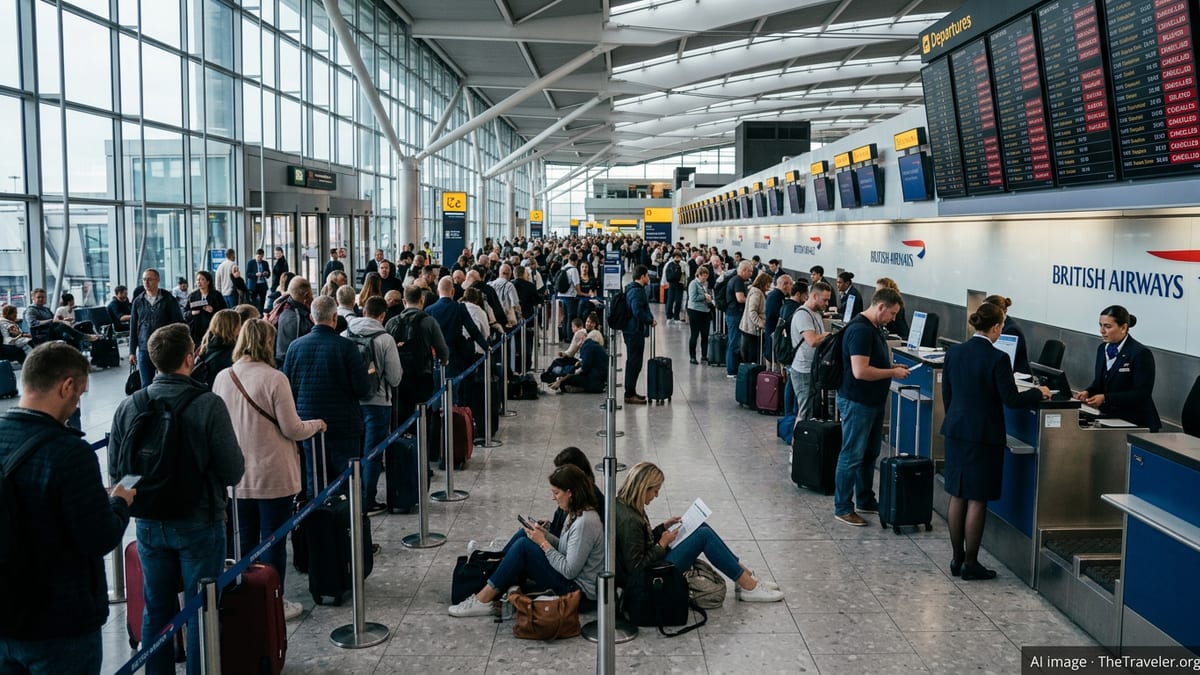
At London Heathrow, where BA is the dominant carrier, the combination of staff shortages, diverted aircraft and heightened security protocols has led to long queues at check in and security, with some travellers reporting waits of more than three hours at peak times as the busy Easter getaway period approaches.
Passengers Face Long Queues, Confusion and Limited Alternatives
For many travellers, the crisis has been felt most acutely on the terminal floor. At Heathrow’s Terminal 5, lines of passengers have formed at BA customer service desks, with holidaymakers, business travellers and expatriate families trying to secure scarce seats home or salvage complex itineraries that relied on Gulf hubs for onward connections.
Some customers have described overnight stays on airport benches after hotel rooms near major airports sold out, while others have turned to rail or ferry options within Europe to bypass congested skies and reach alternative departure points. With BA not part of a broad interline rebooking framework in the Gulf, switching to rival carriers such as Emirates, Qatar Airways or Etihad has often meant paying for entirely new tickets at elevated last minute prices.
Under UK passenger rights rules, travellers whose flights are cancelled are entitled to a choice between a refund and rerouting at the earliest opportunity, along with care such as meals and accommodation when necessary. However, the scale and complexity of the current disruption, together with safety restrictions on where and when airlines can operate, mean that getting passengers moving again has in many cases taken days rather than hours.
Travel agents and consumer groups report a surge in calls from worried customers unsure whether to proceed with trips booked for later in March and April, particularly those involving cruise departures, weddings or other fixed date events that depend on timely arrival in the Middle East or onward destinations in Asia.
Global Flight Patterns Rerouted Around a Growing Conflict Zone
Beyond British Airways, airlines across Europe, Asia and the Middle East have been forced to redraw their route maps as the conflict zone expands and regulators close or restrict airspace over parts of Iran, Iraq, Israel, Syria, Kuwait, Qatar, Bahrain and the United Arab Emirates. Long haul flights that once took the most direct path across the Gulf region are now looping north over Turkey and the Caucasus or south over the Arabian Sea, adding hours of flying time and increasing fuel burn.
The operational impact is filtering through to timetables worldwide, with recent data showing around 190 cancellations and more than 800 delays in a single day across Europe linked to Middle East airspace restrictions. Carriers including KLM, Lufthansa, Air France, Ryanair and Turkish Airlines have all reported schedule changes and longer block times, reducing daily aircraft utilisation and squeezing already tight margins.
These ripple effects matter for UK travellers even when their ticket does not show a Middle East destination. A London to Bangkok or Sydney itinerary that once connected via Dubai or Doha may now require a completely different routing, or face capacity constraints as airlines focus scarce widebody aircraft on the most profitable and strategically important markets.
Analysts warn that if airspace closures and infrastructure damage in the Gulf persist into the peak summer season, airlines could be forced into deeper cuts, consolidating services and raising fares on surviving routes as they attempt to balance safety, cost and demand.
What Disrupted Travellers Should Do Now
Travel experts advise that anyone booked to fly with British Airways to or through the Middle East in the coming weeks should check their booking status frequently and ensure their contact details in the airline’s system are up to date, so they receive notifications of schedule changes as soon as they are issued. Many alterations are being processed in rolling waves as security assessments shift, meaning a flight that appears to be operating today could still be pulled in the days ahead.
Passengers whose flights have already been cancelled are being encouraged to decide quickly between accepting rerouting or requesting a refund, as seats on alternative services remain limited and prices on competing airlines can climb rapidly once disruption becomes widespread. Those with flexible travel plans might consider postponing non essential trips until after mid to late March, when airlines hope for greater clarity on airspace conditions.
For travellers already stranded abroad, consumer groups recommend keeping all receipts for food, accommodation and local transport costs that arise while waiting for a replacement flight, and staying in regular contact with both the airline and, where relevant, travel insurance providers. Policies vary, but some comprehensive plans may offer additional coverage in conflict related disruption beyond the minimum legal entitlements.
With the situation in the Middle East evolving daily and British Airways signalling that further schedule cuts remain possible, the message from the industry is that spring 2026 will be a challenging period for long haul travel. Passengers are being urged to build extra time into their journeys, prepare for last minute changes and remain alert to safety and travel advisories from both airlines and government authorities.