


More news on this day
Qatar Airways is working in lockstep with the Qatar Civil Aviation Authority and international aviation partners to enable the safe, phased reopening of Qatari airspace following an unprecedented security shutdown that has stranded passengers and aircraft across multiple continents.
Get the latest news straight to your inbox!
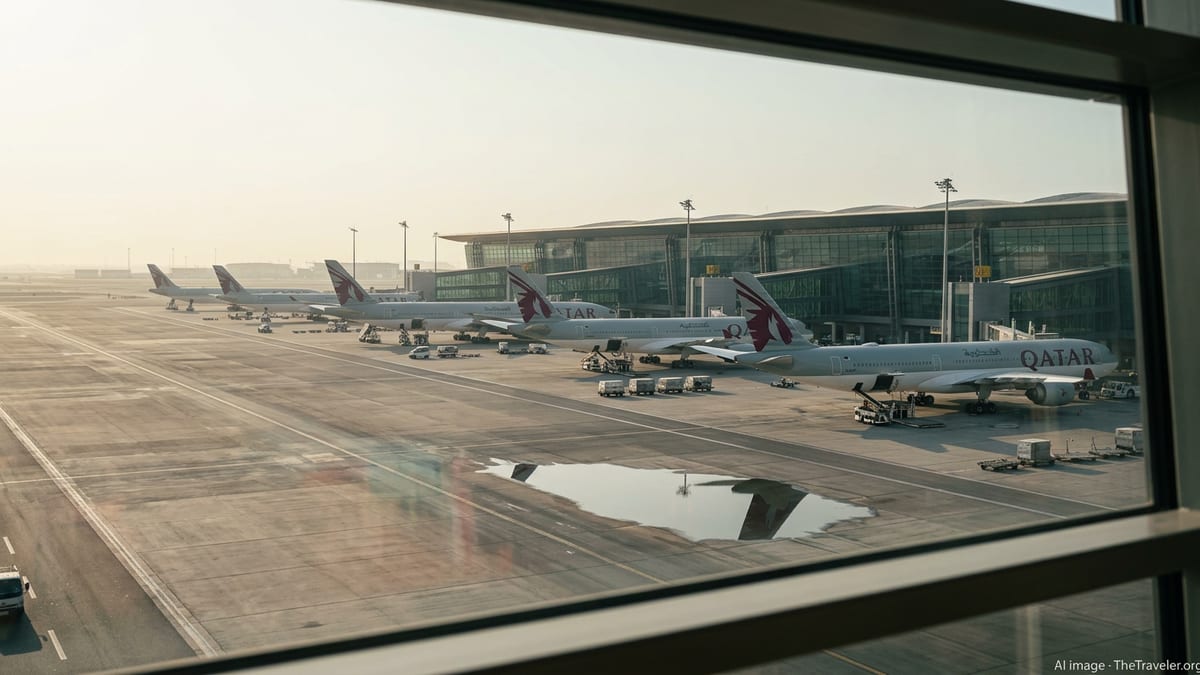
Careful Coordination as Authorities Plan Airspace Reopening
The temporary closure of Qatari airspace on 28 February 2026 in response to regional security developments has left one of the world’s busiest transit hubs effectively offline, forcing Qatar Airways to suspend its scheduled global operations. Since then, the airline has stressed that a full restart will only proceed once the Qatar Civil Aviation Authority formally confirms that it is safe to do so and that navigational corridors can operate at normal capacity.
A partial reopening was introduced in early March through tightly controlled contingency routes, allowing limited repatriation and cargo services from Hamad International Airport. These safe corridors were designed by air traffic specialists and military authorities to route aircraft away from potential risk areas, with strict limits on the number and timing of flights in order to preserve safety margins.
Operational planners at Qatar Airways are now working with regulators, airport operators and regional air navigation service providers on scenarios for a broader restart. These include stepwise increases in traffic volume, continuous risk assessments, and real-time coordination with neighboring airspace units to avoid congestion once regular commercial services are cleared to resume.
Industry analysts say the complexity of Doha’s role as a global connecting hub demands a cautious, layered reopening plan. Restoring full connectivity will require harmonized decisions across multiple states, with Qatar Airways expected to ramp up frequencies gradually rather than flipping immediately back to pre-closure schedules.
Limited Relief Flights and Network Readiness
While its core network remains paused, Qatar Airways has begun operating a small number of relief flights under special authorization. These services, routed via designated safe corridors from Doha and through alternative hubs such as Muscat, are primarily focused on returning stranded passengers to key destinations in Europe and Latin America and repositioning aircraft and crew.
The airline has also mounted select one-off operations from Doha to cities including London, Paris, Madrid, Rome and Frankfurt, as well as a special service to São Paulo. These flights are not part of a regular schedule and are released only after the authorities validate each operating window, reinforcing that safety remains the overriding constraint on capacity.
Behind the scenes, network planners are using these limited operations to test procedures that will be vital once the airspace fully reopens. Ground handling, turnaround times, fueling logistics and crew scheduling are being evaluated under atypical conditions, with lessons fed back into contingency playbooks to smooth the eventual transition to a more normal timetable.
Travel consultants caution that the presence of occasional relief flights should not be interpreted as a broad reopening. Hamad International Airport remains closed to regular passenger traffic, with access restricted to those holding confirmed seats on specially approved services.
Enhanced Support and Flexible Options for Disrupted Passengers
With tens of thousands of travelers affected, Qatar Airways has rolled out an expanded disruption policy designed to give passengers more flexibility while the airspace remains partially closed. Customers with bookings covering the core disruption window from late February through mid-March are being offered a range of options including free rebooking, open-dated tickets, and in many cases refunds or rerouting on alternate carriers.
The airline has urged passengers not to proceed to the airport unless they have received direct confirmation that their specific flight is operating. Instead, customers are being directed to monitor their bookings via the airline’s digital channels or through their travel agents, as departure times and routings can change at short notice while safe-corridor operations are still in effect.
Additional ground staff and call center agents have been deployed in Doha and at major outstations to handle rebooking, care and compensation queries. At key international airports where Qatar Airways aircraft remain parked, station teams have been coordinating with local partners to provide meal vouchers, hotel accommodation where required, and updated travel information to passengers facing extended delays.
Consumer advocates note that the airline’s handling policies must also align with local and regional passenger-rights frameworks, particularly for flights originating in the European Union or United Kingdom. While the closure stems from external security events rather than airline-controlled factors, clear communication and proactive care remain critical for maintaining customer trust.
Hamad International Airport Operates in Contingency Mode
Hamad International Airport, usually a 24-hour hub linking Europe, Asia, Africa and the Americas, has shifted to a contingency posture aligned with the airspace restrictions. The airport operator has stated that regular flight operations are suspended and that any movements depend on temporary approvals from the civil aviation authority under defined emergency conditions.
Only passengers with confirmed seats on authorized relief services are being admitted into the terminal. For all others, officials reiterate that arriving at the airport without a confirmed operating flight will likely result in being turned away at the entrance, as check-in desks and security lanes remain largely inactive.
Inside the terminal, operations are scaled back, but readiness is being maintained for a rapid ramp-up once authorities signal that a broader reopening is safe. Essential staff remain on duty to support permitted flights, maintain critical infrastructure and coordinate with Qatar Airways and other stakeholders on contingency planning.
Aviation experts say Hamad International’s experience managing large passenger volumes and past disruptions gives it a strong foundation for recovery. However, they stress that the pace of normalization will depend on the regional security picture and on how quickly adjacent airspace systems can absorb the return of high-frequency long-haul traffic.
What Travelers Should Do While Waiting for Full Resumption
For passengers with upcoming itineraries involving Doha, the central message from both Qatar Airways and airport authorities is to wait for explicit confirmation before making any move toward the airport. Trip status can change rapidly as regulators adjust operating windows, so relying on an original e-ticket or static schedule is no longer sufficient.
Travelers with flexible dates are being encouraged to consider postponing non-essential trips until clearer guidance emerges on the timing and scale of the reopening. Those with urgent travel needs are advised to work with airlines and travel agents to explore alternative routings that avoid Doha and other affected hubs, recognizing that seats on competing carriers may be limited.
In the meantime, Qatar Airways says it will continue to update its policies and operations in line with regulatory decisions and safety assessments. The airline has pledged to notify customers as soon as the Qatar Civil Aviation Authority declares the full and safe reopening of Qatari airspace, triggering a more extensive restart of its global network.
Until that moment, the carrier’s focus remains on close technical coordination with aviation authorities and on providing as much flexibility and support as possible to passengers caught in one of the most far-reaching airspace disruptions the Gulf region has seen in years.