

More news on this day
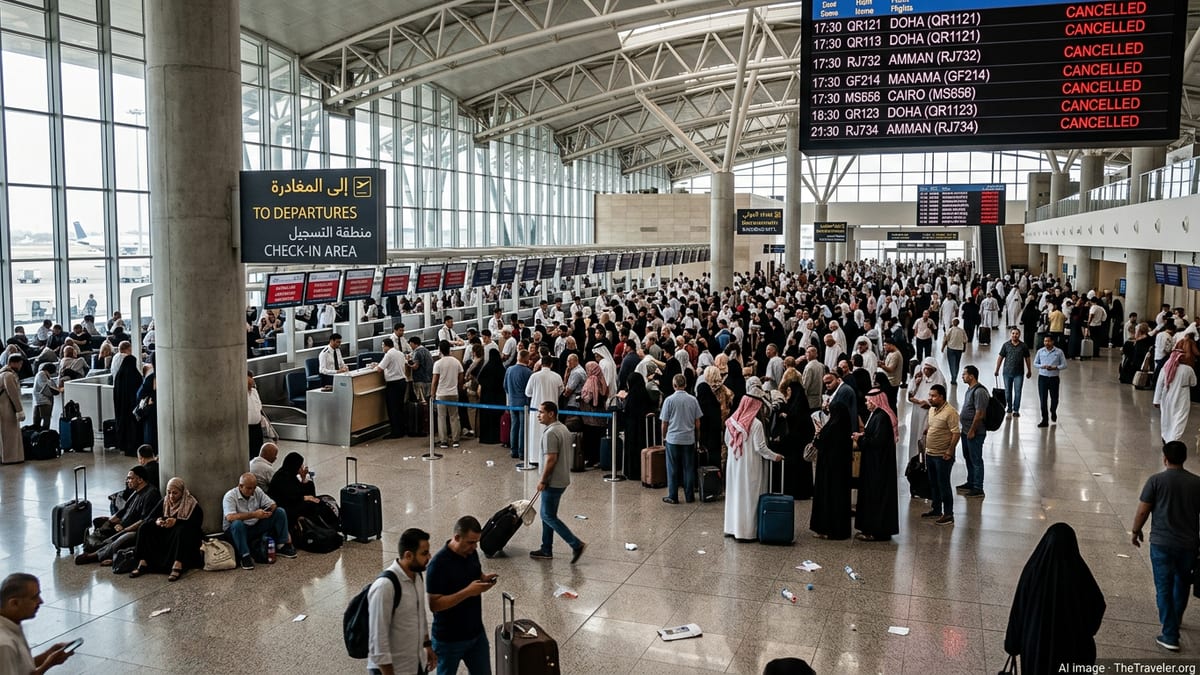
Baghdad International Airport faced significant disruption on Saturday as nine flights operated by Qatar Airways, Royal Jordanian, Gulf-based carriers and other airlines were canceled, stranding hundreds of passengers and rippling delays across Iraq, Qatar, Bahrain, Egypt and beyond.
Get the latest news straight to your inbox!
Security Jitters and Regional Tensions Hit Baghdad Schedules
Airport officials in Baghdad said the wave of cancellations followed renewed security concerns along key air corridors used by carriers linking Iraq with major Gulf hubs. The affected flights, primarily regional services to and from Doha, Amman, Manama and Cairo, were pulled from schedules over a several-hour period, forcing last-minute changes for travelers at one of Iraq’s busiest gateways.
While authorities did not report any direct incident at Baghdad International Airport itself, airline representatives cited evolving risk assessments over overflight routes and proximity to recent military activity in the wider region. Several carriers have been rerouting or temporarily suspending services through Iraqi and neighboring airspace in recent weeks, adding pressure to already tight timetables.
Staff at Baghdad International Airport worked to rebook stranded passengers on later departures or alternative routings via safer corridors, but capacity remained limited. Many travelers reported being offered hotel accommodation in the Iraqi capital or instructed to return home and await confirmation of new travel dates.
Qatar Airways and Royal Jordanian Among Carriers Pulling Flights
Qatar Airways, one of the main Gulf connectors for Iraqi travelers heading to Europe, Asia and North America, canceled at least one rotation between Baghdad and Doha, according to airport departure boards and passenger accounts. The move disrupted onward connections through Hamad International Airport, where the airline has already been juggling schedule changes amid wider regional airspace restrictions.
Royal Jordanian also withdrew a service between Baghdad and Amman, limiting a key link used by both business travelers and transit passengers bound for Europe, North America and the Levant. The Jordanian flag carrier has been adjusting frequencies to Iraq in recent months, balancing demand with fluctuating security conditions along its routes.
Gulf-based airlines, including at least one Bahrain-registered carrier, were also affected, canceling flights that typically feed passengers from Baghdad into their broader networks. Egypt-based services saw at least one cancellation on the Baghdad–Cairo route, affecting workers, students and medical travelers who rely on the connection between Iraq and Egypt’s capital.
Several smaller regional and international airlines operating narrow-body aircraft into Baghdad opted to hold flights pending further guidance, contributing to a patchwork of delays and day-of-departure schedule changes.
Passengers Confront Long Queues, Patchy Information and Missed Connections
Inside Baghdad’s terminal, travelers described long lines at airline counters and crowded seating areas as people waited for clarity on whether their flights would depart. Some passengers said they received cancellation notifications via mobile apps only after arriving at the airport, while others learned of the disruption at check-in.
Transit passengers connecting through Doha, Amman, Manama or Cairo faced the most uncertainty. With limited spare seats on later flights and ongoing pressure on Gulf hub schedules, many saw their trips extended by at least 24 hours. Families returning from visits, migrant workers heading back to jobs in the Gulf and students starting term in Egypt were among those affected.
Travel agents in Baghdad reported a surge of calls from customers seeking alternative routings via less affected hubs such as Istanbul. However, higher fares and longer journey times meant that many travelers opted to wait for the original carriers to reinstate flights or confirm new departure dates.
Several passengers expressed frustration at what they described as fragmented communication, with airlines, handling agents and airport staff sometimes offering differing estimates on when operations would normalize. Others acknowledged that safety considerations needed to take precedence over convenience, even as they faced additional costs for accommodation, food and missed work.
Wider Gulf and Middle East Networks Feel the Strain
The cancellations at Baghdad International Airport fed into wider operational challenges across the Gulf and Middle East, where carriers have been recalibrating networks in response to shifting security guidance and airspace restrictions. Gulf hubs in Qatar and Bahrain, already managing reduced frequencies on some routes, faced additional rebooking demands from Iraq-origin passengers.
Airline planners in Doha and Manama have been working with regional aviation authorities to maintain safe corridors linking major capitals while minimizing knock-on delays. However, the loss of direct Baghdad links, even temporarily, complicates crew rotations, aircraft utilization and onward connections across Europe, Africa and Asia.
In Egypt, where Cairo serves as a major gateway for Iraqi medical tourists and students, the termination of a Baghdad service for the day forced some passengers onto indirect routings via third-country hubs. Aviation analysts noted that such cascading changes can quickly absorb spare capacity, leaving airlines little flexibility to recover from further shocks.
Regional tourism bodies warned that repeated, short-notice disruptions risk undermining traveler confidence in using certain hubs or routings, particularly for time-sensitive journeys such as business trips, religious travel and medical appointments.
Guidance for Affected Travelers and Outlook for Services
Airlines involved in the nine Baghdad cancellations urged passengers to check their booking status online or through official customer service channels rather than heading directly to the airport. Most carriers were offering free rebooking within a defined travel window, subject to seat availability, or refunds for trips no longer deemed essential.
Travel specialists advised passengers to monitor both airline advisories and statements from civil aviation authorities in Iraq and neighboring states, as further adjustments remain possible while security conditions continue to evolve. Travelers with imminent departures were encouraged to allow extra time at airports and to keep flexible plans for accommodation at intermediate hubs.
Aviation observers said that while Saturday’s nine cancellations represented a small fraction of Baghdad’s overall daily schedule, they underscored the fragility of air links in a region where geopolitical tensions can quickly translate into operational decisions. Even isolated cancellations can have an outsized effect on passengers in markets with limited alternative options.
For now, carriers are expected to take a cautious approach to restoring full frequencies to Baghdad, with schedule planners weighing passenger demand against the need for robust risk mitigation. Regular travelers between Iraq and Gulf hubs may need to prepare for short-notice changes and build additional time into their itineraries in the days ahead.