

More news on this day
Australia has widened its emergency crisis registration to include Bahrain, joining the United Arab Emirates, Saudi Arabia, Qatar, Jordan, Israel and other Middle Eastern states as regional strikes, airspace shutdowns and mass flight cancellations disrupt key travel corridors linking Australia with Europe and beyond.
Canberra Expands Crisis Net as Conflict Spreads
Australia’s Department of Foreign Affairs and Trade has moved to extend its crisis registration to Australians in Bahrain, reflecting a rapid deterioration in security and aviation safety across the Middle East in early March 2026. The move adds Bahrain to a growing list of countries where Australians are urged to register their presence so officials can contact them quickly if evacuations or assisted departures become necessary.
DFAT’s crisis portal, previously focused on Iran, Israel, Qatar and the United Arab Emirates, has now been opened to citizens and permanent residents in Bahrain, Kuwait and Lebanon as well. At the same time, Smartraveller advisories have been updated to “do not travel” for multiple Middle Eastern destinations, including Bahrain, Israel, Kuwait, Lebanon, Qatar and the UAE, with Jordan shifted to a higher caution level as fighting intensifies and cross-border strikes continue.
Foreign Minister Penny Wong and Prime Minister Anthony Albanese have framed the changes as a necessary response to a fast-moving conflict that has seen Iranian airspace largely empty of civilian aircraft, retaliatory strikes across the region and a patchwork of sudden airspace closures. Officials warn that Australians in affected countries should not assume the government will be able to mount large-scale rescue operations if conditions worsen further.
Canberra has already deployed extra consular staff to key regional posts, including Amman and Ankara, to manage the surge in calls and registrations from Australians caught up in the turmoil. Thousands have contacted DFAT seeking advice on whether to leave, and how, as the usual network of Gulf transit hubs becomes less reliable by the day.
Airspace Closures Ripple Across the Gulf
The latest escalation has produced one of the most severe disruptions to Middle Eastern aviation in years. Following strikes linked to the Iran war, authorities in Bahrain, Iraq, Israel, Kuwait, Qatar, Syria and the UAE have all temporarily closed or heavily restricted their airspace. The closures have forced airlines to divert or cancel hundreds of flights, affecting passengers far beyond the immediate conflict zone.
Gulf super-connectors Emirates and Etihad, which play a critical role in connecting Australian travellers to Europe, Africa and the Americas, have suspended scheduled services for extended periods while they reassess safety and routing options. Other regional carriers, including Kuwait Airways and Qatar Airways, have also halted or sharply curtailed services as they confront restricted skies and rapidly evolving security assessments.
The result has been a domino effect across the global network. Long-haul flights from Asia and Europe that normally cross Iranian or adjacent airspace have been rerouted along longer, more southerly or northerly paths, adding hours to journeys and intensifying congestion over alternative corridors. Aviation analysts warn that even once some airspace reopens, disrupted crew rosters and aircraft rotations will take days to untangle.
For travellers on the ground in the Middle East, the closures have translated into crowded terminals, long queues at airline desks and a scramble for scarce seats on remaining services to safer hubs such as Cyprus, Athens and parts of southern Europe. In Beirut, Amman and Gulf airports, passengers have reported overnight waits and last-minute cancellations as airlines adjust schedules on an almost hourly basis.
Australian Travellers Face Uncertain Routes Home
The shutdown of key Middle Eastern hubs has immediate consequences for Australians, who have increasingly relied on Gulf carriers and stopovers in Dubai, Abu Dhabi and Doha for travel to Europe, the United Kingdom and parts of Africa. With regular links disrupted, the Australian government is urging citizens to leave affected countries while commercial options still exist, warning that seats may become harder to secure.
Officials say more than a thousand Australians have already returned on a series of commercial flights and government-facilitated services from regional airports since midweek, but tens of thousands more remain spread across the broader Middle East. Many are dual nationals or long-term residents who must weigh complex personal, family and work considerations against the government’s advice to depart.
Airlines serving Australia have begun adjusting their own networks to cope. Some carriers are rerouting Europe-bound flights via Southeast Asian hubs such as Singapore or Bangkok instead of the Gulf, while others are adding capacity on existing non-Middle East routes to absorb displaced demand. Travel agents report a spike in last-minute bookings on these alternative paths as nervous passengers seek to avoid any overflight of conflict-affected skies.
For those still in Bahrain, Qatar, Jordan, Israel and neighbouring states, DFAT’s message is blunt: register on the crisis portal, review personal contingency plans and be prepared to move quickly if an opportunity to leave safely presents itself. The department is also urging people to maintain flexible itineraries, carry essential documents and medications in hand luggage and keep in close contact with airlines for real-time updates.
Tourism and Transit Hubs Under Pressure
The turmoil arrives at a sensitive moment for Middle Eastern tourism, which had been recovering strongly after the pandemic and earlier regional crises. Bahrain, Qatar and the UAE have all invested heavily in leisure and events tourism, promoting stopover city breaks, sporting fixtures and luxury resorts that rely on seamless air connectivity and perceptions of safety.
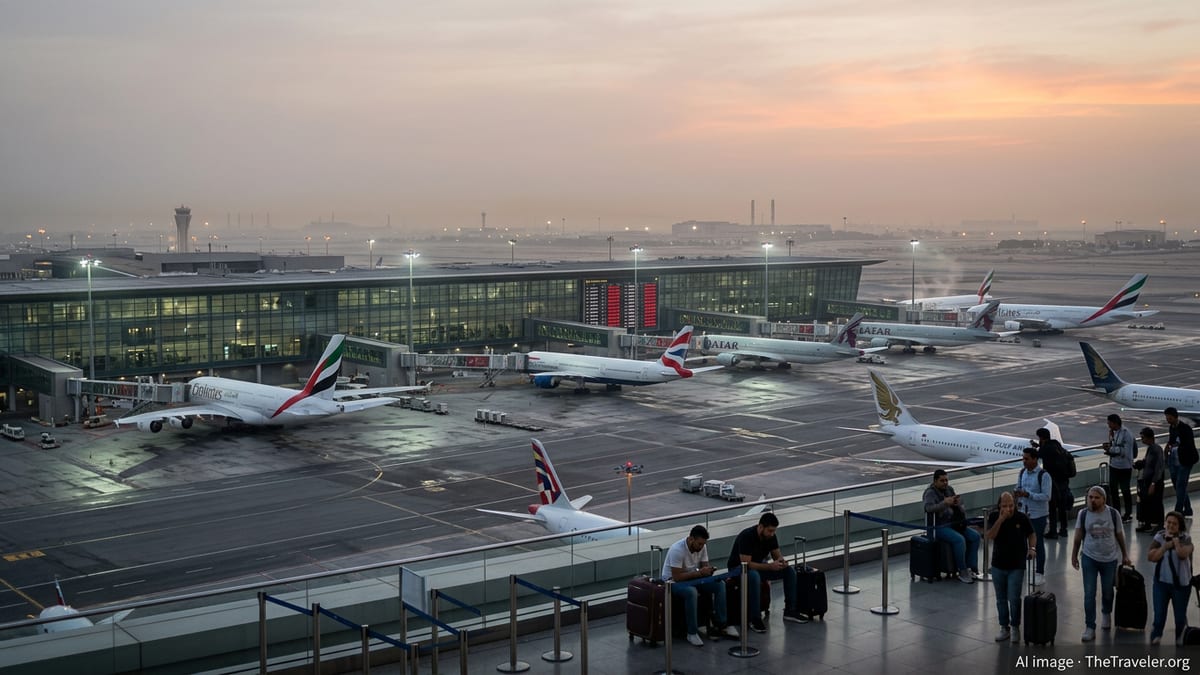
That narrative has been abruptly interrupted by images of grounded aircraft, darkened departure boards and anxious travellers queuing at service desks. In Gulf cities that position themselves as stable gateways between continents, hotel operators and tour companies are now dealing with cancellations, early departures and a wave of inquiries from guests seeking to cut trips short or postpone travel until conditions stabilise.
Jordan, long marketed as one of the region’s more tranquil cultural destinations, is also feeling the impact as tour groups reconsider visits to Petra, Wadi Rum and the Dead Sea in light of heightened regional risk. Even where airports remain technically open and flights continue, the broader perception of instability and the possibility of sudden route changes are prompting many prospective visitors to delay or reroute their travel plans.
Travel industry analysts warn that if the conflict drags on or expands, Middle Eastern hubs could see a sustained loss of transit traffic to competing gateways in Asia and Europe. Carriers able to offer attractive one-stop options that avoid the region entirely may gain a short-term advantage, while Gulf airlines work to rebuild confidence and demonstrate that they can operate safely and reliably in a volatile environment.
What Australians Need to Know Now
For Australians planning or undertaking travel that would normally transit the Middle East, officials and industry specialists are offering a consistent set of messages. First, check Smartraveller advisories for every country on your itinerary, including transit points, as advice for places like Bahrain, Qatar, Jordan, Israel and the UAE is changing rapidly.
Second, travellers already in the region should register with DFAT’s crisis portal if they are in designated countries such as Bahrain, Kuwait, Lebanon, Iran, Israel, Qatar and the UAE. Registration ensures consular officials can push out alerts about evacuation flights, chartered services or sudden opportunities to leave via neighbouring states if commercial options deteriorate further.
Third, passengers are being urged not to head to airports without confirmed bookings, as space on departing flights is limited and overbooked services are common. Instead, they should work through airline call centres, travel agents or online booking tools to secure seats, and consider indirect options via safer third countries where necessary.
Finally, Australians who have flexibility in their plans are being encouraged to route upcoming trips through alternative hubs that do not require overflight of Iran or adjacent conflict zones. While these journeys may be longer and more expensive, officials argue that they offer more predictable options at a time when Middle Eastern skies remain constrained by strikes, airspace shutdowns and an uncertain security outlook.