


More news on this day
Tehran’s Mehrabad Airport, the Iranian capital’s main domestic aviation hub, was engulfed in flames early Saturday after powerful U.S.-Israel airstrikes struck the facility and surrounding neighborhoods, sending plumes of black smoke over the city and plunging air travel in and out of Tehran into fresh chaos.
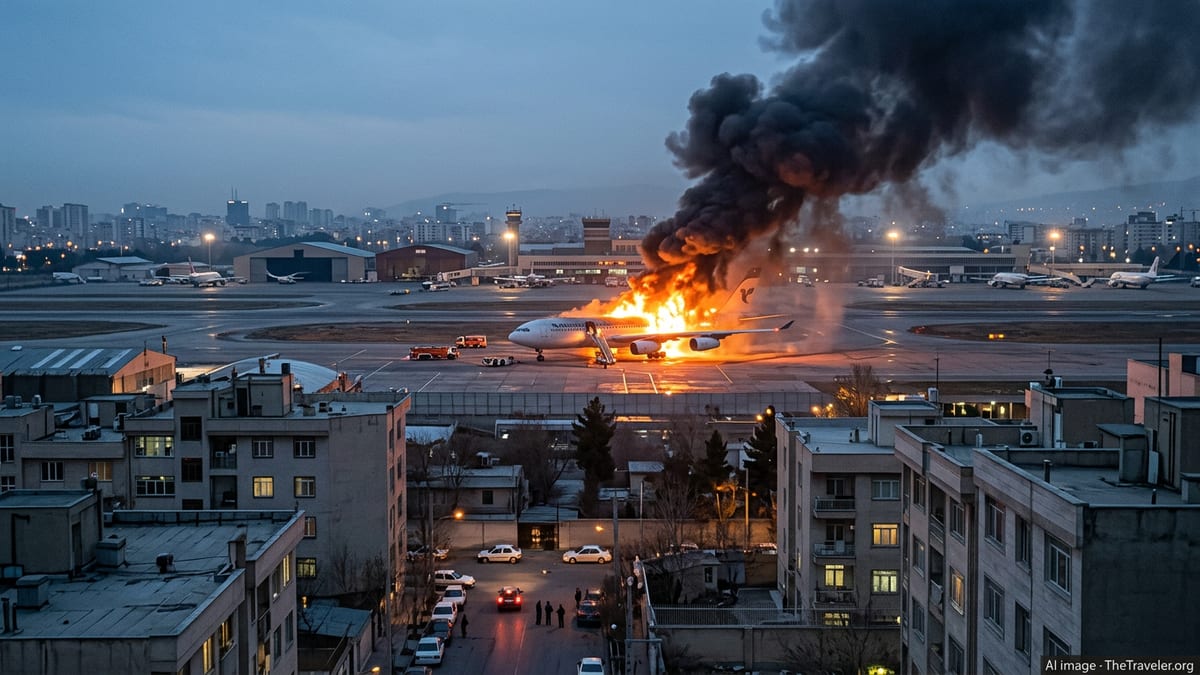
Pre-dawn strikes ignite major blaze at key Tehran hub
The strikes hit shortly before dawn on March 7, jolting residents awake as a series of explosions echoed across western Tehran and thick smoke rose from the direction of Mehrabad, according to Iranian state media and regional outlets. Initial reports pointed to multiple impact sites on or near the airport complex, which serves as Iran’s busiest domestic gateway and a critical logistical node for the country’s armed forces.
Video verified by several international newsrooms showed large fires raging on the airfield, with what appeared to be an aircraft fuselage burning near hangars and service buildings. Emergency vehicles were seen racing toward the blaze as secondary explosions crackled in the background, suggesting fuel stores or munitions may have ignited.
Israel’s military said more than 80 fighter jets participated in a new wave of what it called broad-scale strikes on Iranian targets in Tehran and central Iran, describing the operation as aimed at military infrastructure, missile launchers, and command sites in the capital region. U.S. aircraft were also reported to be involved in the wider campaign against Iranian assets, part of an eight-day confrontation that has steadily escalated from targeted strikes to heavy bombardments of strategic facilities.
Iranian outlets affiliated with the security services confirmed that areas west of the city including districts around Ekbatan and the airport had come under attack. While officials insisted that air defenses had engaged incoming aircraft and missiles, they stopped short of detailing the extent of damage at Mehrabad, even as images of burning structures and debris circulated widely online.
Boeing 747 reportedly ablaze amid damage to runways and hangars
Amid the chaos, unverified but widely shared footage showed a large four-engine jet, believed by aviation analysts to be a Boeing 747 used for transport and cargo missions, fully engulfed in flames on the tarmac. The aircraft appeared to be parked near military or maintenance facilities rather than at a passenger terminal, underscoring the dual civilian and strategic role of Mehrabad in Iran’s aviation network.
Satellite imagery and early assessments from defense observers suggested that at least one runway or adjacent taxiway had suffered apparent blast damage, with scorch marks and debris fields visible along portions of the airfield. Several smaller aircraft and service vehicles also appeared damaged or destroyed in images posted by local residents and subsequently analyzed by independent researchers.
The attack came just days after earlier strikes reportedly targeted air defense installations and support infrastructure around Mehrabad, which hosts elements of Iran’s air force, including transport squadrons and logistical aircraft. By returning to hit the same complex with greater intensity, Israeli planners appeared intent on neutralizing any remaining air defense assets and crippling Iran’s ability to move personnel and materiel rapidly by air within the country.
There was no immediate confirmation from Iranian authorities on whether the burning jumbo jet carried military cargo, humanitarian supplies, or was idle at the time of the strike. However, the dramatic images of the wide-body aircraft on fire quickly became a symbol of the attack’s scale, echoing across social media feeds and appearing on front pages throughout the region.
Travelers stranded as domestic network reels from renewed attacks
For ordinary Iranians, the bombardment of Mehrabad translated almost instantly into uncertainty and disruption. The airport is the primary departure point for domestic routes linking Tehran with cities such as Mashhad, Shiraz, Isfahan, Tabriz, and Ahvaz, and it also supports limited regional and government flights. With parts of the facility reportedly ablaze and smoke still lingering over the western districts, commercial operations were widely believed to be suspended or severely curtailed.
Passengers who had been scheduled to travel in the early hours described scenes of confusion as alarms sounded, announcements went silent, and crowds were ushered away from windows facing the airfield. Some travelers told regional media they had been ordered to shelter in interior corridors and stairwells as explosions continued outside, while others said they were turned away at access roads by security forces soon after the first strikes.
Travel agencies in Tehran and other major cities reported a surge of calls from worried customers seeking to reroute journeys or retrieve relatives believed to be near the airport at the time of the attack. With the capital’s other main gateway, Imam Khomeini International Airport to the south, also affected by broader conflict-related closures and intermittent disruptions in recent months, options for domestic and international travelers quickly narrowed.
The strikes deepened concerns among expatriate Iranians and foreign residents with plans to visit family or transit through Tehran in the coming weeks. Airlines that still serve Iran from regional hubs were already operating under significant constraints, and Saturday’s events raised the likelihood of further cancellations or rerouting away from the capital’s airspace.
Civilian risk rises as military targets overlap with urban fabric
The attack on Mehrabad placed a stark spotlight on the risks posed to civilians when military infrastructure is embedded within dense urban areas. The airport sits within Tehran’s metropolitan sprawl, ringed by residential neighborhoods, apartment towers, schools, and highways that are used daily by millions of commuters.
Residents in western districts reported shattered windows, falling debris, and shockwaves that rattled buildings far from the perimeter fence. Columns of smoke rising from the airfield were visible from central landmarks and major expressways, turning the airport’s distinctive control tower and hangars into a grim backdrop for morning traffic and daily life.
Humanitarian organizations and aviation safety specialists warned that repeated strikes against such a centrally located hub pose a high risk of collateral damage. Even when the stated targets are radar sites, fuel depots, or aircraft associated with military operations, blast effects can easily extend into civilian areas, particularly in a city where infrastructure is tightly packed and often aging.
The bombardment also raised questions about emergency response capacity in a capital already strained by days of air alerts and partial blackouts. Firefighting and medical teams faced the challenge of reaching the airport through congested roads while navigating ongoing security cordons and the possibility of follow-up strikes. As daylight advanced on Saturday, authorities had yet to issue a clear, consolidated account of casualties or structural damage, fueling anxiety both inside Iran and among observers abroad.
Regional escalation heightens volatility across air corridors
The assault on Mehrabad came as the U.S.-Israel campaign against Iranian targets entered its second week, with strikes reported across multiple provinces and casualty figures climbing sharply. Tehran has vowed to respond, and regional governments have been bracing for potential spillover in the form of missile and drone attacks, cyber operations, and renewed proxy activity.
Airspace management has emerged as a central concern for neighboring states and international carriers, which are closely monitoring conflict developments around Iran’s major airports. Several airlines had already rerouted flights to avoid Iranian airspace earlier in the crisis; Saturday’s dramatic images from western Tehran are likely to reinforce those precautions and extend detours that add hours to long-haul routes between Europe, the Gulf, and Asia.
For travelers, the situation underscores how quickly geopolitical flashpoints can transform into practical challenges, from canceled itineraries and extended layovers to visa complications caused by last-minute rebookings. Travel advisories from multiple governments currently urge citizens to avoid non-essential trips to Iran and to exercise extreme caution in the wider region as military operations continue.
While diplomatic efforts to slow the escalation continue in the background, the blackened runways and burning aircraft at Tehran’s Mehrabad Airport have become a stark visual reminder of how the latest chapter in the U.S.-Israel confrontation with Iran is reshaping not only regional security, but also the simple act of moving from one city to another by air.