

Choosing the right bank in Spain is a core operational decision for foreign residents, affecting everything from rent payments and utilities to salary, investments, and cross‑border transfers. The Spanish banking market is competitive and well regulated, but conditions, fees, and accessibility for non‑Spaniards vary significantly between institutions. This briefing evaluates the most relevant banks and account options for foreign residents in Spain in early 2026, highlighting how they differ in documentation requirements, fees, digital experience, and international usability.
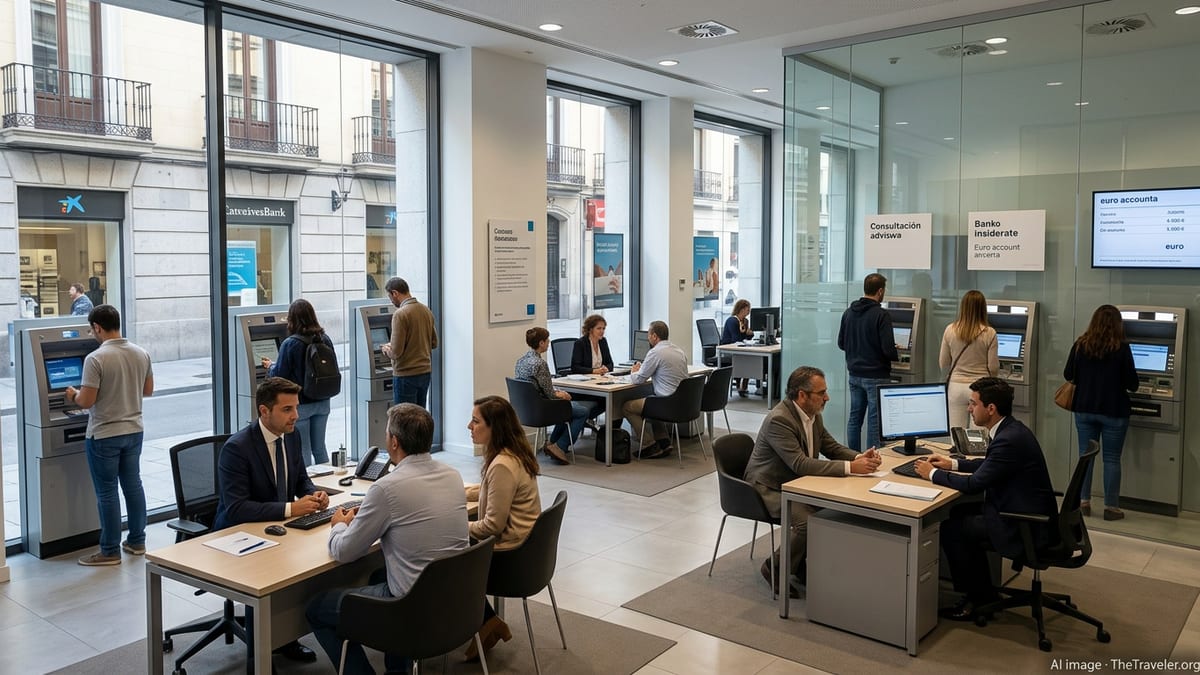
Banking Framework in Spain for Foreign Residents
Spain has a modern, EU‑regulated banking system with strong capital and deposit protection standards. For day‑to‑day life, most foreign residents will need a current account in euros with a Spanish IBAN, a debit card, and digital banking access. Many landlords, employers, and utilities still strongly prefer or effectively require a Spanish IBAN for payments, despite EU rules against IBAN discrimination.
Foreigners encounter two main categories of accounts: non‑resident accounts, designed for people who live abroad or are newly arrived without full local documentation, and resident accounts, intended once an individual is registered in Spain and usually tax‑resident. Non‑resident accounts typically involve slightly higher monthly fees and more documentation checks, while resident accounts often become low‑fee or fee‑free when certain income or activity conditions are met.
Across the market, banks routinely apply know‑your‑customer and anti‑money laundering checks. As a result, foreign residents should expect to provide at minimum a passport, contact details, and information on their source of funds. Many banks will also ask for a foreigner identification number (NIE) and local address once the customer has settled in Spain, transitioning the account from non‑resident to resident status over time.
For relocation planning, the key practical questions are: how easy it is to open an account as a foreigner, how much it will cost in recurring fees, what digital and English‑language support is available, and how convenient the bank will be for everyday payments and international transfers.
Documentation and Eligibility: What Foreigners Typically Need
While specific requirements differ by bank, common patterns have emerged. Large traditional banks generally allow non‑resident account opening, either in person or through specialized international desks. Documentation typically includes a valid passport, a foreign tax identification number or equivalent, and a declaration of non‑residence. Some institutions may ask for proof of address abroad and, after arrival, proof of Spanish address such as a lease or utility bill.
For fully resident accounts, banks increasingly insist on a Spanish foreigner identification number (NIE) and, if applicable, registration as a tax resident once the individual spends more than 183 days per year in Spain. Guidance from legal and financial sector publications indicates that foreign representatives and individuals may open accounts by presenting a passport plus notarized or certified identification when they are not yet resident, but the bank will later require NIE once status changes.
Prospective customers should also be prepared for additional documentation if their situation is considered higher risk, such as politically exposed persons or those with complex cross‑border income. In such cases, banks may request proof of income, employment contracts, or tax returns. In practical terms, however, most employed or retired foreign residents will face straightforward procedures, especially with banks that maintain dedicated expat or international client units.
A practical implication for relocation timing is that it is often easiest to begin with a non‑resident account using a passport and foreign address, then convert to a resident account once NIE and local registration are in place. Several major banks explicitly promote this staged approach in their marketing for international clients.
Major Traditional Banks Most Used by Foreign Residents
Spain’s largest retail banks by market share include Banco Santander, BBVA, CaixaBank, Banco Sabadell, Bankinter, and a handful of regional entities. For foreign residents, the most relevant are those with nationwide branch networks and explicit products for non‑residents or expats. Comparative relocation and expat banking guides in 2025 and early 2026 consistently highlight four institutions: BBVA, Banco Santander, Banco Sabadell, and Bankinter, with CaixaBank also present in many local markets.
BBVA, Spain’s second‑largest bank by assets, offers a widely marketed online current account with no monthly administration or maintenance fees for customers resident in Spain who meet basic conditions. Its ATM network counts several thousand machines nationwide, and its digital banking app is regarded as one of the strongest in the market. External banking reviews aimed at foreigners frequently rank BBVA as a top option for digital banking and no‑fee accounts.
Banco Santander, the country’s largest bank, leverages its global presence to support international clients. For non‑residents, it promotes specialized current accounts that allow euro payments and card usage in Spain while customers remain tax‑resident abroad. Expat‑focused sources regularly note Santander as a strong choice for those who value international brand familiarity and extensive branch coverage rather than the lowest possible fees.
Banco Sabadell has actively positioned itself as an expat‑friendly bank, particularly through its dedicated international client services and tailored non‑resident products. Several relocation and municipal guides point out that Sabadell is often more flexible than peers regarding proof of residency at the initial stage and that many branches in key cities provide English‑speaking staff. Bankinter, while smaller than the big two, is also frequently recommended in expat communities for its relatively good English‑language support and pragmatic attitude toward foreign clients.
Specialized Non‑Resident and Expat Accounts
Among traditional banks, Banco Sabadell’s Key Account is one of the most clearly targeted products for foreigners in Spain. Marketed specifically as “the account for non‑residents,” it is designed for international clients who may live abroad but spend time or have financial ties in Spain. Official product information specifies that non‑residents can open the account using a passport and proof of address in their home country; in some cases, a formal non‑residence certificate may also be required.
The Key Account typically includes a debit card and, subject to approval, a credit card with no issuance or maintenance fee, free or low‑cost SEPA transfers in euros within the European Economic Area up to specified thresholds, and fee‑free cash withdrawals on debit from Sabadell ATMs. The bank advertises additional features aimed at foreigners, such as a limited free translation service for documents up to a set word count and preferred pricing for larger translations. Non‑resident accounts at Sabadell do, however, usually carry a fixed monthly maintenance fee, the exact amount of which should be confirmed at the time of opening as it can be revised periodically.
Banco Santander and other major banks offer comparable non‑resident current accounts, often under branding that emphasizes international or “world” usage. Typical features include euro current account functionality, online banking, and international card acceptance. In exchange for more flexible documentation requirements, these accounts frequently apply monthly fees ranging from roughly 8 to 20 euros, depending on the package and whether the client meets activity conditions such as minimum deposits or direct debits.
For foreign residents planning to stay long term, the strategic approach is often to accept a paid non‑resident package during the initial relocation phase and then transition to a resident, lower‑fee account once NIE, local address registration, and regular income in Spain are established. Banks may not automatically move customers to the lower‑cost tier, so proactive renegotiation after documentation is complete is advisable.
Resident, Low‑Fee and Digital‑First Accounts
Once a foreigner is living in Spain with an NIE and, ideally, a regular local income, more attractive current account options become available. BBVA advertises a fee‑free online account with no administration or maintenance charges, 0 percent nominal interest rate and APR, and a debit card with no issuance or maintenance cost for each account holder. The product documentation highlights free online transfers within the European Economic Area and cash withdrawals on debit at BBVA’s national ATM network without additional bank fees.
These digital resident accounts are specifically oriented toward customers who are already living in Spain, and eligibility normally requires Spanish tax or residence credentials. External comparison sites clarify that BBVA’s flagship fee‑free online account, for example, is available only to new customers who reside in Spain. Similar resident digital accounts exist at CaixaBank, Santander’s digital brand Openbank, and other institutions, often labeled as “no‑fee” or “zero commission” accounts when salaries or recurring payments are routed through them.
In practice, many banks condition their best pricing on either a minimum monthly salary deposit, often in the range of 800 to 1,200 euros, or a combination of income and recurring direct debits for utilities. Some also offer fee exemptions when customers maintain a minimum balance of around 5,000 to 6,000 euros. Relocation‑oriented financial guides in 2025 and 2026 emphasize that these conditions matter, as failure to meet them can trigger significant monthly maintenance charges even on accounts marketed initially as low‑fee.
Digital‑first banks, including Spanish and pan‑European platforms, can be attractive complements for foreign residents who need low‑cost cross‑border payments. Fintech providers are often praised for their multi‑currency accounts, competitive foreign exchange rates, and inexpensive international transfers. However, not all Spanish employers or public bodies accept non‑Spanish IBANs in practice, so a digital euro account alone is rarely sufficient for full integration into local financial routines.
Fees, International Transfers, and Practical Cost Considerations
Fee structures in Spain are varied and can change, but recurring patterns are clear. Traditional banks often charge flat monthly account maintenance fees for non‑resident or no‑salary accounts, which can reach into the high tens of euros per month if conditions are not met. Some expat reports from recent years highlight cases of substantial quarterly charges applied to accounts that lacked regular activity or did not hold qualifying deposits, underscoring the importance of understanding fee triggers upfront.
Most banks provide domestic transfers in euros and SEPA transfers within the European Economic Area at no additional charge when initiated via online banking or mobile apps. This reflects EU payment regulation that requires equal pricing for euro transfers within the SEPA area. However, transfers to non‑EEA destinations or in non‑euro currencies can still incur sizable wire fees and foreign exchange markups when handled through traditional banks.
To control overall relocation banking costs, many foreign residents combine a Spanish current account for salary, rent, and utilities with international transfer specialists for moving money in and out of Spain. Independent financial comparison resources routinely point out that specialized cross‑border payment providers can be significantly cheaper than retail banks for recurring international transfers, especially for non‑euro currencies.
Foreign residents should also evaluate ATM and card usage costs. Large Spanish banks typically allow free cash withdrawals from their own ATM networks, which may consist of several thousand machines, while charging or passing through third‑party ATM fees for withdrawals at other banks’ terminals. Card foreign transaction fees vary and can add several percentage points to international purchases, so residents who travel frequently outside the euro area may wish to pair a domestic current account with a low‑fee multi‑currency card from a fintech provider.
Service Quality, Language Support, and Digital Experience
Beyond fees and technical features, service quality and language support strongly influence how suitable a bank will feel for foreign residents. Large banks such as BBVA, Santander, CaixaBank, Sabadell, and Bankinter provide extensive online banking and mobile applications, generally available in Spanish and often in English. Independent reviews and expat community feedback commonly highlight BBVA’s app as one of the most user‑friendly in the Spanish market.
Branch‑level English proficiency varies by region. In major cities and popular coastal areas with high concentrations of foreign residents, international desks and English‑speaking staff are more common, particularly at Banco Sabadell and some Bankinter and Santander branches. In smaller towns, customers may encounter limited English, and managing banking tasks may depend more heavily on digital channels or assistance from local contacts.
It is important to recognize that service experiences can differ widely, even within the same bank. Online anecdotes show foreign residents reporting both positive and negative encounters with specific branches. For relocation planning, this suggests prioritizing institutions with strong digital platforms that minimize the need for branch visits, while also considering proximity to at least one branch with staff familiar with foreign documentation and common expat needs.
Another practical factor is how efficiently the bank handles transitions from non‑resident to resident status. Some institutions proactively reach out to customers to update documentation once a certain time has passed, while others may only act when the customer initiates the change. Delayed updates can result in continued payment of higher non‑resident fees, so foreign residents should proactively schedule a status review once key documents, such as NIE and residency cards, are obtained.
Comparative Overview of Leading Options for Foreign Residents
The following qualitative comparison summarizes how leading banks often used by foreign residents in Spain tend to position themselves in early 2026. Conditions can vary and should be checked at the time of account opening, but these general patterns provide a planning framework.
| Bank | Strengths for Foreign Residents | Typical Trade‑offs |
| BBVA | Strong digital banking, widely available fee‑free resident online account, extensive ATM network, well‑documented basic payment account for EU residents. | Best pricing usually reserved for residents with Spanish address; non‑resident conditions and fees can be higher. |
| Banco Santander | Largest national footprint, global brand familiarity, tailored non‑resident and international accounts, extensive ATM and branch coverage. | Non‑resident and no‑salary accounts may carry relatively high monthly fees if conditions are not met. |
| Banco Sabadell | Dedicated Key Account for non‑residents, international client services, comparatively strong English support in major locations. | Non‑resident accounts generally involve a fixed monthly maintenance fee; smaller network than Santander and BBVA. |
| Bankinter | Reputation for pragmatic handling of foreign clients, reasonably good English service, competitive digital offering. | Smaller branch network and brand visibility; conditions and offerings can vary more by region. |
| Digital‑only providers | Low or zero account fees, competitive FX for international transfers, fast online onboarding for EU residents. | Non‑Spanish IBANs can be problematic for some employers or authorities; reliance on external ATMs and online support only. |
In practice, many foreign residents adopt a hybrid strategy: a mainstream Spanish bank for core domestic needs and a secondary digital or multi‑currency account to optimize international transfers and travel spending. This approach balances acceptance and regulatory comfort in Spain with cost‑effective cross‑border functionality.
The Takeaway
For foreign residents, the “best” bank in Spain is not a single institution, but rather the one whose fee structure, documentation tolerance, and digital capabilities match their relocation profile. New arrivals without full Spanish documentation may find Banco Sabadell’s Key Account or comparable non‑resident offerings at Santander or other major banks particularly practical, despite moderate monthly fees. Once established with an NIE, Spanish address, and regular income, many residents can reduce or eliminate account fees by migrating to digital‑first resident accounts such as BBVA’s fee‑free online account or similar products at competing banks.
Decision‑grade evaluation should focus on four dimensions: how easily an account can be opened and later converted from non‑resident to resident status; the long‑term monthly cost, including any conditions around salary deposits or balances; the strength of online and mobile banking, ideally with English‑language interfaces; and the bank’s approach to international transfers and card usage abroad. For many foreign residents, the optimal configuration will be a combination of a Spanish bank with robust local acceptance and a specialized provider for cross‑border transfers.
Relocation plans benefit from early financial preparation. Prospective movers should research current account terms shortly before arrival, assemble required documentation such as passport, tax numbers, and proof of address, and allocate time in their first weeks in Spain to visit branches or complete video identification processes. With a suitable bank partnership in place, managing daily expenses, rent, and income in Spain becomes significantly more predictable and efficient.
FAQ
Q1. Can a foreigner open a bank account in Spain without living there yet?
Yes, many banks offer non‑resident accounts that can be opened before or shortly after arrival, typically using a passport and foreign address, although in‑person verification is still common.
Q2. Do I need a Spanish NIE to open a bank account?
For non‑resident accounts, some banks will initially accept only a passport and supporting documents, but for full resident accounts and long‑term use, an NIE is usually required.
Q3. Which banks are generally considered most convenient for foreign residents?
Relocation and expat guides frequently highlight BBVA, Banco Santander, Banco Sabadell, and Bankinter due to their nationwide presence, digital services, and experience with foreign clients.
Q4. How much are typical monthly bank fees for foreigners in Spain?
Non‑resident and no‑salary accounts can charge roughly 8 to 20 euros per month, while resident digital accounts are often fee‑free if salary or certain activity conditions are met.
Q5. Are there truly fee‑free bank accounts for residents in Spain?
Yes, several banks market resident online accounts with zero maintenance fees, but they usually require that you live in Spain and meet conditions such as receiving a salary or maintaining activity.
Q6. Can I rely on an international digital bank instead of a Spanish bank?
Digital banks are useful for low‑cost international transfers and cards, but some Spanish employers, landlords, and public bodies insist on a Spanish IBAN, so a local account is often still necessary.
Q7. Is English widely available in Spanish bank branches?
English support is more common in large cities and expat areas, particularly at banks with international client desks; smaller towns may require more reliance on Spanish or digital channels.
Q8. How easy is it to transfer money in and out of Spain?
Euro transfers within the SEPA area are generally straightforward and often free online, but transfers to non‑euro or non‑EEA destinations can incur higher bank fees and foreign exchange markups.
Q9. Can my non‑resident account be converted to a resident account later?
Yes, many banks allow conversion once you obtain an NIE and meet residency criteria, but you usually need to request the change to benefit from lower resident‑account fees.
Q10. What is the safest strategy to minimize banking costs as a foreign resident?
A common approach is to start with a practical non‑resident account, then switch to a fee‑free resident digital account when eligible and use a specialist provider for international currency transfers.