

More news on this day
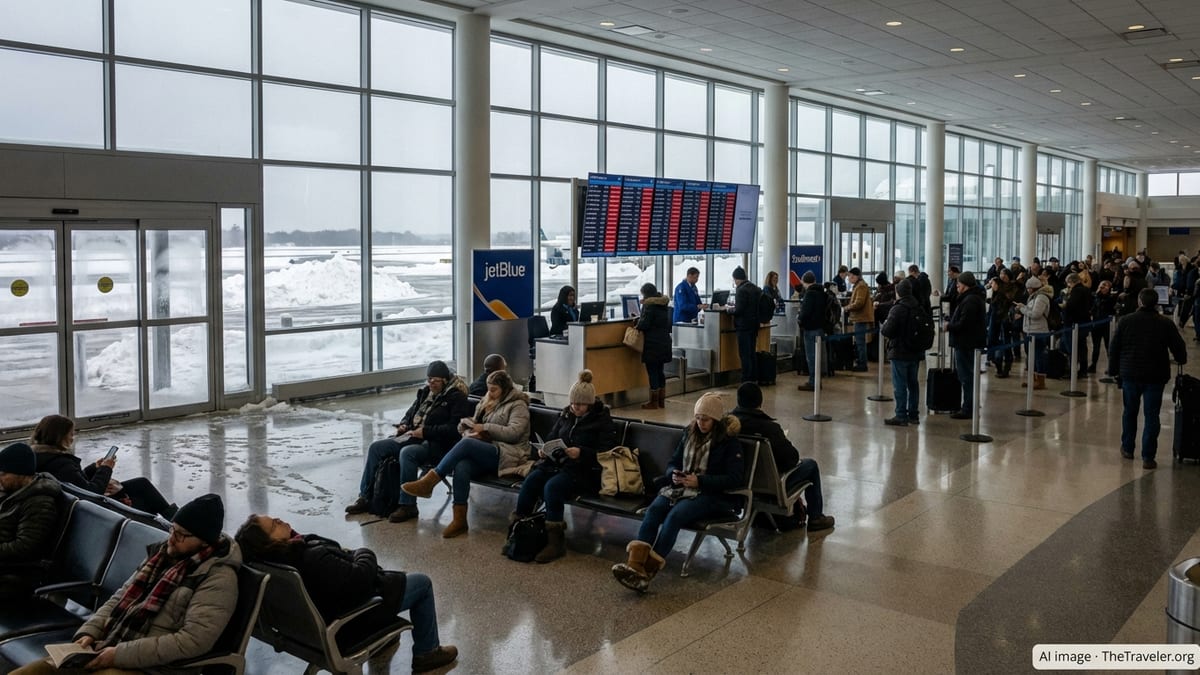
Hundreds of travelers were left sleeping in chairs and queueing at service desks at Bradley International Airport on Tuesday after a wave of 29 flight cancellations and 24 delays by JetBlue, PSA Airlines and Southwest rippled through already fragile post-blizzard operations across the Northeast.
Storm Aftermath Hits Hartford Hard
The disruptions at Bradley International Airport in Windsor Locks, serving the Hartford–Springfield region, came as the Northeast continued to dig out from a powerful blizzard that crippled air travel over the weekend and into Monday. While the airfield remained technically open, snow removal and reduced runway capacity forced airlines to trim schedules and consolidate flights.
Airport officials said roughly a quarter of Tuesday’s schedule had been proactively canceled as carriers continued recovery efforts. For passengers booked on JetBlue, PSA Airlines, and Southwest services linking Hartford with New York and Boston, that translated into sudden gate changes, rolling delay estimates, and last-minute cancellations that left many travelers with few same-day alternatives.
The knock-on effect was particularly acute for regional connections and short-haul routes that rely on tight aircraft and crew rotations. With aircraft and pilots out of position after widespread shutdowns at major Northeast hubs, airlines prioritized core trunk routes and longer-haul services, leaving thinner Hartford links vulnerable to cuts.
Inside the terminal, departure boards flashed red as more flights shifted from delayed to canceled status through the morning. Families returning from school breaks, business travelers trying to reach meetings, and medical passengers bound for specialist appointments in New York and Boston all found themselves caught in an hours-long scramble to rebook.
JetBlue and PSA Struggle to Rebuild Schedules
JetBlue, which maintains a large presence across New York and Boston, entered Tuesday already stretched. The carrier had been among the hardest hit by the blizzard, scrubbing a significant share of its operations at John F. Kennedy, LaGuardia, and Boston Logan airports over the previous two days. That disruption cascaded into secondary markets, including Hartford, where several JetBlue departures and arrivals were canceled outright.
PSA Airlines, a regional operator that feeds mainline networks through connections to larger hubs, also faced operational headwinds. With many of its partner hubs only gradually restoring normal traffic flows, PSA’s regional jets were left out of sequence, forcing the airline to consolidate flights and cancel lightly booked services. For Bradley passengers booked on early-morning and late-evening regional legs, this meant long gaps between remaining flights and limited rerouting options.
Southwest, which had reduced schedules at multiple Northeast airports during the height of the storm, focused Tuesday on restoring reliability across its broader network. While the airline operated many of its planned Bradley services, it also cut several rotations and padded turn times to give crews more breathing room. These adjustments, designed to stabilize the system, contributed to the cluster of cancellations and delays affecting Hartford travelers.
Airline representatives on the ground and via call centers spent much of the day waiving change fees, rebooking passengers onto later flights, and in some cases arranging overnight accommodation or travel credits. However, with alternative flights often departing from fully booked New York and Boston airports, many customers found themselves facing waits of 24 hours or more.
New York and Boston Gridlock Spills Into Connecticut
The problems at Bradley could not be separated from the near-standstill conditions at the region’s largest hubs. New York’s three main airports had already canceled most departures on Monday, while Boston Logan saw the vast majority of its flights scrubbed or heavily delayed as blizzard conditions intensified. Even as plows cleared runways and taxiways on Tuesday, crews and aircraft remained badly out of position.
For Hartford-area passengers, this meant that traditional backup plans were often unavailable. Normally, travelers facing a cancellation at Bradley might drive to New York or Boston in hopes of catching an alternate flight. On Tuesday, however, many of those flights were full, still grounded, or operating on reduced schedules as carriers carefully ramped up operations.
The blizzard also disrupted rail and road corridors that typically serve as safety valves when air travel falters. Portions of the busy New York–Boston rail line had faced earlier suspensions, and lingering snow, ice, and high winds continued to complicate long-distance bus and highway travel. As a result, travelers attempting to shift from air to ground transport ran into limited seat availability and long journey times.
Travel experts noted that the storm’s impact underscored just how tightly coupled the Northeast’s transportation networks have become. A shutdown at major hubs in New York and Boston rapidly cascades into airports like Bradley, where schedules are closely synchronized with larger national and international networks.
Passengers Face Tough Choices and Thin Information
On the concourses at Bradley, the human cost of those cascading disruptions was evident. Long lines formed at airline customer-service counters, where frustrated travelers clutched paper itineraries and stared at phone screens showing conflicting status updates. Families with small children camped out near power outlets, while solo travelers tried to work from laptops balanced on their luggage.
Several passengers reported difficulty getting clear, consistent information about their options as airlines continually updated departure times in response to changing conditions at other airports. Estimated departure times were sometimes pushed back in 30-minute increments before flights were ultimately canceled, prolonging uncertainty and making it harder for travelers to decide whether to remain at the airport or seek a hotel.
Some passengers arriving from unaffected regions encountered a different problem: landing in Hartford only to discover that their onward connections to New York or Boston had been canceled. With hotels near the airport quickly filling up and rental car lots thinned by earlier demand, these travelers weighed whether to extend their stay in Connecticut or attempt slow, snowy drives toward their intended destinations.
Airport staff and airline agents urged patience, emphasizing that safety and operational stability had to come before schedule recovery. Still, for travelers facing missed family events, delayed medical treatments, or lost work days, the message offered limited comfort.
What Travelers Can Expect Next
With the worst of the snowfall now past, aviation analysts expect a gradual normalization of operations across the Northeast over the next 24 to 48 hours. Airlines typically need multiple schedule cycles to fully reset after a systemwide disruption of this scale, particularly when both aircraft and crews are out of position in multiple cities.
At Bradley International, officials signaled cautious optimism that the volume of cancellations would decline as Tuesday wore on and into Wednesday, though they warned that scattered disruptions are likely to persist. Travelers booked on JetBlue, PSA Airlines, and Southwest flights in and out of Hartford, New York, and Boston over the coming days were advised to monitor their flight status frequently and to make use of mobile apps and text alerts for the most up-to-date information.
Travel planners recommended that passengers build extra buffer time into their itineraries, avoid tight connections through major Northeast hubs where possible, and consider flexible fares that allow easier rebooking when storms threaten. For those whose trips are time-sensitive, rethinking routing through less affected hubs away from the storm’s core can sometimes improve the chances of an on-time arrival, even if it means a longer flight path.
For now, rows of cots, clusters of wheelie bags, and the constant chime of gate announcements at Bradley International are a reminder that for many travelers in the Hartford region, the blizzard’s impact did not end when the snow stopped falling.