

More news on this day
A historic winter storm sweeping across the northeastern United States has triggered widespread flight cancellations between Brazil and major American hubs, with United Airlines, LATAM, American Airlines, Delta, GOL, Azul and other carriers scrapping more than a dozen services and disrupting journeys to New York, Newark, Brasília, São Paulo, Rio de Janeiro and other key destinations.
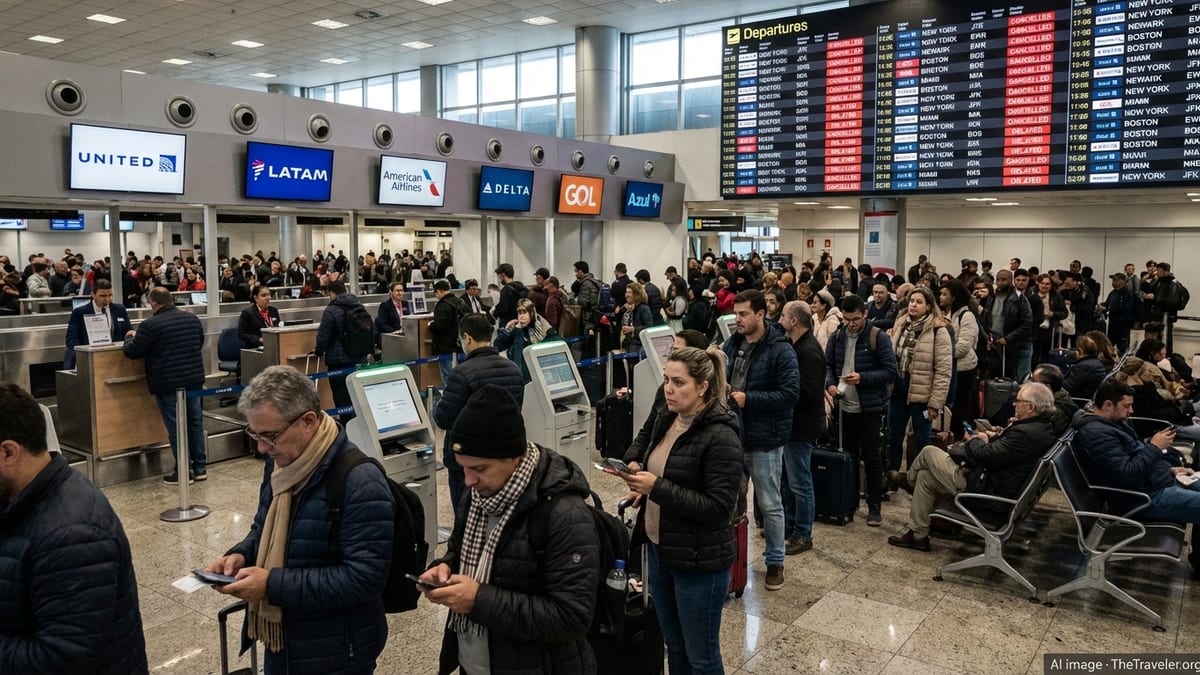
Blizzard in the US Northeast Ripples Across Brazil–US Routes
The latest wave of disruptions is directly linked to a powerful blizzard affecting the US Northeast, where authorities have issued extensive weather warnings and travel bans across states including New York and New Jersey. As operations slow or halt at major airports such as New York’s John F. Kennedy and Newark Liberty, the impact is being felt thousands of kilometers away in Brazil’s busiest international gateways.
On Sunday, February 22, and Monday, February 23, at least a dozen Brazil–US flights were cancelled as the storm intensified, according to airport and airline data. Services linking São Paulo and Rio de Janeiro with New York and Boston were among the hardest hit, compounding an already challenging peak travel period for both business and leisure passengers moving between the two countries.
At São Paulo–Guarulhos International Airport, Brazil’s largest hub, multiple departures and arrivals to New York and Boston were removed from the boards over the two-day period. Rio de Janeiro’s Galeão International Airport also saw outbound and inbound flights to New York suspended, leaving travelers scrambling to find alternative connections or last-minute accommodation.
Major Carriers Cancel Key Services to New York and Newark
Flag carriers and large network airlines, including United Airlines, LATAM, American Airlines and Delta Air Lines, have all been forced to adjust operations on Brazil–US routes. United, which connects Brazilian hubs to Newark Liberty International Airport, has cancelled select services as conditions at its New Jersey hub deteriorate in heavy snow and strong winds. American and Delta have likewise reduced their Brazil flying to New York area airports as part of broader schedule cuts across the Northeast.
Brazilian operators GOL and Azul, which feed long haul and codeshare networks, are also experiencing knock-on effects. Their domestic services into São Paulo, Rio de Janeiro and Brasília are being reshuffled to reflect international cancellations, often resulting in aircraft and crew out of position for subsequent rotations. This has led to a mix of outright cancellations and significant delays on internal routes, even where weather locally in Brazil remains stable.
While the majority of cancelled flights are focused on New York, Newark and Boston, disruption is radiating across the wider transcontinental network. Some passengers bound for US destinations such as Miami and Houston are being rebooked via alternative gateways or placed on later services, as airlines try to consolidate demand onto the reduced number of flights able to operate safely.
Passengers Stranded at Brazilian Hubs Amid Rolling Disruptions
At terminals in São Paulo and Rio de Janeiro, scenes of crowded check in halls and long customer service queues have become familiar over the past 48 hours. Many travelers only learned of cancellations after arriving at the airport, expecting routine overnight flights to North American cities, only to find departure boards filling with red status alerts.
Families returning from holidays, students traveling to universities in the United States and corporate travelers heading to meetings in New York and Newark have all been affected. Some have been offered hotel vouchers and meal assistance, while others report spending the night in terminal seating as they wait for available seats on later flights. The sudden nature of the storm related changes has left limited spare capacity, especially on high demand routes linking São Paulo and Rio de Janeiro with the US East Coast.
Beyond international sectors, domestic travelers within Brazil are also experiencing a cascade of operational challenges. Adjustments to long haul schedules mean aircraft and crews that would normally rotate onto internal flights between cities such as Brasília, São Paulo, Rio de Janeiro, Salvador and Porto Alegre are no longer available, resulting in further cancellations and delays even far from the storm zone.
Airlines Offer Flexibility but Warn of Ongoing Impact
In response to the unfolding situation, United, American, Delta and LATAM have activated flexible travel policies for affected passengers, allowing date changes without change fees on certain tickets and travel dates. Many customers are being encouraged to rebook onto flights later in the week, when conditions in the northeastern United States are expected to gradually improve and airport operations can begin to normalize.
Brazilian carriers GOL and Azul are coordinating closely with their international partners and advising travelers to monitor flight status through official channels and apps before heading to the airport. With aircraft movements constrained at key US hubs, airlines caution that schedules will likely remain fluid, and further last minute adjustments are possible as ground conditions, de icing capacity and air traffic control restrictions evolve.
Despite these measures, capacity on core Brazil–US city pairs remains tight. Many services that are still operating are departing close to full, limiting rebooking options in the short term. Travelers with non essential plans are being urged, where possible, to postpone trips until the backlog of stranded passengers has cleared.
What Travelers Between Brazil and the US Should Expect Next
Industry observers note that even as the storm system moves away from the Northeast, the operational hangover could persist for several days. Aircraft displaced by multiple cycles of cancellations must be repositioned, crews will require rest in line with safety regulations, and airports will need time to clear accumulated snow and ice from runways, taxiways and stands before returning to normal throughput.
In Brazil, airports in São Paulo, Rio de Janeiro and Brasília are preparing for a renewed surge in passenger volumes once flights begin to ramp back up. Airlines are expected to prioritize stranded passengers on the earliest available departures, meaning those with fresh bookings may find limited availability or higher fares in the near term on transcontinental services to New York, Newark and other key US gateways.
For now, travelers are being advised to build additional buffer time into their itineraries, particularly if connecting through hubs on either side of the route. With weather related disruptions increasingly affecting long haul networks, today’s storm driven cancellations between Brazil and the United States serve as a reminder of just how quickly global travel plans can be upended when conditions deteriorate in one critical aviation corridor.