


More news on this day
British Airways is drawing on fuel hedging, strategic reserves and aggressive route reshaping in the Middle East as it works to protect a busy summer 2026 schedule from record jet fuel costs and deepening regional tensions.
Get the latest news straight to your inbox!
Record Fuel Costs Meet Geopolitical Shock
The aviation group behind British Airways is confronting one of its most challenging operating environments since the pandemic, with jet fuel costs pushed sharply higher by the 2026 Strait of Hormuz crisis and wider conflict across the region. Publicly available information on the crisis indicates that tanker traffic through the chokepoint has been repeatedly disrupted since early March, driving up global oil and aviation fuel prices.
Recent financial disclosures from International Airlines Group, the parent of British Airways, show that the company expects billions of euros in additional fuel expense in 2026 compared with earlier internal planning. Spanish financial coverage of IAG’s latest outlook indicates that the group has lifted its annual fuel budget by close to 30 percent as the cost of jet fuel and associated emission charges rises.
Despite this surge, IAG has emphasized the cushion provided by its fuel hedging program. Company results presentations for 2024 and early 2025 show that around two thirds to 70 percent of expected fuel needs are typically locked in at fixed prices over a rolling horizon, helping to soften sudden price spikes. That framework is now being tested by the Middle East turmoil and the knock-on effects in global energy markets.
Analysts following the group note that a strong balance sheet, robust post‑pandemic demand and disciplined capacity growth are allowing British Airways to absorb part of the shock while continuing to invest in fleet renewal and cabin upgrades that improve fuel efficiency per seat.
Strategic Fuel Reserves and Hedging Under Strain
British Airways is not a crude oil producer, but through IAG it operates what industry observers describe as a layered fuel risk strategy that combines financial hedging, physical supply diversification and efficiency measures. Annual reports and investor presentations outline how the group staggers forward purchases of jet fuel and related derivatives across multiple maturities, effectively building a financial “reserve” against price surges.
The latest reporting on IAG’s 2025 fuel position suggests that roughly 70 percent of its anticipated fuel consumption for the year has already been secured at predetermined prices, limiting the immediate impact of the 2026 spike. This does not completely insulate British Airways from current record levels, but it slows the pass‑through to ticket prices and helps preserve schedule stability going into the peak summer season.
Operationally, British Airways is also leaning on a more fuel‑efficient long‑haul fleet. Deliveries of Airbus A350s and Boeing 787s in recent years have allowed the airline to retire older four‑engine aircraft, cutting fuel burn on key intercontinental routes. Group disclosures indicate that IAG’s ongoing fleet renewal program is central to its response to more volatile fuel markets, reducing exposure per available seat kilometer.
Industry analysts point out that the airline is simultaneously managing regulatory and reputational pressure to decarbonize. IAG has committed to increasing the share of sustainable aviation fuel in its mix this decade, and planning documents assume higher per‑tonne prices for those fuels. Balancing that long‑term transition with the short‑term reality of war‑driven fuel inflation is emerging as one of British Airways’ most complex strategic tasks.
Middle East Route Cuts, Detours and a Patchwork Network
The same regional tensions that have upended fuel markets have also forced British Airways to redraw its Middle East map. Travel industry reports over the past two months describe a rolling series of suspensions and reductions affecting flights from London to Israel and the Gulf as airspace corridors over Iran, Iraq and parts of Syria have closed or become operationally constrained.
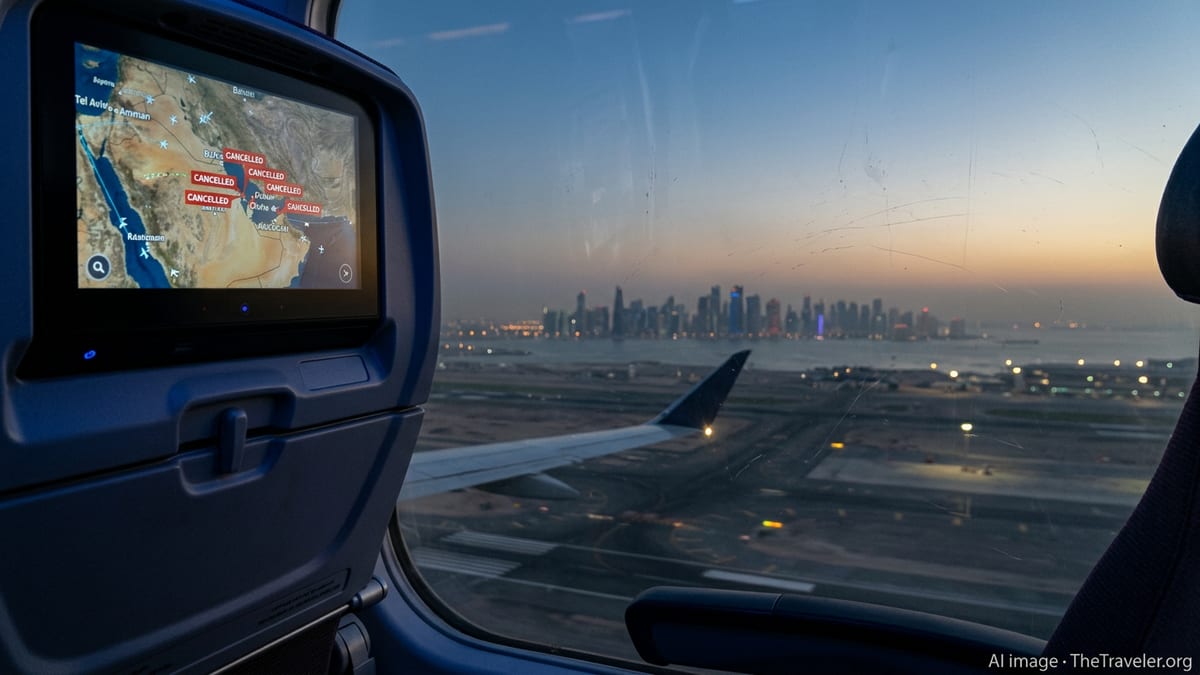
Coverage from specialist aviation outlets and mainstream travel media indicates that British Airways has suspended all services to Tel Aviv, Dubai, Doha, Bahrain and Amman through at least late May 2026, with some routes, such as Abu Dhabi, paused until further notice. Earlier reports show that Tel Aviv flights had already been halted for extended periods during previous phases of the Israel‑Hamas conflict, creating a precedent for long suspensions when risk assessments dictate.
Where flying is still possible, airlines across Europe have been diverting around conflict zones, lengthening flight times and increasing fuel and crew costs. Mapping and flight tracking analysis published since 2024 shows carriers routing via the Eastern Mediterranean, Saudi Arabia and Egypt instead of traditional corridors over Iran and Iraq. British Airways has been part of that broader industry shift when operating flights that would normally cross higher‑risk airspace.
According to recent travel advisory coverage, some affected British Airways passengers have been rebooked on partner carriers via alternative hubs such as Doha and Istanbul, while others have been offered refunds or travel vouchers. This patchwork approach reflects the evolving nature of airspace restrictions and the airline’s attempt to preserve connectivity for as many long‑haul itineraries as possible without compromising safety.
Protecting the Core Summer Schedule
While its Middle East network remains heavily disrupted, British Airways is working to shield its core transatlantic and short‑haul European operation from the regional crisis in order to preserve a largely seamless summer for most customers. Heathrow planning documents and IAG’s operational updates for 2024 and 2025 highlight a sustained focus on on‑time performance and resilience, including changes to ground handling, crew planning and airport processes.
Internal performance data referenced in public presentations show that British Airways significantly improved punctuality after implementing a new operating model at Heathrow in 2024, adding buffers to schedules and simplifying some aircraft rotations. Those changes were designed in part to make the airline more resistant to external shocks such as air traffic control disruptions or sudden airspace closures.
Industry observers say that capacity that would have been deployed on Middle East routes has been redirected into more resilient markets for summer 2026, such as North America, the Caribbean and parts of Asia and Africa where airspace remains stable. Recent schedule filings suggest incremental growth on key leisure routes to the United States and Mediterranean Europe, helping to accommodate high summer demand from UK holidaymakers.
At the same time, British Airways has publicly reiterated its priority of customer communication. Travel press reports note that the airline has been issuing rolling updates about Middle East cancellations and reroutings and advising affected passengers of their options under UK and European consumer protection rules. That approach is intended to limit last‑minute disruption while acknowledging that further changes are possible if the regional security situation deteriorates.
Balancing Costs, Capacity and Customer Expectations
The combination of record fuel prices and a fractured Middle East network is forcing British Airways and its parent group to make difficult trade‑offs between profitability and schedule continuity. Financial commentary on IAG’s latest results suggests that the group aims to recover a significant portion of the higher fuel bill through a mix of fare adjustments, ancillary revenue and careful capacity management, while absorbing part of the impact through efficiency gains.
For travelers, that can translate into higher average ticket prices on some long‑haul routes and reduced choice of nonstop options to certain destinations in the Gulf and Levant. However, strong demand for leisure and visiting‑friends‑and‑relatives travel from the UK and Europe is giving the airline some room to maintain load factors even as it prunes its network in sensitive areas.
Observers note that the situation remains fluid heading into the peak summer months. If airspace restrictions ease and energy markets stabilize, British Airways could gradually rebuild its Middle East services and dial back some of the most expensive fuel hedges. If tensions worsen or the Strait of Hormuz crisis deepens, further detours and suspensions may be necessary, and the pressure on fuel budgets will intensify.
For now, the carrier is leaning on its hedging strategy, fleet investments and revamped Heathrow operation to keep the bulk of its summer 2026 schedule running close to normal, even as one of the world’s most strategically important aviation corridors remains in turmoil.