

More news on this day
Flights at Baltimore/Washington International Thurgood Marshall Airport and four other Mid-Atlantic airports were briefly halted Friday evening after a strong chemical odor at a regional air-traffic facility triggered a temporary ground stop, compounding an already difficult March for Washington-area air travel.
Get the latest news straight to your inbox!
Chemical Smell at Potomac TRACON Leads to Halted Arrivals
According to published coverage, the Federal Aviation Administration temporarily stopped traffic into Baltimore/Washington International (BWI), Ronald Reagan Washington National (DCA), Washington Dulles International (IAD), Charlottesville-Albemarle (CHO) and Richmond International (RIC) on Friday, March 27, after personnel reported a strong chemical smell at the Potomac TRACON facility in Warrenton, Virginia. The center manages approach and departure traffic for the busy Washington-Baltimore airspace, meaning an interruption there has immediate ripple effects across the region.
Reports indicate controllers were moved out of parts of the building while the odor was investigated, prompting the FAA to impose a regional ground stop affecting flights headed to the five airports. Departures already in the air were diverted or placed into holding, while aircraft on the ground waited at gates and on taxiways until operations slowly resumed.
By later in the evening, publicly available information showed that the ground stop had been lifted and traffic flows were gradually recovering. Nonetheless, delays of up to several hours persisted across the system as airlines worked to reposition aircraft and crews disrupted by the sudden pause in arrivals.
Second Incident This Month Heightens Traveler Frustration
Friday’s disruption is the second time in March that Washington-area airports have faced a regional halt connected to conditions at Potomac TRACON. Earlier in the month, a similar chemical odor led to a roughly hour-long ground stop impacting BWI, DCA and IAD, with some flights diverted to airports as far away as Dallas and Pittsburgh. Social media posts from affected travelers on that day described multi-hour delays and diversions that stretched already long travel days.
The recurrence within weeks is likely to raise renewed questions about the resilience of critical air-traffic infrastructure serving the nation’s capital region. While investigations into the source of the odor continue, early indications from previous incidents pointed to issues with facility equipment rather than an external environmental event. Aviation observers note that even short operational pauses at terminal radar approach facilities can translate into cascading delays when they occur at high-demand hubs.
For passengers, the distinction between technical root causes matters less than the practical outcome. Many travelers at BWI and the other affected airports reported missed connections, extended tarmac waits and late-night arrivals, underscoring how tightly scheduled airline networks are vulnerable to even localized disruptions.
Impact on BWI Passengers and Terminal Operations
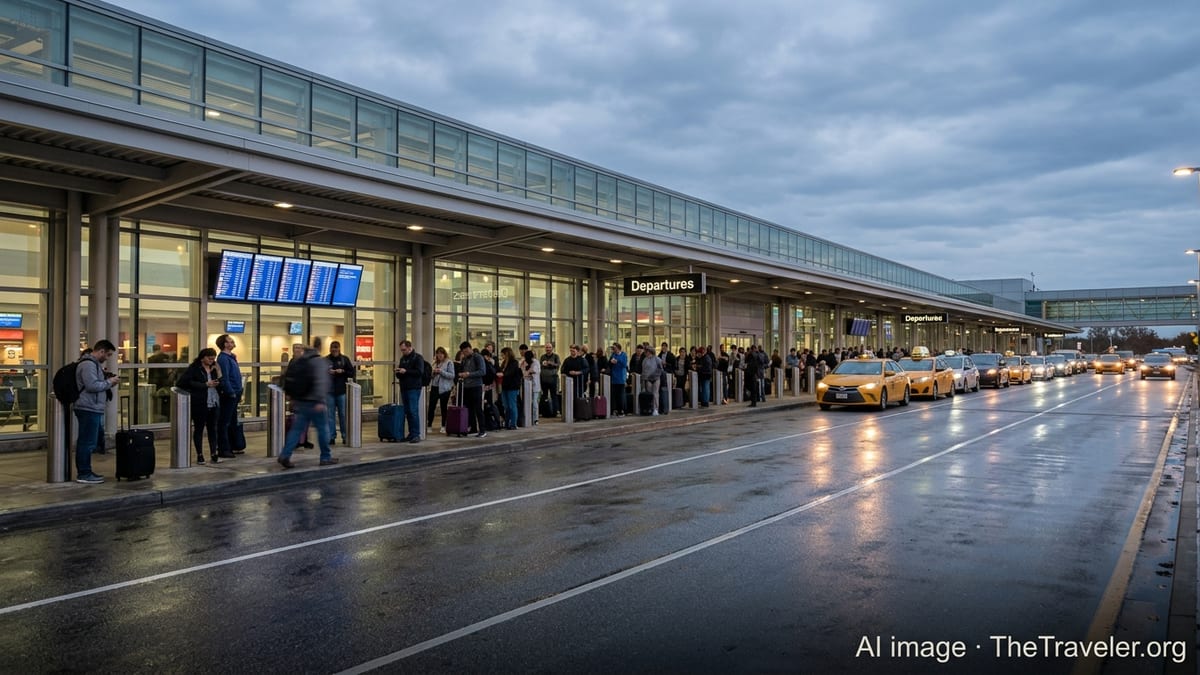
At BWI, the ground stop came on top of an already challenging evening in the terminal. Separate reports from airport-focused discussion forums on Friday highlighted lengthy security lines, with some travelers describing waits exceeding an hour as certain checkpoints temporarily closed. Airport messaging earlier in the evening warned of long screening times and urged passengers to arrive well ahead of departure.
Once the ground stop took effect, travelers who had finally cleared security faced additional uncertainty at the gates. Publicly available flight-tracking data showed a pattern of rolling departure delays, as airlines held aircraft until arrival rates into the Washington-area airspace were increased. Some departures left out of sequence while others were re-timed to accommodate crew duty limits and aircraft repositioning.
Although BWI indicated through its public channels that the FAA ground stop had been lifted by late evening, the airport also cautioned that residual disruptions would likely continue into the night. For some travelers on the last wave of departures, that meant overnight arrivals at their destinations or, in some cases, unscheduled hotel stays and rebooking for Saturday flights.
Regional Ripple Effects Across the Mid-Atlantic
The ground stop’s reach extended beyond the Washington-Baltimore core. Airlines serving smaller Mid-Atlantic and Northeast markets reported knock-on impacts as aircraft scheduled to pass through BWI, DCA or IAD later in the evening were delayed upstream. New York City emergency management officials earlier this month had highlighted how similar regional ground stops can trigger holds and cancellations far from the original disruption, and Friday’s episode followed a comparable pattern.
Travelers connecting through the region experienced a mix of gate holds and diversions, with some flights pausing at intermediate cities to wait for updated arrival slots. Carriers adjusted by consolidating lightly booked late-night services, reassigning aircraft, or waiving change fees for passengers willing to shift to flights on Saturday.
For airport operators, events of this kind add pressure to staffing, concessions and ground transportation systems. Extended operating hours for retail outlets, increased demand for airport hotels and surges in late-night ride-hailing and taxi traffic are common side effects when schedules slide deep into the overnight period.
What Travelers Should Expect in the Coming Days
Published coverage suggests that air-traffic operations at Potomac TRACON were moving back toward normal by early Saturday, with no long-term restrictions yet announced. However, analysts note that airlines may spend part of the weekend working through residual aircraft and crew imbalances, so travelers flying to or from BWI, DCA, IAD, CHO and RIC may still encounter scattered delays.
Airline advisories typically encourage passengers traveling within 24 hours of such disruptions to monitor flight status frequently and allow extra time at the airport, especially during morning and evening peaks when rebooked travelers are added to existing loads. Flexible same-day travel policies, when offered, can help passengers shift to less congested time slots.
The latest incident underscores how a localized technical or environmental issue at a single air-traffic facility can have regionwide implications, particularly in a corridor that already handles dense schedules and complex routings. For Washington-area travelers, the March disruptions serve as a reminder that keeping close watch on weather, infrastructure updates and real-time flight information is increasingly essential to navigating peak travel periods.