

More news on this day
Hundreds of travelers across Canada, from the country’s busiest hubs to small Arctic communities, are facing another difficult travel day as more than 20 flights are canceled and nearly 300 more are newly delayed on March 28, affecting services operated by Air Canada, Air Inuit, Jazz, Endeavor and other carriers.
Get the latest news straight to your inbox!
Ripple Effects at Major Canadian Hubs
Publicly available airline and flight-tracking data for March 28 show fresh disruption building across Canada’s largest airports, with Toronto Pearson, Vancouver International and Montreal-Trudeau again ranking among the country’s most affected hubs for delays. While total numbers fluctuate throughout the day, combined figures indicate at least 21 cancellations touching Canadian-bound or Canadian-operated services and roughly 280 additional flights newly delayed by mid- to late-morning local time.
Air Canada and its regional partners, including Jazz-operated Air Canada Express flights, appear prominently in the lists of affected services, reflecting the dominant role the carrier plays in domestic and transborder traffic. U.S. regional operator Endeavor Air, which flies under a major U.S. legacy airline brand, is also visible in delay statistics for cross-border routes that link Canadian hubs with northeastern U.S. airports.
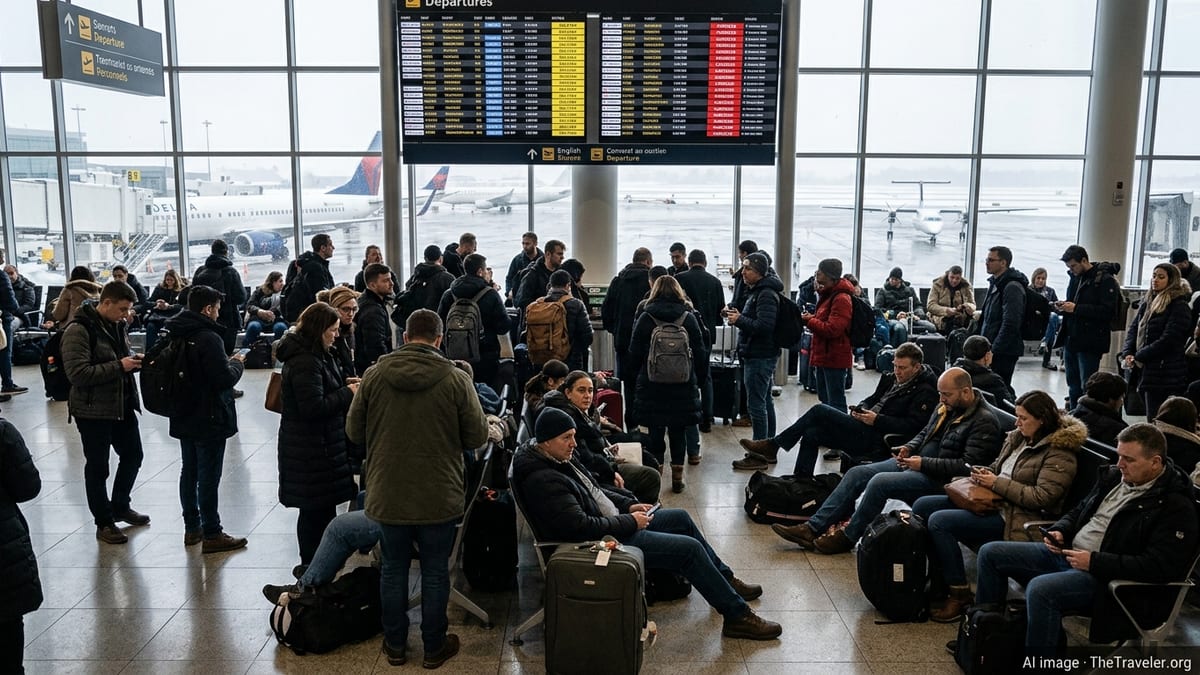
The impact for travelers is tangible inside terminals. Long queues at check-in desks and rebooking counters, combined with crowded gate areas, are being reported in social media posts from passengers passing through Toronto, Vancouver and Montreal. Many travelers are documenting missed connections, overnight airport stays and short-notice schedule changes as they try to piece together onward itineraries.
Operationally, the knock-on effect from earlier weather-related disruptions in March continues to strain airline networks. A series of winter storms and strong wind events this season has repeatedly forced carriers to trim schedules, and current flight-status data suggests that crews and aircraft are still in the process of being repositioned across the country.
Remote Arctic Communities Hit by Schedule Disruptions
The latest wave of delays is not limited to Canada’s major population centers. In Nunavik and other northern regions, travelers in remote communities such as Quaqtaq and Kangirsuk are also facing interruptions. These villages, served primarily by regional operator Air Inuit and other northern carriers, depend heavily on reliable air links for medical travel, education, work rotations and essential supplies.
According to published schedules, Air Inuit normally connects Quaqtaq and Kangirsuk with larger regional hubs several days per week, using turboprop aircraft suited to short, gravel airstrips. On days when visibility, wind or mechanical constraints force cancellations, there are often few immediate alternatives. The current pattern of intermittent disruptions means some residents are experiencing extended waits to leave their communities or return home.
Reports from regional aviation observers note that a single canceled rotation in the eastern Arctic can cascade quickly, affecting mail deliveries, cargo shipments and the movement of healthcare professionals. For travelers already en route, a missed connection at a regional hub can translate into an unplanned overnight stay and a multi-day delay in reaching their final destination.
Community leaders and local organizations in northern Quebec and Nunavut have long stressed how fragile these air corridors can be, particularly in late winter and early spring when weather can change rapidly. The latest cancellations and delays underscore how disruptions that barely register at a large southern airport can have an outsized impact in remote communities.
Weather and Safety Constraints Continue to Drive Irregular Operations
Weather remains a key factor behind many of the cancellations and delays affecting Canada-linked flights this month. National and regional meteorological bulletins for late March highlight episodes of low cloud, freezing temperatures, gusty winds and localized snow in parts of Quebec, Atlantic Canada and the Arctic, conditions that can easily push flights outside the limits required for safe takeoff and landing.
Airlines and airport operators are also contending with lingering operational consequences from significant winter storms earlier in the year, which led to some of the highest cancellation totals in recent seasons. Even after runways and taxiways are cleared, airlines must deal with displaced aircraft, crew duty-time limits and backlogged maintenance checks, all of which can lead to schedule adjustments days or weeks later.
For Canadian carriers such as Air Canada and regionals like Jazz and Air Inuit, the balance between maintaining schedules and preserving safety margins is especially delicate on routes with tight turnarounds or limited alternate airports. In the Arctic, in particular, sudden drops in visibility or crosswinds that exceed aircraft limits can quickly force flight crews to delay departure or divert to another community.
Publicly available guidance from Canadian and international aviation regulators emphasizes that flight delays and cancellations tied to weather or safety concerns are treated differently from those caused by controllable factors such as crew or maintenance planning. For passengers, this distinction often shapes what kind of compensation or assistance may be available, but it also underlines that safety remains the overriding consideration behind many last-minute changes.
Passengers Navigate Rebooking, Rights and Workarounds
As disruption builds through the day, many travelers are turning to mobile apps, airline websites and third-party trackers to monitor gate changes and rolling delays. Travel forums and social media posts on March 28 suggest that some passengers on affected Air Canada, Jazz and Endeavor services are managing to rebook onto later flights or alternate routings, while others report long waits for customer support queues to move.
Consumer advocates in Canada frequently encourage passengers to familiarize themselves with the Air Passenger Protection Regulations, which outline minimum standards of treatment and, in some cases, compensation when flights are delayed or canceled. Under those rules, the assistance owed to travelers depends on whether a disruption is within an airline’s control, within its control but required for safety, or completely outside its control, such as severe weather or air traffic restrictions.
Public information from government agencies and legal analysts notes that travelers can often expect meals, hotel accommodations and rebooking support when delays stretch into many hours, particularly for larger carriers. However, the framework is complex, and real-life experiences documented online suggest that outcomes vary widely between airlines and even between individual cases on the same day.
Many seasoned travelers recommend building additional buffer time into itineraries that rely on tight connections, especially during late-winter months when Canadian weather is at its most volatile. Some also suggest considering travel insurance or flexible tickets on critical journeys, pointing to repeated episodes this season in which multi-hour delays have rippled across networks for days at a time.
Outlook for the Remainder of the Weekend
Forecasts for the final days of March point to a mixed picture. While no single nationwide storm is currently dominating the weather map, localized bands of snow, freezing drizzle and gusty winds in parts of Quebec, Ontario and the eastern Arctic continue to threaten flight schedules. Flight-status boards for major Canadian airports on March 28 indicate that additional delays and scattered cancellations are likely into the evening.
For travelers in remote communities like Quaqtaq and Kangirsuk, the situation may remain fluid, with operators such as Air Inuit adjusting departures to narrow windows of acceptable conditions. Historically, such regions can see rapid improvements and deteriorations within hours, meaning a canceled morning departure might be followed by a cleared afternoon flight or, in more challenging scenarios, another day of waiting.
In Canada’s southern hubs, the immediate focus for airlines including Air Canada and its partners will be clearing backlogs, reuniting travelers with their luggage and returning aircraft and crews to their intended positions in the network. Operational updates published throughout the day will determine whether the system can absorb the latest wave of delays without triggering a broader reset of schedules into the new week.
With spring travel demand beginning to build and winter weather still lingering, March 28 is shaping up as another reminder of how vulnerable tightly timed air networks remain to even modest disturbances. For hundreds of passengers scattered between Vancouver, Toronto, Montreal and far-north communities, the priority for now is simply getting out of isolation and back on the move.