

The Canadian Museum for Human Rights in Winnipeg is not a typical museum. Part architectural landmark, part national conscience, it invites visitors to reflect on how struggles for dignity and justice have shaped Canada and the wider world. Planning a visit here means preparing for more than a few hours of sightseeing. It is an experience that can be moving, challenging and surprisingly hopeful, especially if you know what to look for and how to navigate its many stories.
Understanding the Vision Behind the Museum
The Canadian Museum for Human Rights is the first national museum in Canada to be built outside the capital region, a deliberate choice that signals its role as a meeting place rather than a monument. Opened in 2014 at The Forks in downtown Winnipeg, where the Red and Assiniboine rivers meet, it was conceived as a space to explore past abuses, present challenges and future possibilities for human rights. The focus is rooted in Canadian experiences but always connected to global struggles, from genocide to gender equality.
Unlike traditional museums that concentrate on objects, this institution is driven by stories, testimonies and ideas. Many of the exhibits centre on individual voices, survivor accounts, legal milestones and grassroots movements rather than large collections of artifacts. The result is a museum that feels contemporary and evolving, with digital media, interactive displays and temporary exhibitions that are regularly updated to reflect current human rights debates.
The museum’s mandate is educational rather than commemorative. It aims to encourage visitors to ask difficult questions, to recognize that rights have often been contested and won at great cost, and to consider their own responsibilities in upholding dignity for others. This emphasis on critical reflection can make a visit emotionally demanding, but it also offers opportunities for hope by highlighting change-makers and concrete progress.
For travelers, the museum offers a way to understand Canada beyond its landscapes and cities. It opens a window onto some of the hardest chapters of the country’s past, including colonization and residential schools, while also showcasing legal protections, social movements and ongoing reconciliation efforts. A visit here can enrich any trip to Winnipeg, particularly for those interested in culture, history and contemporary politics.
Architecture and First Impressions
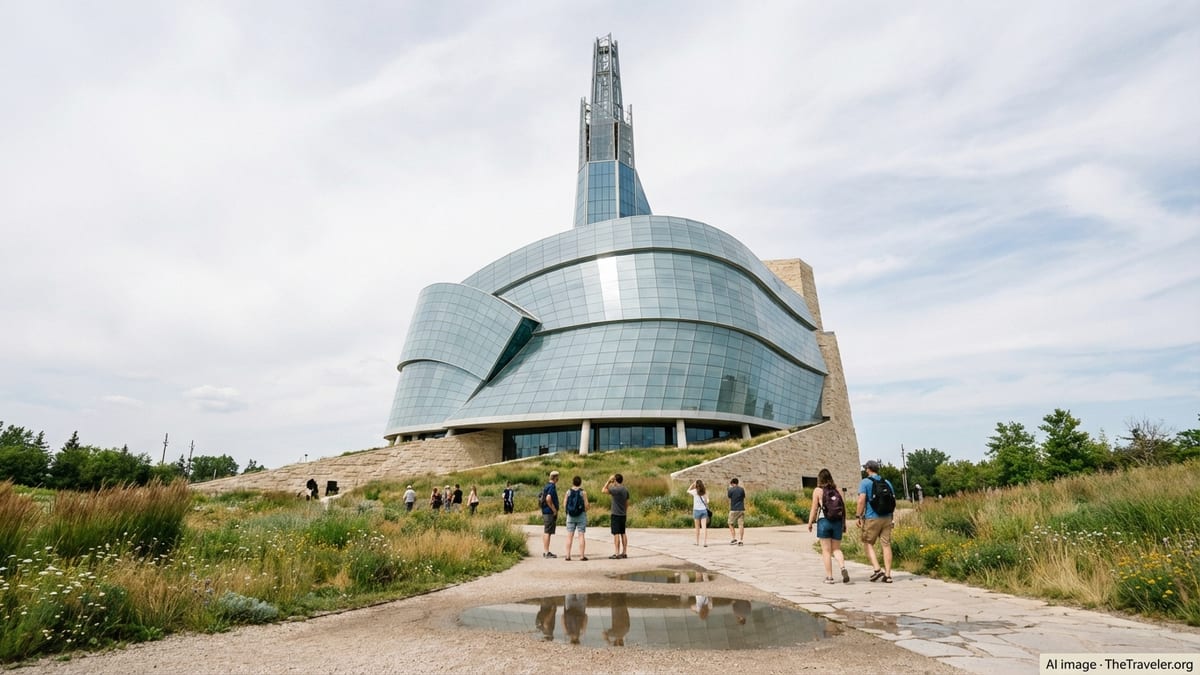
The building of the Canadian Museum for Human Rights is itself part of the experience. Designed by architect Antoine Predock, it rises from a rough stone base into a cluster of angled glass and steel, crowned by a 100 metre glass spire known as the Tower of Hope. From the outside, the structure feels both grounded and aspirational, anchored in the prairie landscape yet reaching upward toward open sky, a metaphor for the difficult climb toward justice.
As you enter, you pass through a low, cave-like space of dark basalt and concrete that gradually opens into brighter halls. This transition from shadow to light is intentional. The building was designed to mirror the emotional arc of many human rights stories, moving from oppression and fear to resistance, resilience and, in some cases, reconciliation. Even if you are not usually drawn to architecture, it is worth taking a moment in the entrance hall to look up at the crisscrossing alabaster ramps that spiral overhead like illuminated pathways.
Natural light plays a central role throughout the museum. The glass “cloud” that wraps the building filters daylight into the galleries, while the warm glow of backlit Spanish alabaster ramps provides a constant visual guide as you move upward. On cloudy winter days the light can feel soft and introspective; on bright summer afternoons reflections ripple across the stone surfaces, giving the spaces a more energetic tone. The shifting atmosphere underscores how context changes our perception of rights and history.
Before you start exploring the galleries, it is worth visiting the Great Hall on the lower level, where orientation panels and staff can help you plan your route. Many visitors underestimate how much time they will want to spend here. Allow at least three hours to move through the building at a comfortable pace, longer if you like to read deeply or join a tour. Comfortable shoes are essential, as you will be walking up ramps rather than taking elevators between most levels.
Planning Your Visit: Practical Information
The Canadian Museum for Human Rights is located at The Forks in downtown Winnipeg, a historic gathering place that is also home to markets, restaurants and walking trails. The museum is easy to reach on foot from many downtown hotels and is well served by public transit and taxis. For those driving, there are paid parking lots in the surrounding area. Winters in Winnipeg are very cold and summers can be hot, so plan your arrival and departure with the weather in mind, especially if you want to explore The Forks before or after your visit.
The museum is generally open from mid-morning to late afternoon or early evening on most days, with reduced hours on some statutory holidays. Schedules can vary throughout the year and on special occasions, and the museum closes on certain days such as Christmas and Canadian Thanksgiving. It is wise to check current opening hours shortly before your trip, particularly if you are visiting around holidays or planning a tight connection with other activities in the city.
Admission is ticketed, with pricing that reflects its status as a national institution. Adults pay a modest fee, with discounted tickets available for seniors, post-secondary students and youth. Children under a certain age can enter for free, and Indigenous visitors do not pay admission. The museum also offers free entry for all visitors on Friday evenings after 5 p.m., and on specific commemorative days such as Human Rights Day in December. For families or groups, there are bundled ticket options that can offer better value than buying individual admissions.
Inside, the museum is fully accessible, with elevators, ramps, seating areas and services for visitors with mobility, sensory or cognitive needs. Clear signage, staff support and visual aids help guide guests who may find the content emotionally or intellectually demanding. Lockers and a cloakroom are typically available, and there is a café and gift shop for breaks. Wi-Fi access makes it easy to use digital guides or translation tools. Because galleries can be intense, especially those dealing with genocide or residential schools, it is sensible to plan short pauses for reflection in quieter spaces such as the Garden of Contemplation.
Key Galleries and Exhibits Not to Miss
The museum’s galleries are arranged thematically rather than chronologically, inviting visitors to consider ideas and dilemmas rather than memorizing timelines. One of the first major spaces many guests encounter examines the concept of human rights itself: where these ideas come from, how they are defined in law and how they have shifted over time. This introductory gallery is a good place to pause, especially for younger visitors, because it provides the language and framework that will recur throughout the building.
Further up are galleries that explore Indigenous perspectives on rights and responsibilities, long before terms like “human rights” were written into constitutions or international declarations. These spaces examine the impact of colonization, broken treaties and the residential school system, as well as contemporary efforts at self-determination and revitalization of Indigenous languages and cultures. For many visitors, this is among the most powerful sections of the museum, not least because it foregrounds Indigenous voices and community-led initiatives rather than speaking about them from a distance.
Another major focus is the Holocaust gallery, which traces how prejudice, propaganda and state power combined to produce systematic mass murder during the Second World War. Archival photographs, personal objects and survivor testimony underscore how quickly rights can be stripped away when governments and institutions collaborate in dehumanization. While the museum has faced debate over how much space this history occupies relative to other atrocities, it uses the Holocaust as a detailed case study in how ordinary legal and administrative tools can be turned into instruments of oppression.
Elsewhere in the museum, you will find exhibits on contemporary issues such as freedom of expression, women’s rights, the rights of children, the experiences of refugees and migrants, and the role of technology in both enabling and undermining rights. Interactive stations invite you to consider real-life dilemmas, such as balancing privacy with security or navigating hate speech versus free expression. These exhibits are not static: new displays and digital content are added regularly, drawing on recent court cases, protests and policy changes in Canada and abroad.
The Tower of Hope and Spaces for Reflection
One of the most memorable parts of a visit to the Canadian Museum for Human Rights is the ascent through the alabaster ramps that eventually lead to the Tower of Hope. As you climb, the galleries gradually give way to more open spaces and increasing natural light. The ramps themselves, glowing softly, evoke pathways and bridges, suggesting that progress in human rights is rarely straightforward but can still be traced through determined effort.
At the top, the Tower of Hope offers wide views over downtown Winnipeg, the rivers and the flat prairie horizon. On clear days you can see far beyond the city’s core, a reminder that the questions raised inside the museum extend well beyond its walls. Many visitors treat this space as a kind of emotional release after engaging with difficult stories. It is a place to breathe, look outward and think about how the histories you have just encountered connect to present-day struggles in your own community or country.
Equally important, though less dramatic, is the Garden of Contemplation, a quiet space set within the building where stone, water and subdued light create a meditative atmosphere. Shallow reflecting pools and rough basalt walls invite visitors to pause between galleries. For those traveling with children or anyone who finds the content overwhelming, this garden offers a chance to reset. The museum’s design recognizes that meaningful engagement with human rights requires time for processing, not just a rapid march from display to display.
Throughout the building, there are smaller nooks and seating areas where visitors can stop to read, write notes or simply sit in silence. Some exhibits include reflection stations where you can record your thoughts or responses. These spaces underline the museum’s emphasis on dialogue and introspection rather than passive consumption. Consider bringing a small notebook or using a notes app to capture personal reactions or questions to explore later, either on your own or in conversation with others.
Why This Museum Matters Today
In an era when news about rights violations, polarization and disinformation travels quickly across borders, a museum dedicated to human rights may feel more urgent than ever. The Canadian Museum for Human Rights is not only a repository of historical memory but also a forum for current debates. Temporary exhibitions, public talks and educational programs often respond to recent events, such as global refugee movements, movements against racism and the evolving conversation about digital surveillance and artificial intelligence.
For Canadians, the museum plays a role in the broader process of reckoning with colonial history and systemic discrimination. Galleries on Indigenous rights, the residential school system and missing and murdered Indigenous women and girls connect to national inquiries, court decisions and grassroots activism. By situating these stories within a wider global context, the museum highlights both the particularities of Canadian history and the shared patterns of dispossession and resistance seen in many countries.
International visitors can read the museum as a case study in how one country chooses to confront its own failings while also celebrating milestones such as the Charter of Rights and Freedoms, advances in LGBTQ+ equality and landmark legal victories for people with disabilities. The museum does not claim that Canada has solved human rights challenges. Instead, it presents rights as a living, contested field that requires constant vigilance, advocacy and listening to marginalized voices.
At the same time, the museum serves as a training ground for empathy. By foregrounding personal narratives, it encourages visitors to see statistics and policies as lived experiences. For families, it can open conversations with children and teenagers about fairness, bullying, prejudice and civic responsibility. For travelers seeking more than a checklist of attractions, it offers a way to connect a trip to Winnipeg with the wider human stories that shape societies everywhere.
Making the Most of Your Time Inside
Because the museum’s content is dense and often emotionally charged, a bit of planning can make your visit more rewarding. On arrival, check whether there are guided tours, introductory talks or special programs scheduled that day. Tours can help orient you quickly, highlight lesser-known exhibits and offer context that is hard to glean from labels alone. Audio guides or mobile app experiences, when available, can also support self-guided exploration at your own pace.
Think about structuring your visit in layers rather than trying to absorb everything in one pass. On a first circuit, focus on the major thematic galleries and any case studies that especially interest you, whether that is Indigenous rights, the Holocaust, freedom of expression or contemporary activism. On a second pass, you can return to specific exhibits for deeper reading or interactive elements. This approach helps prevent fatigue and allows time for reflection between heavier sections.
If you are traveling with children or teenagers, consider discussing beforehand what they might encounter, including images or testimonies related to war, discrimination and state violence. Many galleries are designed with young visitors in mind, offering age-appropriate explanations and interactive stations, yet some content can still be intense. Plan regular breaks for food, conversation and time outdoors at The Forks to balance challenging material with fresh air and physical movement.
Finally, look out for special exhibitions or events during your visit. The museum often collaborates with communities, artists and scholars to present focused displays on particular rights issues or anniversaries. These can range from photography and contemporary art to multimedia installations or documentary screenings. Checking the museum’s programming shortly before your trip can alert you to opportunities that will not be visible in general guidebooks.
The Takeaway
A visit to the Canadian Museum for Human Rights is not light entertainment, but it can be one of the most meaningful experiences on a trip to Winnipeg or across Canada. The building itself is striking, from its raw stone base to the luminous Tower of Hope, and the location at The Forks adds layers of Indigenous and settler history. Yet it is the stories inside, and the questions they pose, that linger longest.
By combining national self-examination with global perspectives, the museum invites visitors to consider how rights are gained, denied, defended and sometimes lost. It underscores that progress is rarely linear and that many communities are still fighting for recognition and justice. Rather than presenting a finished narrative, it asks each person who passes through to become part of an ongoing conversation.
For travelers, this means leaving with more than photographs. You may depart with a sharper sense of how your own freedoms were won, a deeper understanding of Canada’s past and present, or renewed motivation to support human rights work at home. The museum does not prescribe what you must think, but it makes a compelling case that remembering and engaging are themselves forms of action.
Whether you visit on a bright summer day or during a quiet winter afternoon, allow enough time, attention and openness to let the museum do what it was designed to do: connect architecture, history and personal stories into an experience that challenges indifference and nurtures hope.
FAQ
Q1. Where is the Canadian Museum for Human Rights located?
The Canadian Museum for Human Rights is in downtown Winnipeg, Manitoba, at The Forks, a historic meeting place where the Red and Assiniboine rivers converge.
Q2. How long should I plan to spend at the museum?
Most visitors find that three to four hours allows time to explore the main galleries, visit the Tower of Hope and take breaks without rushing.
Q3. Is the museum suitable for children?
Yes, the museum welcomes families and offers interactive elements and age-appropriate explanations, but some content about violence or discrimination can be intense, so guidance from adults is recommended.
Q4. Do I need to book tickets in advance?
Advance tickets are not always required, but booking ahead can help avoid lineups on busy days and ensures entry during peak travel seasons or special events.
Q5. Are there free admission times?
The museum typically offers free admission for everyone on Friday evenings after 5 p.m., and on selected commemorative days such as Human Rights Day, though policies can change over time.
Q6. Is the museum fully accessible?
Yes, the museum is designed for accessibility, with ramps, elevators, accessible restrooms, seating areas and services for visitors with mobility, sensory or cognitive needs.
Q7. Can I visit the Tower of Hope in bad weather?
The Tower of Hope is generally accessible year-round, but extreme weather or safety concerns may occasionally limit access, so it is wise to check conditions on the day of your visit.
Q8. Are guided tours available?
Guided tours are offered on many days and can provide helpful orientation and deeper context; availability and themes vary, so checking the daily schedule on arrival is recommended.
Q9. Is photography allowed inside the museum?
Photography is usually permitted in many public areas for personal use, but flash, tripods or recording in certain galleries or during programs may be restricted to protect visitors and exhibits.
Q10. What should I wear for a visit?
Wear comfortable clothing and shoes suitable for walking, as you will move up and down ramps between galleries, and consider Winnipeg’s often extreme outdoor weather for your arrival and departure.