

More news on this day
A cable fire at Cape Town International Airport on February 24 has plunged one of Africa’s busiest tourism hubs into disruption, forcing emergency evacuations, suspending international departures and revealing how quickly a single infrastructure failure can cascade into a full-blown breakdown of the travel experience.
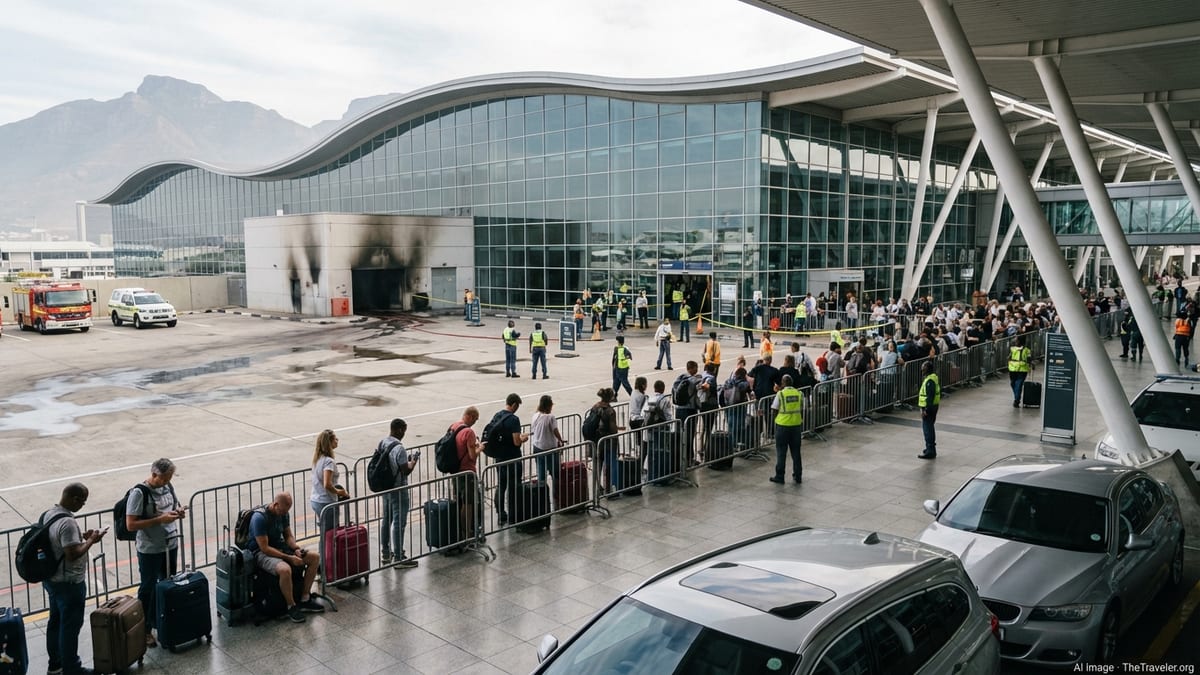
Fire, Evacuation and Sudden Halt to International Travel
The blaze broke out late on Tuesday morning in the airport’s Northern Service Yard along the international inner lane on the landside, an area dense with power and network cabling feeding the main terminal. Within minutes, smoke seeped into parts of the international building and alarm sirens triggered a full-scale response from airport firefighters and city emergency services. Officials confirmed the fire was brought under control and extinguished shortly afterward, with no injuries reported among passengers or staff.
Despite the quick work by fire crews, the incident forced a precautionary evacuation of smoke-affected sections of the international terminal. Thousands of travellers, many en route to long-haul destinations in Europe, the Middle East and other parts of Africa, were ordered out to assembly points outside the terminal complex. Images shared by local media showed queues of passengers with luggage stretching along the drop-off lanes as authorities assessed damage and checked that the building was safe to re-enter.
As the situation unfolded, Airports Company South Africa temporarily suspended all international departures and diverted a limited number of inbound flights to alternative airports. Domestic operations also felt the shock, with flights from Johannesburg paused around midday before gradually resuming. For several hours, Cape Town’s role as a key gateway for South African tourism and business travel was sharply curtailed, with ripple effects on airline schedules across the country.
IT Meltdown Exposes Security and Systems Vulnerabilities
While the flames were quickly contained, the greater damage lay in the airport’s network and power infrastructure. The fire triggered a widespread outage that knocked out critical IT systems, including the airport’s Wi-Fi, display boards and components of the baggage-handling and check-in networks. Check-in counters went dark, payment terminals failed and security screening capacity was sharply reduced.
With automated systems disabled, security processes slowed, and authorities resorted to manual screening of passengers. That meant paper-based checks, visual inspection of documents and more time-consuming verification procedures at security lanes already under strain during peak travel season. The incident came against a global backdrop of heightened aviation security concerns, putting renewed pressure on South African authorities to demonstrate resilience against both physical and cyber threats to key transport nodes.
Officials emphasized that there was no indication the fire was linked to malicious activity and that investigations were focused on the electrical infrastructure in the affected service yard. Nonetheless, the disruption highlighted how dependent modern airport security and operations have become on interconnected digital systems, and how quickly a localised technical failure can degrade border management, customs processing and screening for potential threats.
Manual Check-ins and Baggage Delays Test Traveller Patience
As power was gradually restored by Tuesday evening, airline check-in systems came back online for most carriers, but not all. At least one airline continued processing passengers manually into Wednesday, while the Border Management Authority, customs and baggage operations shifted to manual back-up procedures. Travellers arriving on international flights were warned to expect extended queues at immigration and longer waits for luggage as baggage sorting and delivery were handled without the usual automated conveyors and scanners.
The knock-on effects were particularly visible in the international arrivals area, where the usual corridor remained closed and meeters and greeters were redirected to a temporary entrance in the inner lane. Passengers who had been unable to retrieve luggage during the height of the disruption were instructed to return to a designated area on the northern side of the terminal to collect their bags. For many, that meant additional taxis, rescheduled transfers and extra hours lost at the end of long-haul journeys.
Airlines and airport authorities urged passengers to build in extra time, keep close contact with carriers and monitor official apps for real-time updates. Yet travellers interviewed by local broadcasters described confusion and patchy communication during the peak of the crisis, with many learning more from news outlets and social media than from public announcements. For tourists relying on tight connections to safari lodges, wine country stays or regional flights, the delays translated into missed bookings and hastily rearranged itineraries.
Rising Security Pressures Meet Strained Infrastructure
The incident has unfolded at a moment when Cape Town International Airport is carrying a heavier strategic load for South African tourism and trade. As visitor numbers climb and international carriers add capacity to the city, the airport’s ability to absorb shocks has come under scrutiny. Industry analysts point out that in the past two years the airport has endured multiple power and network failures, and that each event has exposed similar weak points in resilience and contingency planning.
Security experts note that while Tuesday’s fire appears to be an infrastructure failure, its effects overlapped with core security functions. When automated border systems, surveillance feeds and digital access controls are disrupted, staff must fall back on manual checks that are slower and potentially more error-prone. At a time of intensified global concern over airport security, any incident that hampers screening or tracking of passengers carries broader implications than delayed departures alone.
Local tourism bodies are now calling for a comprehensive review of the airport’s critical systems, from cabling and backup power to IT redundancy and public information protocols. They argue that protecting Cape Town’s reputation as an efficient, welcoming gateway requires more than cosmetic upgrades, and that infrastructure must be robust enough to withstand future shocks without forcing the terminal into hours of manual processing.
Modernisation Drive Accelerates Despite Setbacks
Ironically, the fire erupted just days after announcements of a phased infrastructure upgrade programme aimed at supporting long-term growth at Cape Town International Airport. The project is intended to expand capacity, modernise facilities and streamline passenger flows as international visitor numbers continue to climb. For advocates of that investment, this week’s events underline the urgency of accelerating improvements, particularly in behind-the-scenes power and IT networks that most travellers never see until they fail.
Airport management has pledged to complete its investigation into the cause of the blaze and to share findings with regulators and industry partners. Technical teams remain on site working to stabilise systems that are still being restored and to shift more processes back from manual to automated operation. In the meantime, passengers are being asked for patience as operations normalise and residual delays clear over the coming days.
For now, Cape Town International is once again handling domestic and international flights, albeit with some bottlenecks in arrivals processing and baggage delivery. The fire may ultimately be remembered less for the visible flames than for the way it exposed the fragility of the digital backbone that underpins modern air travel. As airports worldwide race to deliver a seamless, tech-driven journey against a backdrop of rising security threats, Cape Town’s experience serves as a reminder that resilience may matter just as much as innovation.