

Lisbon’s skyline is defined by two silhouettes that capture centuries of Portuguese history in a single glance: the hilltop ramparts of Castelo de São Jorge and the riverside profile of Belém Tower. Both are icons, both draw long lines of visitors, and both promise sweeping views and a crash course in Portugal’s past.
With limited time in the city, many travelers find themselves weighing a difficult choice: castle or tower. The answer depends less on which site is objectively better, and more on what kind of Lisbon experience you are looking for.
Big Picture: How These Two Landmarks Compare
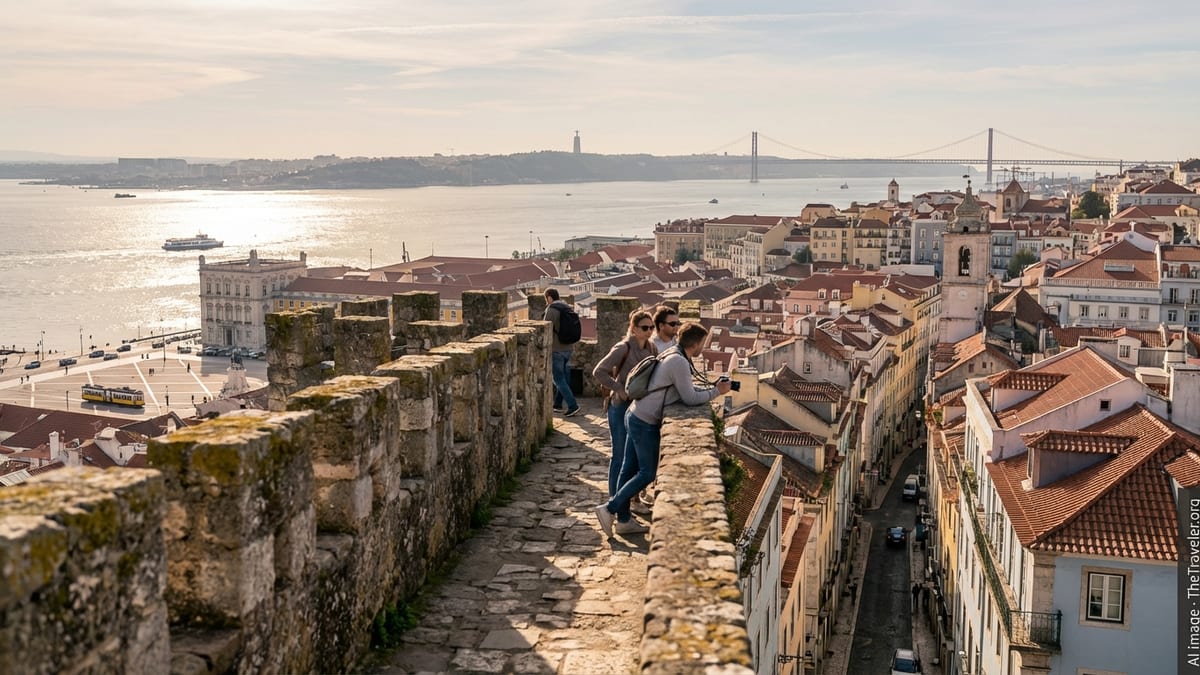
Castelo de São Jorge and Belém Tower stand at opposite ends of Lisbon in every sense: geographically, historically, and atmospherically. The castle looms above the city’s oldest neighborhoods, its stone walls tracing the contours of a hill that has been fortified since at least the 11th century. From its battlements you look inward, across the tiled roofs and church towers of the historic center, and outward to the river.
Belém Tower, by contrast, rises directly from the Tagus riverfront in the Belém district, several kilometers west of downtown. Built in the early 16th century at the height of the Age of Discoveries, it feels more like a ceremonial gateway than a military fortress. Here you look outward toward the estuary and the Atlantic, an angle that helps explain why this modestly sized tower became a symbol of Portugal’s maritime ambitions.
In practical terms, the castle offers a larger footprint, more areas to explore, and more time needed to do it justice. It is an immersive ruin, layered with viewpoints, a small museum, a camera obscura and an archaeological site. Belém Tower is a compact monument where the visit is more linear and focused: a queue to get in, a climb up through a series of chambers, and a final terrace with views along the riverbanks.
For travelers trying to decide, it helps to frame the choice this way: Castelo de São Jorge is the better option if your priority is city views, historic ambiance and wandering ruined ramparts. Belém Tower is the stronger choice if you want a postcard-perfect symbol of Portugal’s seafaring age and you are already planning to spend time in Belém.
History & Atmosphere: Castle on the Hill vs Gateway to the Sea
Castelo de São Jorge has roots that stretch back over a millennium. Fortifications existed on this hill in the Moorish period, and in 1147 it became a Christian stronghold after the conquest of Lisbon. Over the centuries it served as royal residence, military bastion and symbolic seat of power. Today, as you walk its walls and peer from its towers, the space still feels defensive and contemplative, more about guarding the city than celebrating empire.
Belém Tower belongs to a very different chapter. Completed around 1519, it was conceived as both fortress and ceremonial gateway. This was the Lisbon of caravels and spice routes, when Portuguese ships departed for Africa, Asia and South America. Standing on its riverside terrace, you can imagine those vessels slipping past the tower on their way toward the ocean, the tower functioning as a last lookout before open sea.
Atmospherically, the castle exudes a layered, almost archaeological feel. Pine trees shade interior courtyards, peacocks roam the grounds, and the ruins of earlier settlements lie within the walls. It feels like a place where history has been lived in, modified, damaged by earthquakes and rebuilt. Time here is long and uneven.
Belém Tower has a more singular, almost theatrical presence. Its carved balconies, corner turrets crowned with Moorish-inspired cupolas, and ornate maritime details give it the decorative flair associated with Portugal’s Manueline style. Despite having once served real military and even prison functions, it now feels more like a monument and less like a ruin. If the castle is about the continuity of Lisbon as a city, Belém Tower is about a concentrated moment when that city looked out to global horizons.
Views & Photography: Where Lisbon Looks Best
When it comes to panoramas, Castelo de São Jorge is hard to beat. Perched high above the Alfama and Baixa districts, it delivers sweeping views in almost every direction. From the ramparts you can trace the axes of the city’s streets, follow the Tagus as it widens into an estuary, and pick out landmarks such as the 25 de Abril Bridge and the Christ the King statue. The perspective helps first-time visitors make sense of Lisbon’s hills and neighborhoods.
These elevated views also translate into strong photography opportunities throughout the day. In the morning, the sun lights up the Baixa grid below. Near sunset, warm light washes the terracotta rooftops, and shadows emphasize the sculpted forms of the walls and towers. Even on hazy days, the castle’s height gives you dramatic silhouettes and long depth-of-field cityscapes.
Belém Tower, on the other hand, offers views that are more horizontal and water-oriented. From the upper terrace you look back toward the Belém waterfront, with its gardens, promenades and other major sites such as the Jerónimos Monastery. To the west, you see the open stretch of the Tagus and, in the distance, the Atlantic corridor that once carried fleets of explorers.
For photographers, Belém Tower is arguably more photogenic from the outside than from within. Its silhouette against a sunrise or sunset sky is classic Lisbon imagery, as are shots taken from the small platform or nearby riverwalk, showing the tower framed by water. Inside, the chambers and narrow staircases are atmospheric but can feel crowded and dim, which can limit photography options. If your goal is a portfolio of Lisbon panoramas, the castle has the edge. If you want that single, iconic shot of a lone tower rising from the river, Belém delivers.
Visitor Experience, Crowds & Practicalities
Both attractions are extremely popular, but the way crowds affect your visit is quite different. At Castelo de São Jorge, lines at the entrance can form in peak season, yet once inside the complex spreads people out across ramparts, courtyards and gardens. It is relatively easy to step away from the busiest spots and find a quiet corner with a view. The larger grounds mean you can spend anywhere from an hour to half a day wandering, especially if you join a guided tour or explore the small museum and archaeological area.
Belém Tower is more constrained. Visitor flows are funneled through a single tower connected by a steep, narrow spiral staircase. To manage traffic, staff often use a system of alternating one-way passage up and down, which can result in bottlenecks on busy days. The result is that queues to get inside can be long, and the actual movement through the interiors can feel slow and compressed. Many travelers report spending as much time waiting as they do exploring.
In terms of logistics, Castelo de São Jorge is open daily, with extended hours in summer. The hilltop location does require a bit of effort. You can walk up through steep streets and staircases from Baixa or Alfama, or take taxis, ride-share services, tuk-tuks, or the iconic tram 28 to a stop within walking distance. Once inside, expect uneven pavements, steps, and some exposed sections along the walls, although there are also more level garden and courtyard areas.
Belém Tower has more limited opening days and closes on Mondays and certain holidays. Reaching it from central Lisbon typically involves a tram or train ride followed by a short walk along the waterfront. Once there, accessibility is limited: the ground level can be visited by travelers with reduced mobility, but the upper floors are reachable only via that tight spiral staircase. Those with claustrophobia, reduced mobility or traveling with very young children should factor this in when deciding.
Tickets, Costs & Value for Time
Ticket prices for both landmarks are modest by Western European capital standards, and they are frequently included in city passes or combined tickets. Castelo de São Jorge’s standard adult ticket is currently in the upper teens in euros, with reduced rates for youths and seniors. In return, you gain access not just to the walls and towers but also to a small museum, an archaeological site, landscaped spaces and, on many days, guided tours in Portuguese and English included in the entry price.
Those tours, which typically last around an hour, help contextualize the layers of occupation from pre-Roman settlements to Moorish quarters and later royal use. The camera obscura experience, when available and weather permitting, offers a striking live, 360-degree optical view of Lisbon from within one of the towers. All of this combines to give the castle strong value per hour spent, especially for travelers who enjoy historical interpretation alongside vistas.
Belém Tower’s entry fee is lower, and it remains one of the more affordable UNESCO-listed sites in Europe. The visit, however, is shorter and more linear. You explore several floors, see some historical chambers, and reach the terrace. There is less interpretive content on-site compared with the castle, so travelers who are not already familiar with Portuguese history may leave with more questions than answers. Guided tours of Belém, booked through tour operators, can fill that gap, but come at an additional cost.
In terms of value for time, many visitors find that Castelo de São Jorge offers a richer, more flexible experience for a single entry fee. Belém Tower is still worthwhile, but it truly shines when combined with other Belém attractions such as the Jerónimos Monastery and the riverside promenade. If you only want to pay for one site and dedicate a couple of hours to it, the castle often feels like the more complete stand-alone excursion.
Location & What Else You Can See Around Them
Your itinerary and base in Lisbon will strongly influence which landmark fits better into your plans. Castelo de São Jorge crowns one of the central hills between the Alfama and Mouraria neighborhoods. Visiting the castle can easily be combined with an exploration of the maze-like streets below, a wander through viewpoints such as Miradouro de Santa Luzia and Portas do Sol, and a meal in traditional taverns. For many visitors, the castle functions as a keystone of a day spent entirely in historic central Lisbon.
From a logistical standpoint, this centrality makes the castle an attractive option if you have limited time in the city. You can walk there from major downtown squares such as Praça do Comércio or Rossio in under half an hour, even accounting for the climb. Public transport and taxis shorten the ascent, and you are never far from tram stops, cafes and other sights.
Belém Tower sits in a dedicated riverside district several kilometers to the west. The neighborhood of Belém is something of an open-air museum of the Discoveries era, home not only to the tower but also to the monumental Jerónimos Monastery, the Monument to the Discoveries, the National Coach Museum and modern cultural centers. Many travelers plan Belém as a half- or full-day excursion from central Lisbon, hopping between these sites and sampling the district’s famous custard tarts.
This clustering of attractions means that if you are already going out to Belém, adding a visit to the tower only requires extra patience for the lines. But if your time is too short for a trip west, the castle makes more geographical sense. As a rule of thumb, think of Castelo de São Jorge as the anchor of a “historic Lisbon” day in the city center, and Belém Tower as one component of a broader “Discoveries and museums” day on the riverfront.
Which Landmark Suits Your Travel Style?
Deciding between Castelo de São Jorge and Belém Tower ultimately comes down to what you value most in a travel experience. If you are a visual traveler who wants that first, sweeping overview of Lisbon’s topography, the castle is the clear winner. Standing on its walls you can mentally map out the city, understand the relationships between neighborhoods, and take photos that define your trip album.
History buffs tend to gravitate toward the castle as well. The layers of archaeological remains, the onsite museum and the free guided tours offer a richer narrative arc that spans centuries. The castle lets you step into spaces where medieval rulers lived and defended the city, then look out over a modern metropolis that grew around those fortifications.
Belém Tower, however, has its own ideal audience. If the Age of Discoveries is what drew you to Lisbon, if you are fascinated by navigation, caravels and global trade routes, the tower’s riverside presence is hard to resist. It distills a key chapter of Portuguese identity into a compact, highly symbolic structure. For many visitors, standing on its terrace with the wind off the Tagus feels like a tangible connection to those early voyages.
Families and travelers with mobility considerations may find the castle’s larger outdoor spaces more forgiving, as it is easier to avoid tight staircases and congested interiors. Meanwhile, travelers who prefer smaller, more focused visits may appreciate the fact that Belém Tower can be seen relatively quickly, leaving time the same day for museums, riverside walks and pastry stops without feeling rushed.
The Takeaway
Castelo de São Jorge and Belém Tower are not rivals so much as complementary pieces of Lisbon’s story. One looks inward, guarding a city that has grown around its walls; the other looks outward, commemorating the moment that city projected itself across oceans. Both are worthy of your time, but each shines in different circumstances and for different types of traveler.
If this is your first visit to Lisbon, you have limited time and you want one defining landmark that gives you both context and views, Castelo de São Jorge is usually the better choice. Its panoramic outlook, layered history, flexible visitor experience and central location make it the more satisfying stand-alone attraction. You can spend an unhurried morning or afternoon there and feel you have truly oriented yourself to the city.
Belém Tower is best seen as part of a wider Belém itinerary. If you are already planning to visit the Jerónimos Monastery, stroll the riverfront and explore the museums, then adding the tower completes the picture of Portugal’s maritime golden age. It may not offer as expansive a view or as much interpretive depth as the castle, but it delivers one of Lisbon’s most enduring images and a direct link to the voyages that shaped the early modern world.
In an ideal trip, you do not choose. You spend a day in historic Lisbon, climbing up to Castelo de São Jorge, then dedicate another to Belém and its riverside monuments. If you must pick only one, ask yourself a simple question: do you want to see Lisbon from above, or to stand at the threshold of where Lisbon once met the sea? Your answer will tell you which landmark is better for you.
FAQ
Q1. If I only have one day in Lisbon, should I visit Castelo de São Jorge or Belém Tower?
With just one day and no time to go out to Belém, Castelo de São Jorge is usually the better choice. It is centrally located, offers some of the best views in the city, and can be combined easily with exploring nearby neighborhoods such as Alfama and Baixa.
Q2. Which site has better views, the castle or the tower?
Castelo de São Jorge has broader, more comprehensive views over the historic center and the Tagus, which help you understand Lisbon’s layout. Belém Tower offers beautiful but more limited vistas focused on the riverfront and estuary, and is more photogenic from the outside than from its upper terrace.
Q3. Which landmark is less crowded?
Both attract many visitors, but the castle generally feels less cramped because it covers a larger area. Belém Tower’s interior is compact, with a single narrow spiral staircase that often creates bottlenecks and long queues, especially in high season and on weekends.
Q4. How much time should I plan for each visit?
Most travelers spend between one and two hours at Castelo de São Jorge, longer if they join a guided tour or linger in the gardens and viewpoints. Belém Tower typically takes about an hour, though you may wait significantly longer in line on busy days.
Q5. Are either of the sites suitable for visitors with reduced mobility?
Both landmarks present challenges. Castelo de São Jorge sits on a hill and has uneven surfaces and many steps, but there are some more level areas and viewpoints. Belém Tower has ground-floor access, yet the upper floors are reached only via a tight spiral staircase. Travelers with reduced mobility often find the castle’s open spaces somewhat easier to manage.
Q6. Which site is better for families with children?
Families often prefer Castelo de São Jorge because children can move more freely along the ramparts and in the gardens, and there is more room to spread out. Belém Tower can be exciting for kids but the lengthy queues, narrow stairs and confined spaces can be tiring and stressful, particularly with very young children.
Q7. Can I visit both Castelo de São Jorge and Belém Tower on the same day?
It is possible, but it makes for a long and packed day. A more relaxed plan is to dedicate one day to central Lisbon with the castle as your highlight, and another to the Belém district, combining the tower with the monastery and other nearby sights.
Q8. Do I need to book tickets in advance?
Advance tickets are advisable for both, particularly in peak season. Buying ahead can reduce waiting times at Castelo de São Jorge and is strongly recommended for Belém Tower, where same-day lines at the ticket office are often long.
Q9. Which landmark is more historically important?
They represent different facets of Portugal’s past. Castelo de São Jorge reflects Lisbon’s medieval and Moorish history and its role as a defended capital, while Belém Tower symbolizes the Age of Discoveries and Portugal’s maritime expansion. In global terms, the tower’s UNESCO World Heritage listing highlights its symbolic importance, but within the story of Lisbon itself, the castle is equally significant.
Q10. If I am mainly interested in photography, which should I prioritize?
If you want wide city panoramas and varied compositions, prioritize Castelo de São Jorge. If your goal is to capture that iconic riverside silhouette that appears on postcards and tourism posters, make sure Belém Tower is on your list, even if you focus more on photographing it from the outside than on its interiors.