

In Alaska, the moment you leave town, your phone often leaves you. On the map it may look like you are driving along a major highway or cruising a busy marine corridor. In reality, once you slip past the last cell tower on the fringe of Anchorage, Fairbanks, Juneau or a regional hub, bars vanish surprisingly quickly. Visitor expectations shaped by lower 48 coverage maps collide with one of the sparsest and most rugged communications landscapes in the United States. Understanding how and where cell service really works in Alaska is essential if you want your trip to be memorable for the right reasons.
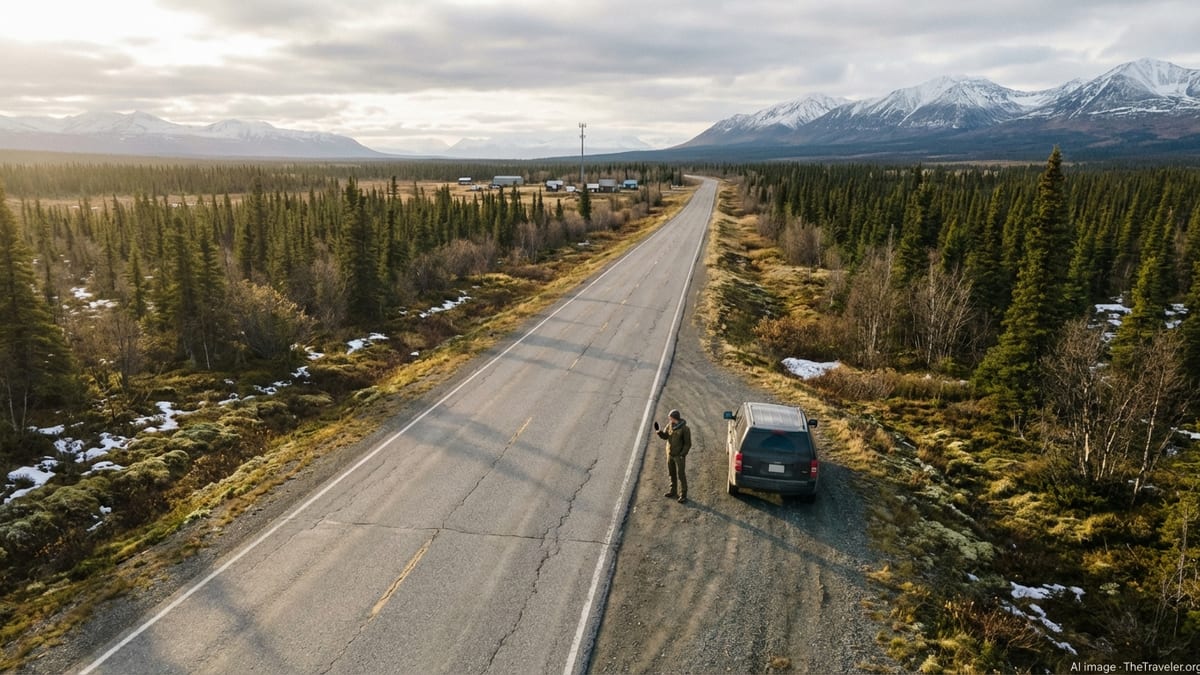
Why Coverage Maps Mislead Travelers in Alaska
Most travelers planning a trip to Alaska pull up their carrier’s coverage map and zoom north. What they see is usually a patchwork of color following the road system and outlining major towns, which can create a false sense of security. Those maps are marketing tools that show modeled signal reach under ideal conditions. In Alaska, mountains, fjords, dense forest and vast distances mean that what looks like coverage on a map can translate to a fleeting or unusable signal in real life. Even the Federal Communications Commission warns that mobile coverage depictions are approximate and that service breaks can occur in areas that appear to be covered.
Another issue is scale. At the level of the entire state, a thin line of coverage along a highway may look impressive. On the ground, that line might represent a tower every 40 to 60 miles serving a narrow corridor of population. If you pull into a turnout to photograph a glacier, drop into a river valley, or drive past a ridgeline, your phone can lose contact in seconds. That disconnect between map scale and lived experience is at the heart of why cell service seems to disappear faster than most visitors expect.
Finally, maps rarely distinguish between a marginal signal and a strong one in a way that is meaningful for travelers. A single bar of 3G or older LTE technology can technically qualify as “covered,” yet be too weak to support navigation updates, messaging, or calls. In many rural parts of Alaska, coverage consists of exactly that sort of fragile edge signal, susceptible to vanishing as soon as you leave a lodge parking lot or small town main street.
Where Cell Service Exists – and Where It Does Not
Alaska’s cell network is built around a few population centers, a limited road grid, and pockets of coastal settlement. Anchorage, Fairbanks, Juneau and other larger communities typically offer dependable 4G LTE and growing 5G coverage from at least one national carrier and the regional provider GCI. Within these city limits, visitors can generally rely on their phones just as they would in a mid‑sized city in the lower 48, with strong data speeds and indoor reception in most buildings.
Outside urban areas, reception follows infrastructure. Along major road corridors such as the Parks, Glenn, Seward and Sterling highways, there is intermittent coverage that tends to cluster around junctions, gas stations, lodges and small towns. You may have full bars at a roadside café and then lose everything five minutes down the road as the line of sight to the tower disappears. The same pattern holds along coastal communities in Southeast Alaska, where service is strongest in town centers and drops quickly in surrounding bays and channels.
Vast tracts of the state have no conventional cell service at all. The interior backcountry, much of the Brooks Range, large sections of western Alaska and many islands in the Aleutian chain are effectively off the grid. Even some well‑known tourism regions combine small pockets of signal with expanses of dead zone. Denali National Park, for example, has practical cell coverage only near the park entrance, with service typically ending within the first few miles of the park road and none deep in the six million acres of wilderness. Once you board a backcountry bus or fly toward a remote lodge, assume you are leaving the network behind completely.
Denali, National Parks and the Illusion of Connectivity
Nowhere is the mismatch between expectation and reality clearer than in Alaska’s national parks. Denali, Kenai Fjords, Wrangell–St. Elias, Glacier Bay and Katmai attract visitors from all over the world who are accustomed to having at least some phone reception in popular parks elsewhere in the United States. The National Park Service cautions that coverage can be inconsistent even in parks that advertise some level of connectivity, and that many sites intentionally promote disconnection as part of the wilderness experience.
Denali is a prime example. There may be acceptable cell service near the visitor center and first few miles of the park road, especially around park‑adjacent accommodations and campuses that sit close to the highway. Beyond that threshold, towers vanish and the landscape takes over. Lodges deep in the park interior report no cell coverage at all and often rely on satellite phones and limited satellite internet purely for operational and emergency needs. For guests, a stay there is effectively phone‑free, regardless of carrier or handset.
Other famed destinations follow a similar pattern. In Kenai Fjords, you can check email in Seward’s harbor before boarding a day cruise, but once the boat leaves Resurrection Bay, rugged fjords and distance from shore mean cell signals quickly fall away. Glacier Bay’s main lodge area in Gustavus may have intermittent service depending on provider, yet the bay itself and most of the park waters are beyond the reach of land‑based cell towers. Visitors who arrive expecting to livestream a calving glacier or video chat from a backcountry campsite often discover that their phone has become little more than a camera.
Ships, Ferries and Remote Highways: Going Dark at the Edges
Many travelers assume that popular routes like the Alaska Marine Highway or major cruise ship corridors are lined with continuous connectivity. The reality is more complicated. Coastal cell coverage hugs towns and roadside communities, and even then can be patchy behind steep terrain. As ferries and cruise ships move into more remote channels, phones fall back to a weak roaming signal, then often to nothing at all. A pilot program on one Alaska Marine Highway ferry now offers ship‑wide Wi‑Fi in certain areas, but that service is the exception rather than the rule and depends on satellite backhaul that can be slow and subject to weather.
On the road system, the sense of connection can evaporate with similar speed. Driving north from Anchorage toward Denali or west toward the Kenai Peninsula, service initially feels robust. Then the highway threads through a mountain gap or along a river, and the last bar of LTE disappears. Long stretches of the Parks Highway between communities, segments of the Dalton Highway north of Fairbanks, and parts of the Richardson, Glenn and Tok Cutoff have little to no usable signal. Spotty roadside coverage often returns near pipeline camps, highway lodges or small towns, then vanishes again between them.
Even in regions with reasonably modern infrastructure, the edge of coverage can be surprisingly close. In Fairbanks or Juneau you may enjoy strong service across town, but a short drive to a trailhead or lake can put you on the margin of a cell sector. Park your car behind a hill or hike down into a valley and you may find that navigation apps stop updating and messages remain unsent. For visitors who equate a paved road or a busy trailhead with dependable connectivity, that rapid transition can be jarring.
Why Alaska’s Cell Networks Thin Out So Quickly
There are concrete reasons why Alaska’s networks fade faster than many travelers expect. The first is geography. Cell towers rely on line of sight to handsets, and Alaska’s terrain is dominated by mountain ranges, narrow fjords and broad river valleys. A tower that might cover a wide radius across flat plains in the Midwest can reach far fewer users in a landscape where ridges and deep valleys constantly block and scatter radio signals.
Distance is another limiting factor. Alaska is vast, with small populations spread across enormous areas. Building and maintaining towers, power lines and backhaul connections in remote terrain is expensive, and in many places technically difficult. Providers must prioritize routes and communities where infrastructure serves enough people to justify the cost. That leads to a backbone of service in and between cities, with minimal incentive to fill in the gaps far from any settlement.
Climate and logistics add further complexity. Harsh winters, high winds, sea ice and permafrost all challenge equipment and construction. Towers and microwave links may be located where they are easier to maintain and supply, not where they would best blanket a wilderness area with signal. Crews have limited seasonal windows to install and upgrade sites, and storms can take infrastructure offline for extended periods. In some places, providers rely on radio links or satellite connections to feed towers instead of fiber, which can limit capacity and stability even when a phone shows bars.
Finally, technologies roll out to Alaska later and more unevenly. Urban areas and some hubs now see expanding 5G coverage, but many rural zones remain on older LTE or even 3G‑grade connectivity. That means a phone may connect but still struggle with modern, data‑hungry apps. When people describe coverage as unreliable, they are often experiencing the difference between nominal technical availability and practical, day‑to‑day usability.
How Quickly Bars Vanish Once You Leave Town
From a traveler’s perspective, the most striking feature of Alaska’s cell landscape is how abruptly the experience changes. You may be standing in downtown Anchorage enjoying fast data and instant photo uploads. Twenty minutes later, as you climb into the Chugach foothills on the way to a trailhead, your service may have dropped to a single bar of low‑band LTE or disappeared entirely. The same pattern repeats around all major centers: solid coverage within city limits and their immediate surroundings, then a rapid taper into sparsity.
Along key highways, coverage often behaves like a series of overlapping circles around towers and small communities. Entering one of those circles, your phone wakes up, messages pour in and maps refresh. Leave it, and within a few miles the signal fades. Because those circles may be spaced dozens of miles apart, stretches of complete disconnection are common. For visitors watching their screen, it can feel as though coverage switches on and off rather than diminishing gradually.
On water, the change can be even sharper. In Southeast Alaska, cellular sites typically sit in towns such as Ketchikan, Juneau, Sitka and smaller communities. Ferries and cruise ships may enjoy service while hugging the shoreline near town, but as soon as they round a headland or sail into open channels, the signal often vanishes outright. A passenger who boards with four bars and starts uploading photos may find their feed frozen a short time later, with no meaningful connection until the next port of call several hours or even a full day away.
This pattern is not a flaw in your specific phone or a quirk of one carrier. It reflects how the networks are engineered for sparsely populated and extreme environments. The practical result is that in Alaska, you should assume a binary reality: good service in and very near towns, and little to none once you move into wild or remote areas, even if the road or waterway you are following appears important on the map.
Staying Safe When You Are Suddenly Offline
Because cell service in Alaska disappears so quickly, safety planning cannot depend solely on a smartphone. The state’s search and rescue agencies routinely urge visitors to prepare for long stretches without reception. That starts with something as simple as not relying on real‑time navigation apps. Download offline maps before leaving a city or large town, carry paper maps for remote routes, and make sure someone at home knows your itinerary, including planned return times and backup options.
Travelers headed into areas without reliable coverage increasingly carry dedicated satellite communicators or satellite phones. Compact messaging devices can send simple check‑in texts and SOS alerts from almost anywhere with a view of the sky, providing a critical lifeline on remote highways, rivers and trails. Many Alaskans also travel with traditional gear such as detailed atlases, two‑way radios and extra fuel, operating on the assumption that help may be many miles and many hours away.
On the road, prudence matters as much as technology. Do not wait for your low‑fuel light to come on, since the next open gas station may be much farther than expected and you may not be able to check online for hours. Start remote drives with a full tank, carry extra water and warm clothing even in summer, and be prepared to handle basic car troubles yourself. If you break down in a dead zone, it could be the next passing vehicle, not the next cell tower, that brings assistance.
For those traveling by ferry or small boat, similar principles apply. Assume you will lose connectivity once you leave port, copy critical information such as reservation details or tide tables to offline notes, and coordinate check‑in plans with family or guides ahead of time. Treat each transition from town to wilderness or open water as a point where your digital leash to the outside world may effectively end.
Planning an Alaska Trip Around Patchy Connectivity
Accepting the limits of Alaska’s networks can transform the way you plan your trip. Rather than assuming you will always be able to research on the fly, build your itinerary and key reservations before you arrive or while you are solidly online in Anchorage, Fairbanks or Juneau. Save confirmation numbers, trail information and emergency contacts locally on your phone or on paper. If you will spend time in national parks or remote lodges, ask in advance about their connectivity so you know whether you can expect basic messaging, slow Wi‑Fi or complete disconnection.
Business travelers and remote workers face extra challenges. Uploading large files, joining video calls or even maintaining a stable voice call may be impossible outside of major towns. Some hotels and coworking spaces in hub communities now advertise enhanced broadband and reliable cellular indoor coverage, but that connectivity rarely extends far beyond their walls. If work obligations are critical, plan to cluster important tasks in cities and treat excursions into wild areas as essentially offline time.
Families and groups should also talk openly about what disconnection means. Teenagers used to constant connectivity may find the sudden loss of messaging and social media stressful. Setting expectations in advance, agreeing on meeting points at trailheads or cruise ships, and emphasizing the benefits of being present can soften the shock. Many travelers later describe the forced offline time as one of the most memorable aspects of their trip, as long as it was anticipated rather than a surprise.
Ultimately, planning around patchy connectivity is not about lowering standards. It is about aligning expectations with Alaska’s reality so that limited service becomes a known constraint rather than a source of frustration or risk. By thinking of cell coverage as a convenience available in certain zones rather than a constant, you give yourself permission to experience the state on its own terms.
The Takeaway
Cell service in Alaska does not gently fade as you leave the airport. It tends to fall off a cliff. Beyond the glow of Anchorage, Fairbanks, Juneau and a handful of regional hubs, the combination of rough terrain, enormous distances and sparse infrastructure means that the bars on your screen can drop from full to none in the space of a short drive or a quick sail out of port. Coverage maps, even those based on detailed modeling, often overstate practical availability and do little to convey how sudden those transitions can feel.
For travelers, the key is to treat connectivity as an occasional bonus rather than a given. Build solid plans while you have service, download what you need, carry basic safety gear and consider a satellite communicator for remote adventures. Ask lodges, guides and ferry operators what to expect so that you are not surprised when your phone stops working just as the scenery becomes most dramatic. If you do that, Alaska’s vanishing cell signal shifts from a liability into a defining part of the experience: a rare chance to step off the grid, look up from the screen and immerse yourself fully in a vast, wild landscape.
FAQ
Q1. Will my phone work everywhere in Alaska if I have a major carrier?
Your phone will usually work well in and immediately around major cities and towns, but large parts of the state, including many highways and national parks, have little or no coverage regardless of carrier.
Q2. How far outside Anchorage or Fairbanks does cell service typically last?
Expect strong coverage within city limits and on some nearby roads, then a rapid dropoff. In many directions, you may start seeing weak or no signal within 20 to 40 minutes of driving away from town.
Q3. Is there cell service inside Denali National Park?
There is generally usable service only near the park entrance and the first few miles of the park road. Once you travel deeper into the park, you should assume there is no cell coverage at all.
Q4. Do Alaska cruise ships have reliable cell coverage at sea?
You may have reception near larger ports or while sailing close to shore, but once ships move into remote channels, land‑based cell signals often disappear and connectivity depends on onboard satellite systems, if offered.
Q5. Can I rely on my phone’s GPS and maps in remote areas?
The GPS receiver will still work without cell service, but map tiles and routing may not. Download offline maps in advance and carry paper maps for remote travel.
Q6. Are there dead zones on major highways like the Parks or Seward Highway?
Yes. While some stretches have coverage, there are long segments with weak or no signal. Services cluster near towns and highway lodges, with gaps in between where your phone may not work.
Q7. Is it worth getting a local Alaska SIM card for better coverage?
A regional provider may offer slightly better service in some communities, but no carrier can provide continuous coverage across the state. A local SIM can help at the margins but will not eliminate dead zones.
Q8. What is the best way to stay safe if I lose cell service?
Share your plans with someone you trust, carry offline maps, basic emergency supplies and consider a satellite messenger or phone for remote trips, especially when traveling solo or in winter.
Q9. Do national parks in Alaska offer Wi‑Fi as a backup?
Some visitor centers and concession lodges have limited Wi‑Fi, often slow and sometimes restricted to guests. Outside those specific buildings, you should not expect any wireless connectivity.
Q10. How should I prepare my phone before going into an area with poor coverage?
Download maps and key documents, save important contacts locally, enable offline use for essential apps, and let family or colleagues know you may be unreachable for extended periods.