

More news on this day
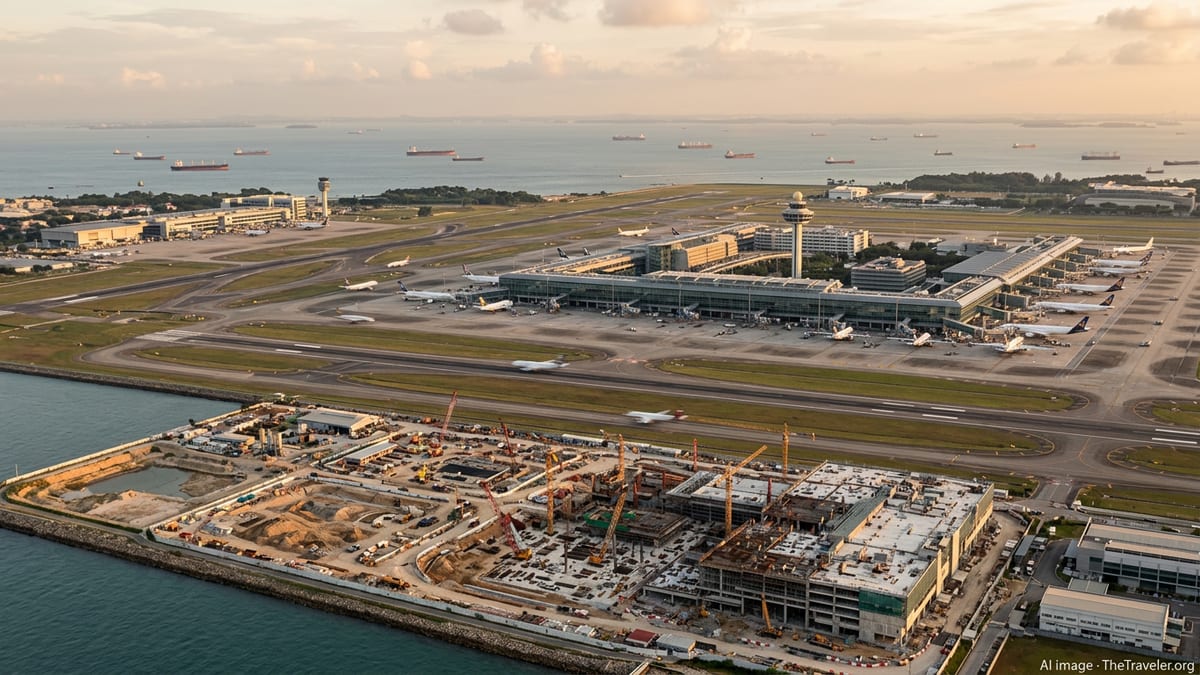
Singapore’s Changi Airport is accelerating work on its giant Terminal 5 project, a long-term expansion designed to lift the hub’s total capacity toward 150 million passengers a year while reinventing how efficiently a global gateway can operate.
Ambitious Capacity Targets for a Growing Air Hub
Changi Airport has spent the past few years quietly rebuilding its capacity, restoring and expanding its four existing terminals to handle about 90 million passengers annually. Passenger volumes rebounded strongly after the pandemic, reaching around 70 million travellers in 2025, underscoring the need for additional room to grow as traffic across Asia rises.
The planned Terminal 5, part of the broader Changi East development, is central to that strategy. In its first phase, the new terminal is being designed to accommodate about 50 million passengers a year once it opens in the mid-2030s. When combined with incremental improvements across the rest of the airport estate, Singaporean officials and planners say the development trajectory positions Changi to ultimately support around 150 million passengers annually in the longer term.
For policymakers, building ahead of demand is a familiar playbook. Singapore sees aviation as a critical pillar of its economy, linking the city-state to more than 100 countries and supporting tens of thousands of jobs in tourism, logistics and advanced services. Ensuring that capacity is in place before congestion returns is viewed as essential to protecting Changi’s competitive edge over emerging regional rivals.
The project also reflects a broader shift in global air travel patterns. With Asia forecast to be the world’s largest aviation market within the next decade, airports from Bangkok to Jakarta are racing to expand. Changi’s move to plan for 150 million passengers signals Singapore’s intent not just to keep pace, but to anchor some of that future growth.
Terminal 5 Breaks Ground After Pandemic Pause
Work on Terminal 5 was halted for two years during the pandemic as demand for air travel collapsed and long-term forecasts were reassessed. Planning resumed in 2022, and in May 2025 ground was formally broken on the mega-terminal and associated airside infrastructure, including a third runway and new taxiways on reclaimed land at Changi East.
The Singapore government has committed several billion dollars in new funding tranches to the project in recent budgets, while Changi Airport Group has awarded multibillion-dollar contracts for substructure and airside works to international and local consortia. These early packages cover deep foundations, tunnels, drainage, and the shaping of airfield layouts that will underpin the terminal superstructure that follows.
Officials describe Terminal 5 as one of the largest aviation infrastructure projects now under way in the Asia Pacific region. The single terminal building will sit on more than 1,000 hectares of land, with provisions to add contact gates, remote stands and satellite piers over time. The mid-2030s opening timeline is intended to align with projected growth in travel across Southeast Asia and China as incomes rise and fleets expand.
Beyond the main passenger building, the Changi East programme includes an industrial and logistics zone to cluster airfreight, e-commerce and aerospace services. Taken together, the campus is meant to deepen the airport’s role as an integrated air hub rather than just a passenger gateway.
Automation and Design Aimed at Faster, Smoother Journeys
While capacity is the headline number, Changi’s planners are positioning Terminal 5 as a showcase for high-efficiency airport operations. The building layout is being modelled around shorter walking distances, intuitively zoned check-in areas and panoramic airside views intended to help passengers orient themselves quickly. Large structural spans will allow flexible use of space as airline networks and travel behaviours change.
Automation is expected to be pervasive. The terminal will be built to support extensive use of self-service bag drop, automated early baggage storage, and high-capacity baggage handling systems capable of dynamically routing luggage based on real-time flight conditions. Behind the scenes, data platforms will feed predictive analytics into airport and airline control centres, helping to smooth peaks and recover quickly from disruption.
Border clearance at Changi is already shifting toward biometric, passport-free processing for many travellers, and Terminal 5 is being designed around that model from day one. Immigration halls will feature banks of automated lanes rather than traditional manned counters, reducing the space and staffing required per passenger while aiming to cut wait times even at peak hours.
The focus on efficiency extends to ground access. Future rail connections via extensions of key metro lines, along with new road links, are planned to feed directly into the terminal, with dedicated areas for taxis, ride-hailing services and coaches. Planners say the goal is to make the overall journey from city to gate more predictable and less stressful, even as passenger numbers climb.
Balancing Sustainability with Long-Term Growth
As aviation faces mounting pressure over its environmental footprint, Singapore is seeking to position Terminal 5 as a more sustainable model of large-scale airport expansion. The terminal is being engineered with high-performance building envelopes, advanced cooling systems and extensive use of natural light to reduce energy demand in Singapore’s tropical climate.
Designs include provisions for large rooftop solar arrays, smart ventilation and the ability to plug aircraft into fixed electrical ground power rather than running auxiliary engines at the gate. The airport operator is also exploring the use of more sustainable construction materials and methods for the terminal and airfield, seeking to curb embodied carbon where possible.
On the operational side, airfield layouts and taxiway systems are being optimised to shorten taxi times and reduce fuel burn. The third runway and new rapid-exit taxiways are expected to give air traffic controllers more flexibility to sequence arrivals and departures efficiently, easing delays as movements grow.
Officials acknowledge that building for up to 150 million passengers in an era of climate concern is a delicate balancing act. Their argument is that concentrating growth in a high-efficiency hub, coupled with regional efforts on sustainable aviation fuels and fleet renewal, can deliver more connectivity per tonne of emissions than a fragmented system of smaller, less efficient gateways.
What a 150 Million Passenger Changi Means for Travellers
For passengers, Changi’s expansion is likely to translate into more routes, higher frequencies and a wider choice of airlines over the coming decades. Additional gates and stands at Terminal 5 will give carriers room to grow long-haul and regional networks, potentially opening new non-stop city pairs as aircraft technology advances.
The airport’s retail and hospitality offer is also expected to scale up. Terminal 5 will integrate commercial zones, green spaces and family-friendly facilities that build on Changi’s reputation for experiential amenities, from gardens to art installations. The challenge will be to maintain the airport’s hallmark ease of use and human scale even as it grows to handle more passengers than many major cities see in a year.
For Singaporeans, the mega-terminal is framed as an investment in future jobs and connectivity. Construction will support thousands of roles over the next decade, while the completed development is expected to anchor growth in tourism, trade and high-value services well beyond the aviation sector itself.
With ground broken, contracts flowing and traffic rebounding, Changi Airport’s march toward a 150 million passenger future is shifting from blueprints to reality. The next decade will show whether one of the world’s most celebrated airports can scale up dramatically while staying efficient, sustainable and passenger-friendly.