

More news on this day
Guadalajara International Airport was thrown into chaos on Sunday, February 22, as dozens of flights were abruptly canceled or delayed amid a fast-moving security crisis triggered by the killing of powerful cartel leader Nemesio “El Mencho” Oseguera Cervantes, leaving stranded travelers scrambling for scarce seats, safe routes and reliable information across western Mexico.
Violence in Jalisco Spills Into the Skies
The sudden operational breakdown at Guadalajara International Airport unfolded against a backdrop of roadblocks, burning vehicles and gunfire reported across Jalisco state after Mexican troops carried out a high-profile operation that authorities say killed El Mencho, the elusive leader of the Jalisco New Generation Cartel. Within hours, aviation data showed nearly half of all flights to or from Guadalajara either canceled or significantly delayed, mirroring the paralysis seen at Puerto Vallarta’s airport on the same day.
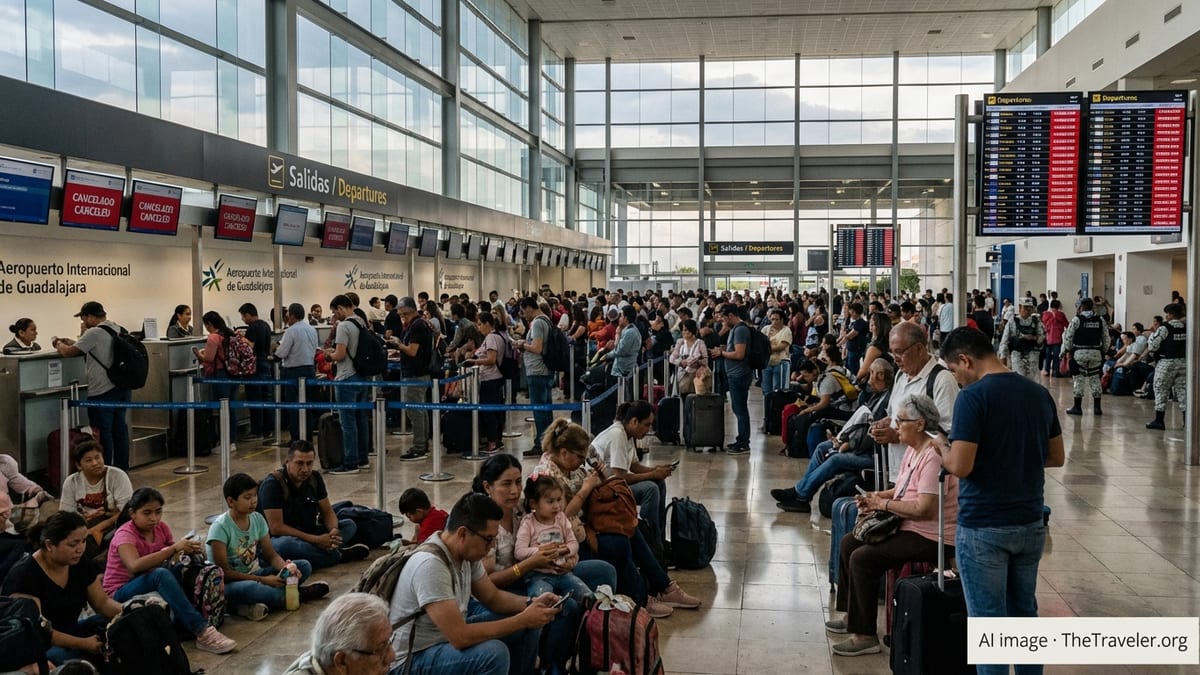
According to real-time tracking services, roughly a quarter of scheduled flights at Guadalajara were canceled and nearly as many delayed by Sunday evening, amounting to around 50 canceled and more than 40 delayed services in just a few hours. That disruption translated into long queues at airline counters, full departure halls and growing confusion as screens filled with red cancellation notices while announcements remained sporadic or difficult for foreign tourists to understand.
Airport operators insisted that no armed attacks had occurred inside the terminal itself and that the facilities remained under the protection of federal security forces. Yet images and videos shared on social networks showed passengers and airport workers running for cover, crouching behind counters and huddling in secure areas as unverified reports of gunmen near the premises spread, amplifying the sense of panic even as officials repeated that operations inside the building were secure.
For travelers who had arrived early in hopes of beating the turmoil on the roads, the interior calm described by authorities contrasted sharply with the psychological stress they experienced on the concourse. Families traveling with children, older passengers, and visitors with limited Spanish all struggled to piece together what was happening beyond the glass walls of the terminal, where smoke from burning vehicles and blocked access routes made it clear that the crisis extended well beyond a routine day of weather-related disruptions.
Fifty-Plus Flights Scrapped as Operational Collapse Widens
While initial reports focused on scattered cancellations, by late Sunday the situation had escalated into what many aviation observers described as a rolling operational collapse across western Mexico’s main gateways. At Puerto Vallarta, airport authorities confirmed that all international operations and most domestic services had been canceled for the day at the request of airlines. In Guadalajara, tracking data indicated close to 50 flights canceled and dozens more delayed, putting the total number of disrupted services across the two airports into the triple digits.
Industry sources said that at least 52 individual flights linked to Guadalajara alone were dropped over a 24-hour period as the ripple effects spread through airline networks, with more cancellations likely to emerge as carriers reassessed security, crew positioning and airport access. Those numbers are expected to fluctuate as airlines consolidate operations, reroute aircraft and attempt to restart a skeleton schedule once authorities confirm safer ground conditions between city centers and terminal complexes.
In practical terms, that meant full-day shutdowns for some destinations and patchy service for others. Short-haul links between Guadalajara and cities in the United States such as Portland and Fresno were among the first to be cut as carriers weighed the risks of operating into a region where road transport to and from the airport was at times impossible. Domestic routes fared no better, with key connections within Mexico either grounded or operating with heavy delays and last-minute gate changes.
The cascading cancellations have also produced a secondary wave of disruption at airports far from Jalisco. Hubs in the United States and Canada reported inbound flights returning with empty seats due to outbound restrictions, while aircraft and crews scheduled to continue on to other cities were trapped in place, spurring additional cancellations in markets with no direct security threat. For many airlines, what began as a localized security response quickly morphed into an intricate operational puzzle spanning multiple countries.
Stranded Travelers Face Long Lines and Limited Options
For passengers on the ground in Guadalajara, the numbers translated into an exhausting wait. With flights disappearing from departure boards, crowds formed rapidly at airline service desks as travelers tried to rebook for the coming days or secure refunds and hotel vouchers. Staff struggled to keep up, juggling overflowing queues, anxious questions and ever-changing operational guidance from head offices abroad.
Many travelers arriving at the airport early in the morning did so after receiving warnings from hotels, vacation rentals or local acquaintances that trouble was brewing. Some managed to slip past roadblocks before the unrest intensified, only to discover that their flights had already been canceled. Others reached the terminal on foot or by improvised transport after taxis and ride-hailing services were suspended in parts of Jalisco, forcing them to drag suitcases along stretches of highway under the watch of security forces.
Families with small children were particularly vulnerable, with food outlets inside the terminal struggling to meet sudden spikes in demand and hotel rooms near the airport quickly selling out. Tourists reported sleeping on terminal floors or in crowded waiting areas, improvising makeshift beds with jackets and towels as they awaited information about when flying might resume. The lack of clear timelines complicated decisions about whether to remain at the airport or attempt to return to accommodations in the city amid sporadic reports of gunshots and road closures.
Despite the challenges, some travelers described acts of solidarity among passengers and staff. Bilingual volunteers stepped in to translate announcements for foreign visitors, and local residents used social media to relay updates from official channels and warn others away from blocked areas. For many, however, the overall impression was one of disarray, with fragmented bits of information taking hours to coalesce into a coherent picture of the unfolding crisis.
Airlines Cut Routes and Activate Emergency Playbooks
Major carriers serving Guadalajara and Puerto Vallarta moved quickly to suspend operations once the scope of the violence became clear. U.S. airlines including United, Southwest, American, Delta and Alaska announced widespread cancellations on Sunday, focusing on routes into Jalisco and neighboring states. Canadian operators such as Air Canada and WestJet halted flights to Puerto Vallarta and Guadalajara, advising customers not to proceed to the airport unless their flight status showed as confirmed and operating.
Alaska Airlines reported canceling two dozen flights to and from Mexican destinations including Guadalajara, Puerto Vallarta and Manzanillo in a single day, while United confirmed it had scrubbed all Sunday flights to both Guadalajara and Puerto Vallarta. Domestic and regional carriers including Aeromexico and Volaris also scaled back operations, canceling connections between Guadalajara and secondary cities in the United States and Mexico as part of a broader response to the unrest.
With the disruptions clearly tied to a security event rather than weather or technical problems, airlines activated their irregular-operations playbooks, issuing travel waivers and flexible rebooking options for affected customers. Passengers booked on flights to or from Jalisco over the coming days were offered the chance to change dates or destinations without additional fees, though actual seat availability remained extremely tight as carriers consolidated schedules and prioritized crew repositioning and aircraft safety.
Some airlines signaled hopes of cautiously resuming operations as early as Monday, February 23, if conditions allowed and authorities could guarantee secure access routes to airport facilities. However, they also emphasized that schedules would remain fluid, with last-minute cancellations possible should new blockades or security incidents arise. For travelers, that uncertainty means even confirmed reservations may be subject to change until the situation fully stabilizes.
Security Alerts and Shelter-in-Place Orders Intensify Anxiety
As cancellations mounted, the U.S. Embassy in Mexico City issued a sweeping security alert urging American citizens in multiple states, including Jalisco, to shelter in place amid road blockages and criminal activity. Officials specifically cited impacts on airline operations in Guadalajara and Puerto Vallarta and noted that taxis and ride-share services were suspended in key tourist areas, further complicating the movement of travelers already caught in transit.
Other governments, including Canada and several European countries, followed with their own advisories warning citizens to avoid nonessential travel to affected regions and to remain inside hotels or private accommodations until authorities could restore order. Travel agencies and tour operators rushed to contact clients in resort areas around Puerto Vallarta and the city of Guadalajara, advising them to stay away from public spaces, avoid demonstrations and monitor trusted news sources for updates.
Within the terminals, the contrast between relatively calm passenger flows and the anxiety generated by shelter-in-place messages was stark. Many travelers checked their phones and discovered official alerts urging them not to move around the city at the same time that airport announcements encouraged them to proceed to security checkpoints and boarding gates for the few flights still operating. The mixed messaging underscored the difficulties of managing a fast-moving security crisis across multiple agencies and jurisdictions.
For aviation and security analysts, the episode has become a case study in how quickly localized violence can cascade into a cross-border travel emergency. The combination of armed confrontations, blocked highways, and viral social media posts about alleged gunmen in airports created a feedback loop that eroded confidence among travelers and forced airlines to adopt the most cautious possible stance, even where no direct attacks on aviation infrastructure were confirmed.
Impact on Tourism and Mexico’s Aviation Reputation
The timing of the disruptions could hardly be worse for Mexico’s tourism industry. Late February is high season for sun-seeking visitors from North America and Europe, and airports in Jalisco serve as key gateways not only to Guadalajara’s cultural attractions but also to Pacific coast resorts and inland towns favored by international travelers. The sight of burning vehicles near resort corridors and mass flight cancellations in beach destinations risks tarnishing Mexico’s carefully cultivated image as a safe and accessible winter escape.
In the short term, hoteliers and local tourism operators face a dual challenge. Vacationers already in the region are extending stays involuntarily as they await new flights, stretching hotel capacity and complicating staffing plans. At the same time, future bookings are likely to take a hit as headlines about cartel violence and shut-down airports circulate widely in source markets. Travel advisors report a spike in calls from clients asking whether to postpone or reroute upcoming trips, and some airlines have already started offering free destination changes from affected Mexican airports.
For Mexico’s aviation sector, the episode raises fresh questions about resilience and coordination. Airport authorities emphasized that their facilities remained secure and protected by the National Guard and the armed forces, yet the broader transport ecosystem that allows passengers and staff to reach those facilities proved vulnerable to criminal disruption. Analysts argue that restoring confidence will require not just temporary security surges, but also more robust contingency planning for ground access, communication protocols and multi-agency cooperation when civil unrest flares near key infrastructure.
In the meantime, tourism boards and industry groups are likely to mount aggressive messaging campaigns once the immediate crisis passes, highlighting the rapid return of normal operations and emphasizing that no civilian casualties have been reported inside airports. Whether that will be enough to counteract the images of chaos at Guadalajara and Puerto Vallarta remains to be seen, particularly among first-time visitors weighing a choice between Mexican beaches and other winter destinations.
What Travelers Can Expect in the Coming Days
Looking ahead, travelers with plans involving Guadalajara International Airport or other affected gateways in western Mexico should prepare for an extended period of uncertainty. Even if security conditions improve quickly, airlines will need time to reposition aircraft and crews, clear backlogs of stranded passengers and rebuild coherent schedules. That process can take several days, particularly when multiple carriers and international routes are involved.
Passengers are being urged to remain flexible, maintain close contact with their airlines through official apps and customer-service channels, and avoid traveling to airports without confirmed same-day flight departures. Travel experts recommend keeping accommodation options open, ensuring mobile phones remain charged and loaded with key contact numbers, and traveling with extra medication and essentials in carry-on luggage in case of unexpected overnight stays.
Insurance policies that cover trip interruption and travel delays may help some travelers recoup additional hotel and meal expenses, though coverage terms vary widely. Those who booked through travel agents or tour operators may find it easier to navigate rebooking options, as intermediaries can work directly with multiple airlines and suppliers to assemble new itineraries once flights begin operating more regularly again.
For now, the scenes at Guadalajara International Airport reflect a broader moment of tension across Jalisco, where authorities are racing to restore order after one of the most significant security operations in recent years. Until that effort clearly succeeds and access to airports is fully normalized, anyone traveling through the region is likely to encounter a patchwork of cancellations, crowded terminals and last-minute schedule changes that underscore the fragility of air connectivity in the face of sudden violence.