

More news on this day
Tourists in Puerto Vallarta have been ordered to stay inside resorts, flights have been canceled and streets across Jalisco are choked by torched vehicles after the Mexican military killed cartel kingpin Nemesio “El Mencho” Oseguera Cervantes, triggering an unprecedented wave of violence and urgent travel warnings from multiple governments.
Cartel Leader’s Death Sparks Sudden Unrest
The turmoil began on February 22, 2026, when Mexican military forces launched a security operation in the mountain town of Tapalpa, Jalisco, resulting in the reported killing of Nemesio Oseguera Cervantes, better known as El Mencho, the elusive leader of the Jalisco New Generation Cartel. Within hours, word of his death spread and armed groups mounted coordinated reprisals across western Mexico.
In Jalisco, vehicles were hijacked and set ablaze on major highways, gunfire and explosions were reported in several municipalities, and videos flooded social media showing columns of black smoke rising near urban areas. Although authorities have not released a definitive casualty count, local officials described an “extraordinary security situation,” with security forces deployed in large numbers to contain the unrest.
While much of the cartel’s reaction centered inland, the impact quickly spilled into the Pacific coast, where Puerto Vallarta, one of Mexico’s most visited beach destinations, found itself at the heart of an operation that has upended travel at the height of the winter tourism season.
Puerto Vallarta Under Code Red as Tourists Told to Shelter
As images of burning buses and blocked roads circulated on February 22, Jalisco Governor Pablo Lemus Navarro announced a “code red” for parts of the state. Officials urged residents to remain indoors and advised hotels to keep guests inside their properties. In Puerto Vallarta, tourists reported receiving instructions from resort staff not to leave the grounds and to avoid beaches and public streets beyond hotel security perimeters.
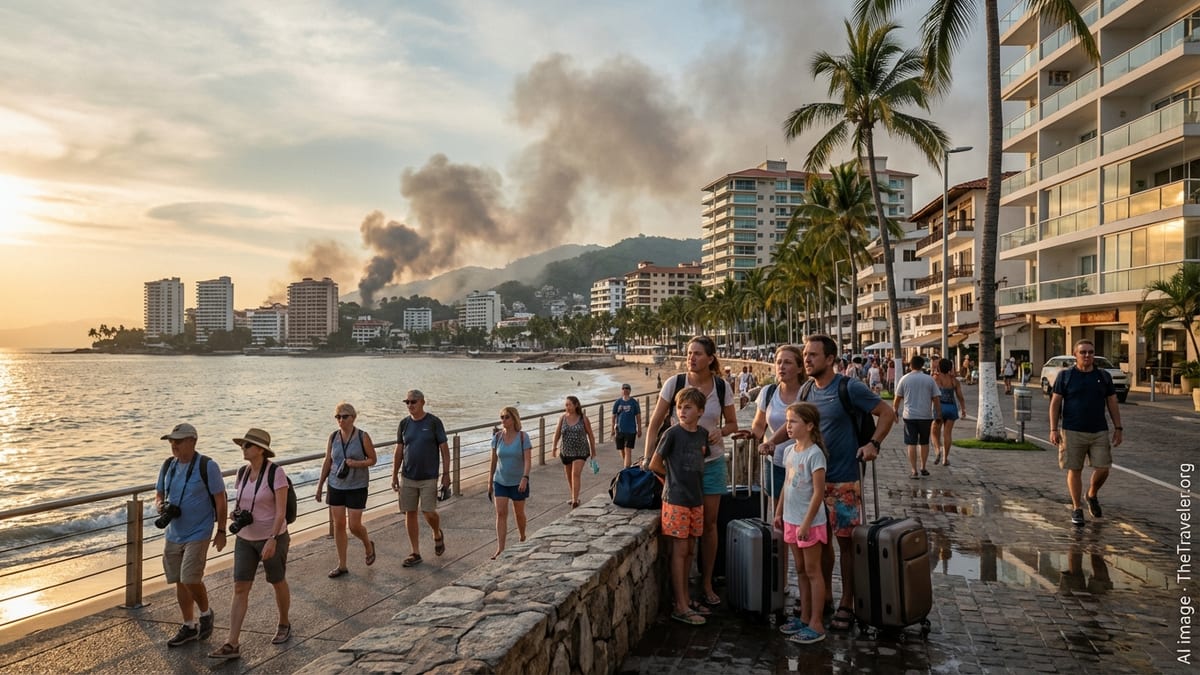
Some visitors described the surreal contrast between the calm within beachfront resorts and the plumes of smoke visible in the distance. Video clips taken from hotel balconies showed families walking along the sand while fire-blackened clouds rose behind the city skyline. Others recounted hearing sporadic pops that they believed were gunshots or small explosions somewhere inland.
Local authorities stressed that many popular tourist zones in Puerto Vallarta itself had not experienced direct attacks. However, they warned that conditions were volatile, particularly on highways and at key access points to the city, and that the primary threat for visitors lay in being caught on the roads during sudden blockades or clashes between security forces and armed groups.
U.S. and Canada Issue Shelter-in-Place Travel Alerts
In response to the fast-moving violence, the United States Embassy in Mexico issued an emergency alert on February 22, urging citizens in several states, including Jalisco, to shelter in place. The advisory specifically named Puerto Vallarta, Chapala and Guadalajara as locations in Jalisco where Americans should remain indoors, avoid crowds and stay away from areas of law enforcement activity.
The alert warned that ongoing security operations, road blockages and criminal activity had created unpredictable conditions, and that citizens should minimize unnecessary movement until further notice. Similar messages advised travelers to monitor local news, keep phones charged and follow instructions from hotel security and local authorities.
Canada’s government followed with its own warning, advising Canadians that a shelter-in-place order was in effect in Puerto Vallarta and cautioning against nonessential movement in affected areas. The United Kingdom and other European governments updated their Mexico travel advice, highlighting the situation in Jalisco and the possibility of further disruption in coming days.
These alerts come on top of preexisting security advisories that already urged travelers to exercise increased caution in parts of Mexico due to crime and kidnapping. What is different now, diplomats say, is the coordinated and highly visible nature of the unrest, along with its direct impact on air travel and major tourist infrastructure.
Airports Disrupted and Flights Canceled
Puerto Vallarta’s Licenciado Gustavo Díaz Ordaz International Airport quickly became one of the flashpoints in the crisis. On February 22, the airport announced that, although the facility remained secured by National Guard and army personnel, airlines had chosen to cancel all international operations and most domestic flights for the day, effectively freezing outbound travel for thousands of tourists.
Major carriers including United Airlines, American Airlines, Southwest and Air Canada suspended flights to and from Puerto Vallarta, citing the evolving security situation. Some airlines also canceled or limited flights to nearby Guadalajara, the state capital, even as airport officials there stressed that their terminals remained secure and fully functional.
By February 23, airlines were offering flexible rebooking policies for passengers scheduled to travel to or through Puerto Vallarta and Guadalajara over the following days. Travelers were urged to check directly with their carriers before leaving for the airport, as schedules continued to shift and some flights were reinstated while others remained grounded.
At Puerto Vallarta’s airport, images shared by stranded passengers showed crowded departure halls, long lines at airline desks and confusion among visitors unsure whether to remain at their hotels or attempt to reach the terminal. Authorities reiterated that the safest course of action was to avoid unnecessary road travel until the pattern of blockades and security operations became clearer.
Cruise Calls Scrapped and Tourism Industry Jolted
The disruption has not been limited to air travel. Puerto Vallarta is one of the most important cruise ports on Mexico’s Pacific coast, and the unrest quickly rippled into the cruise sector. Holland America Line canceled a scheduled call by one of its ships on February 23, rerouting the vessel to avoid Jalisco. Industry observers say more itinerary changes are likely if security conditions do not stabilize.
Puerto Vallarta’s economy is heavily dependent on tourism, attracting millions of visitors each year to its beaches, historic center and nearby coastal communities. Hotel associations and local business leaders expressed deep concern that images of smoke-filled skylines and highway blockades will have a chilling effect on future bookings, even if the current emergency proves short-lived.
In the immediate term, many hotels shifted their operations toward crisis management: reinforcing on-site security, extending in-house entertainment and meal services, and setting up information desks to keep guests updated on airport status and government advisories. Some properties offered late checkouts or complimentary nights to travelers unable to depart as scheduled.
Independent tour operators and small businesses, from whale-watching outfits to beachside restaurants, reported abrupt cancellations and a sudden halt in daily income. Several operators suspended excursions outside the central hotel zones, particularly trips that required use of regional highways or visits to nearby towns in the interior of Jalisco.
On the Ground: Confusion, Anxiety and Moments of Calm
For many travelers already in Puerto Vallarta, the last 48 hours have been marked by a mix of anxiety and relative calm. Inside gated resorts, guests continued to swim in pools, dine at on-site restaurants and stroll private beaches, even as staff quietly relayed updated instructions from management and local authorities.
At the same time, some visitors described hearing sirens and seeing emergency vehicles racing along the coastal boulevard, while social media feeds filled with reports of roadblocks outside the city and thick smoke billowing from burning vehicles in other parts of Jalisco. Parents with young children spoke of trying to balance safety concerns with efforts to keep family vacations as normal as possible within the confines of their hotels.
Longtime visitors to Puerto Vallarta expressed disbelief at the scale of the disruption in a destination long regarded as one of Mexico’s more stable resort cities. While the region, like much of the country, has contended with organized crime for years, the open show of force in response to El Mencho’s killing, combined with the rare shelter-in-place orders from foreign governments, has rattled even seasoned Mexico travelers.
Locals, for their part, emphasized that ordinary residents and workers are bearing the brunt of the uncertainty. Many hotel and restaurant employees faced difficulties commuting from suburban neighborhoods and nearby towns due to road closures, and some businesses closed early or did not open at all as a precaution.
What Travelers Need to Know Before Heading to Jalisco
For those with upcoming trips to Puerto Vallarta or elsewhere in Jalisco, the situation is fluid and requires close monitoring. Travel experts advise that the first step is to review government advisories issued by home countries and to register with consular services if available, so that new alerts are received promptly by email or text.
Potential visitors are also urged to maintain direct communication with airlines, cruise lines and tour operators, rather than relying solely on general news reports or social media posts. Many carriers are offering change-fee waivers or refunds for affected itineraries, but the terms can vary and may be updated as the situation evolves.
Those who decide to travel despite the warnings should be prepared for last-minute schedule changes and should avoid intercity road travel at night. Security specialists recommend using official taxi services or prearranged transfers rather than informal ride-hailing options, keeping a low profile in public, and steering clear of demonstrations, roadblocks or any visible law enforcement operations.
Travel insurance policies that cover trip interruption and security-related disruptions may offer some financial protection, though travelers are advised to read fine print carefully, as coverage for civil unrest can be limited or conditional on the timing of when a policy was purchased relative to the outbreak of violence.
Uncertain Outlook for a Flagship Beach Destination
The killing of El Mencho is being described by analysts as one of the most significant blows to an organized crime group in Mexico in recent years, but it has come at a high immediate cost for Jalisco’s tourism heartland. The very visibility of Puerto Vallarta and nearby coastal areas makes them sensitive to shifts in perception, with travelers quick to reroute to other sun destinations if they believe their safety may be at risk.
How long the current disruption will last is unclear. Mexican authorities insist that security forces are working to dismantle roadblocks, restore safe transit and prevent further retaliatory attacks. Still, cartel dynamics and power struggles are notoriously unpredictable, and the loss of a figure as central as El Mencho could trigger internal realignments and new conflicts that stretch well beyond the current news cycle.
For now, Puerto Vallarta finds itself in an uneasy limbo. On the surface, beaches remain golden, the Pacific is as calm as ever and resort pools are full. Yet beneath that postcard image lies a tense security operation, a shaken travel industry and thousands of visitors navigating a destination that, almost overnight, has become a symbol of how quickly paradise can be overshadowed by the realities of Mexico’s ongoing fight against organized crime.