

More news on this day
Charlotte is moving beyond its reputation as a fast-growing banking center to position itself as one of the United States’ most people-focused urban destinations, blending record visitor growth with investments in public spaces, cultural districts and lower-impact ways to explore the city.
Get the latest news straight to your inbox!
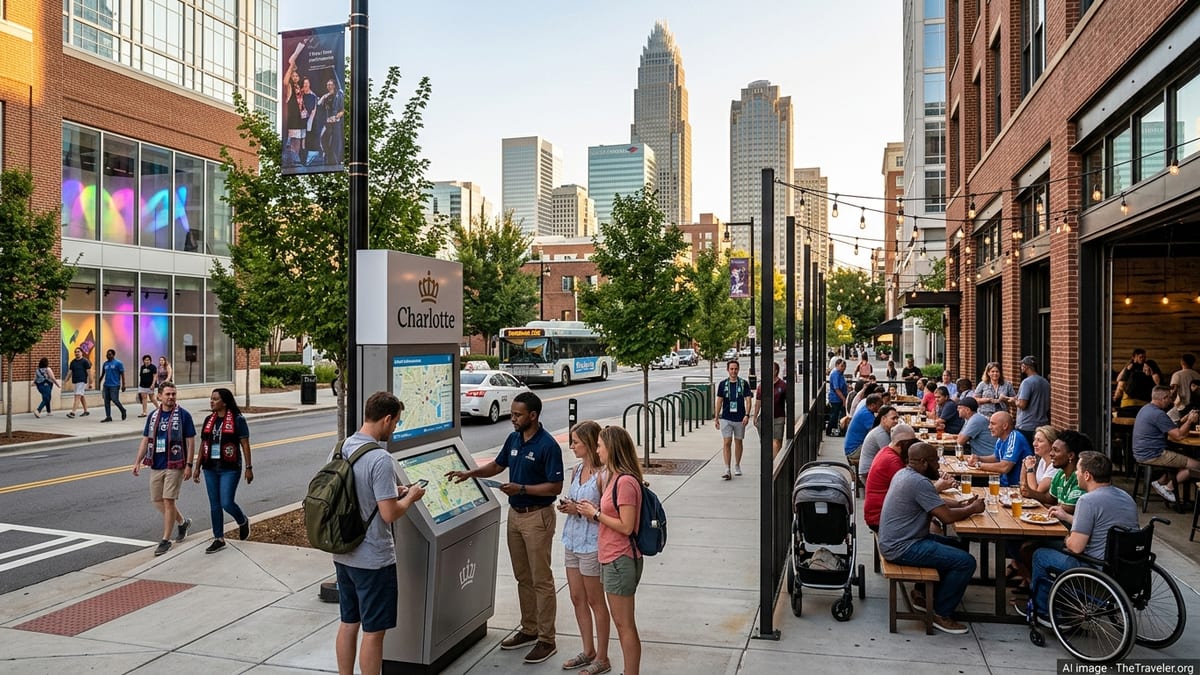
Image by Latest International / Global Travel News, Breaking World Travel News
From Busy Hub to Gateway for People-First Travel
Charlotte Douglas International Airport has emerged as a powerful entry point for the city’s evolving tourism strategy, pairing heavy passenger volumes with a stronger focus on traveler experience. Recent data indicates that the airport handled close to 59 million passengers in 2024, ranking among the busiest hubs in the world and reinforcing Charlotte’s role as a key connector for domestic and international travel. Despite some softening in traffic in early 2025, the long-term trend points to sustained demand for access to the region.
Publicly available information on planned infrastructure shows that the airport is using this demand to justify a major, long-horizon expansion of its terminal lobby, concourses and amenities. The completed lobby modernization, additional security screening capacity and upgrades to baggage systems are designed to make high volumes of passengers easier to move while shortening touchpoints that typically create stress for travelers.
Industry coverage highlights that the airport’s largest carrier is also reshaping its offerings around differentiated experiences. New premium lounges and more flexible club concepts are being introduced to accommodate both time-pressed business travelers and leisure visitors seeking a quieter space before flights. At the same time, the hub’s comparatively low operating costs and high share of connecting traffic are allowing the airport to add long-haul routes, such as the planned service to Abu Dhabi, that strengthen Charlotte’s profile on the global tourism map.
A separate economic impact study prepared for the airline sector reports that the CLT hub supports tens of billions of dollars in economic activity and well over one hundred thousand jobs across North Carolina. That scale has put pressure on the region to ensure that visitor growth is matched by investments in quality of life, sustainable transport and equitable access to the benefits of tourism for local residents.
Walkable Greenways and Parks Reframe Urban Exploration
On the ground, Charlotte is increasingly steering visitors away from car-centric sightseeing and toward parks and greenway corridors that double as both recreational amenities and tourism assets. The Little Sugar Creek Greenway, often cited as a showcase of urban creek restoration, has become a spine for walking and cycling that links neighborhoods, retail districts and public art. More recent work on additional greenway sections in south Charlotte has extended this network and given travelers new options to experience the city at a slower pace.
Revitalized urban parks are another anchor of this human-centered approach. Independence Park, which reopened following a multimillion-dollar renovation, offers new paths, restored landscaping and improved accessibility in one of the city’s historic public spaces. First Ward Park, conceived as part of a long-term vision for uptown, intertwines lawns, play areas and event space with adjacent housing, offices and light rail access, creating a pedestrian-friendly environment that is attractive to both residents and visitors.
Local planning documents and analysis by civic groups describe these investments as part of a broader shift toward “complete neighborhoods” where visitors can stay, dine and explore without depending heavily on cars. For travelers, that increasingly means itineraries that combine museum visits with time in green spaces, or business trips that include a jog or bike ride along a connected greenway system minutes from major hotels.
These outdoor amenities also dovetail with rising interest in wellness-focused travel. Tourism operators and destination marketers are beginning to highlight the city’s parks and trails as key differentiators within the competitive landscape of Sun Belt cities, reinforcing the message that Charlotte can handle big-city visitor numbers while still offering breathable, human-scale environments.
Cultural Districts Emphasize Local Stories and Inclusive Access
Charlotte’s cultural institutions are playing a growing role in this people-first tourism narrative. The Levine Center for the Arts, which concentrates contemporary art, performing arts and heritage institutions in a walkable cluster uptown, has become a focal point for culture-led itineraries. The campus layout makes it possible for visitors to experience multiple venues in a single day, while outdoor plazas encourage lingering rather than quick in-and-out museum stops.
Beyond the central arts campus, neighborhoods such as South End and Camp North End are illustrating how adaptive reuse and creative clustering can shape visitor experiences. Former industrial sites have been transformed into mixed-use districts featuring local food concepts, artist studios, design shops and event spaces. Sustainability-focused organizations regularly use these areas to host tours and gatherings that highlight recycled materials, energy-efficient retrofits and support for local entrepreneurs.
Reports from city economic development agencies point to these districts as important magnets for talent and tourism, complementing Charlotte’s more traditional draws such as professional sports and motorsports heritage. By emphasizing local businesses and walkable streetscapes, the districts encourage spending that stays within the regional economy and help visitors connect with Charlotte’s distinct identity rather than experiencing only generic national brands.
At the same time, cultural programming is increasingly framed around inclusivity and representation, with institutions and community partners working to surface stories from historically underrepresented communities. For visitors, that mix of art, history and lived experience creates richer, more grounded encounters with the city, aligning with a broader global trend toward travel that feels authentic and connected to place.
Sustainable Growth Becomes a Strategic Imperative
As visitor numbers rise, Charlotte faces the challenge of balancing growth with environmental and social sustainability. Aviation and tourism are significant contributors to carbon emissions, and available industry analyses underscore the need for airports and destinations to adopt greener practices. In Charlotte’s case, recent updates highlight a push toward infrastructure that is more energy-efficient, along with exploration of touchless technologies that can streamline processing and reduce physical bottlenecks.
Regional tourism reports also show strong year-over-year gains in visitor spending in Mecklenburg County, reaching well into the billions of dollars. That revenue is helping finance infrastructure such as expanded light rail, streetscape improvements and public realm upgrades, which in turn can reduce reliance on private vehicles and improve the everyday experience of moving around the city. For both residents and visitors, better transit options and safer pedestrian environments are key ingredients of a human-centered destination.
Local climate and business coalitions are increasingly positioning Charlotte as a laboratory for low-carbon development, with initiatives that range from adaptive reuse of existing buildings to advocacy for higher building-performance standards. Events that combine sustainability tours with locally sourced food and discussion sessions are drawing interest from business travelers and conference groups who want experiences that align with their organizations’ environmental and social goals.
In practice, the city’s tourism strategy is evolving toward a model where success is measured less by raw visitor counts and more by quality of experience, distribution of economic benefits and the long-term resilience of its infrastructure. That approach is still taking shape, but Charlotte’s rapid growth, expanding air links and investment in public spaces are giving it a high-profile platform to define what a human-centered tourism boom can look like in a major U.S. city.