

More news on this day
Charlotte, North Carolina is emerging as one of the United States’ most closely watched tourism success stories, pairing record-breaking visitor growth with a deliberate shift toward human-centered, sustainable travel experiences.
Get the latest news straight to your inbox!
Record Tourism Growth Fuels a New Visitor Economy
Recent impact reports indicate that Charlotte’s visitor economy has moved into a new gear, with tourism and events generating more than 1.1 billion dollars in economic impact in fiscal year 2024 and rising to around 1.2 billion dollars in 2025. The Charlotte Regional Visitors Authority’s activities, including major conventions, sports and cultural events, are credited with helping drive that growth as the city competes more aggressively with larger U.S. markets.
At the county level, publicly available data from North Carolina’s tourism studies show Mecklenburg County leading the state with billions in annual visitor spending and posting mid to high single-digit percentage growth in recent years. Analysts describe the pattern as a decisive rebound from the pandemic period, with Charlotte now outpacing many peers in both leisure and event-driven travel.
Observers note that the expansion is not only about raw numbers. Local economic development coverage points to tourism as a pillar of Charlotte’s broader business strategy, supporting tens of thousands of jobs in hospitality, transportation, entertainment and services. The sector’s tax contributions have become a significant funding source for public projects, reinforcing why the city is eager to keep visitors coming while refining how they experience the destination.
Industry commentary suggests Charlotte’s approach is increasingly shaped by visitor expectations for more meaningful, customized journeys. That demand is pushing local operators and planners to evolve beyond traditional attractions into experiences that invite participation, learning and community connection, all while monitoring the impacts of rapid growth on residents and infrastructure.
Human-Centered Experiences Redefine What to Do in Charlotte
One of the clearest indicators of Charlotte’s human-centered tourism shift is the rise of immersive and interactive attractions designed around how people actually want to spend their time. Arts and entertainment organization Blumenthal Arts has leaned into experiential concepts, with Blume Studios in Uptown and the nearby Iron District hosting multimedia exhibitions and participatory shows that encourage guests to move, explore and co-create rather than passively watch.
Reports on these venues emphasize features such as open-concept layouts, flexible staging and advanced projection and sound systems that envelop visitors. Early programming has included large-scale virtual reality journeys, interactive dining theater and rotating installations that blend digital storytelling with physical sets. Accessibility and inclusive design are highlighted as core considerations, from wayfinding and seating to sensory-friendly accommodations.
Beyond the arts, Charlotte’s entertainment scene increasingly revolves around live, social experiences. Coverage of events ranging from professional sports and college championships to novelty baseball exhibitions and game-show-style attractions notes how organizers focus on fan engagement, with pre- and post-event activations, neighborhood pop-ups and family-friendly programming that invite visitors into the city rather than keeping them confined to a single venue.
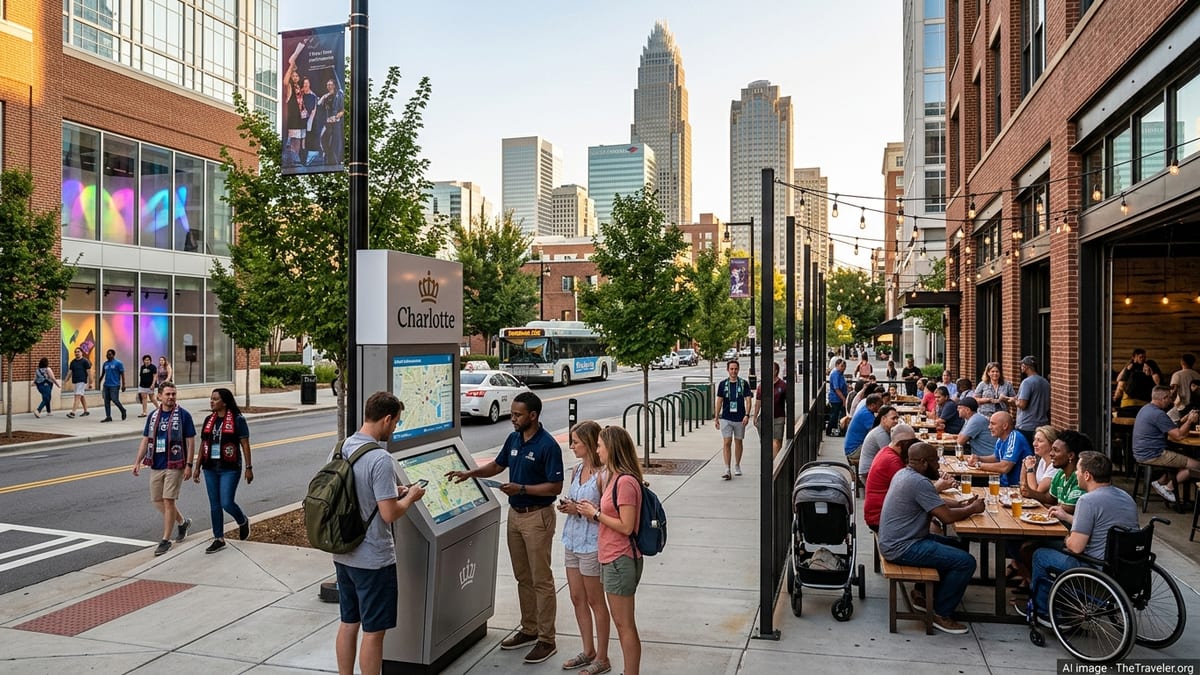
Even the city’s main visitor center has been reimagined. Design firms involved in the space describe it as a modern, interactive hub that integrates digital storytelling, retail and local food with staffed guidance. The goal is to help travelers co-design their stay in real time, using touchpoints across Uptown and nearby districts to discover lesser-known neighborhoods, cultural institutions and small businesses.
Sports, Culture and Neighborhoods Drive People-First Storytelling
Charlotte’s tourism strategy leans heavily on sports and live events, but the narrative around those draws has shifted toward the people and places surrounding them. Recent event summaries show that college football championships, soccer friendlies, motorsports and special baseball events have delivered tens of millions of dollars in direct visitor spending and filled tens of thousands of hotel rooms, yet much of the attention now centers on how those visitors interact with the city’s districts.
Hospitality and economic development reports stress the spillover effects into Uptown restaurants, breweries, galleries and small retailers, particularly during packed weekends when multiple events converge. High hotel occupancy during headline events has been accompanied by strong bookings for neighborhood tours, museum visits and outdoor activities, suggesting that out-of-town guests are increasingly using major matches or concerts as anchors for longer, more varied stays.
Cultural institutions have also embraced people-first storytelling. Museums, historic sites and performance venues around the city are incorporating more local voices, contemporary themes and interactive elements that invite dialogue about Charlotte’s history and rapid transformation. Community-focused festivals and public art initiatives in emerging districts seek to connect visitors with residents through music, food and shared spaces rather than confining tourism to a few blocks of Uptown.
This approach is supported by marketing campaigns that spotlight individual makers, chefs, artists and entrepreneurs, framing Charlotte as a mosaic of human stories. Tourism commentators say this style of promotion aligns with broader trends in travel, in which visitors increasingly look for authentic, face-to-face connections rather than standardized itineraries.
Sustainability and Accessibility Embedded in Growth Plans
While Charlotte’s visitor numbers continue to climb, planners and industry leaders are placing growing emphasis on sustainable and inclusive growth. Statewide tourism strategies and the Charlotte Regional Visitors Authority’s multi-year plans reference long-term competitiveness, community benefits and responsible development as key priorities for the city’s visitor economy.
Major infrastructure investments, such as expansion at Charlotte Douglas International Airport and improvements to convention and sports facilities, are being framed in terms of both capacity and quality of experience. Public documents describe a focus on smoother passenger flows, enhanced transit connections, improved walkability and upgrades that reduce environmental impact through energy efficiency and modernized systems.
Accessibility is another pillar of Charlotte’s human-centered tourism agenda. Venue operators highlight efforts to meet or exceed federal accessibility standards for new and renovated spaces, including immersive arts facilities and stadium enhancements. In practice, that includes more flexible seating, better sightlines, accessible digital content and staff training intended to make visitors with disabilities feel welcome and supported.
Industry analyses also point to increased collaboration between tourism advocates, urban planners and community organizations on how visitor spending can support long-term goals such as small-business resilience, public-space activation and cultural preservation. The aim is to ensure that the benefits of growth extend beyond hotel corridors to neighborhoods across the metropolitan area.
Data-Driven Marketing Targets Quality of Visit, Not Just Volume
Behind Charlotte’s tourism boom is an increasingly data-driven approach that focuses on the quality of each trip as much as overall headcounts. State tourism agencies working with research partners have reported measurable gains in visitor intent and spending tied to targeted campaigns, while local reports cite millions of “incremental trips” generated by marketing that positioned Charlotte as a vibrant, easy-to-access hub.
Travel behavior studies show that visitors drawn by these campaigns are more likely to stay longer, spend more and explore multiple parts of the metro area. Rather than chasing mass-market promotions, Charlotte’s tourism marketers are segmenting audiences, tailoring messages for sports fans, business travelers, families and culture seekers, and then tracking how those segments move through the city once they arrive.
Publicly available summaries of these efforts describe an emphasis on storytelling formats that work across digital channels, including short-form video, social content and influencer collaborations that highlight specific experiences such as immersive art shows, rooftop dining or neighborhood street festivals. The intent is to set expectations before arrival, then encourage on-the-ground exploration that feels spontaneous but is supported by clear information and wayfinding.
As Charlotte looks ahead to another packed calendar of sports, conventions and cultural events in 2026, tourism analysts expect the city to continue refining this human-centered model. The combination of record demand, people-first experience design and a growing focus on sustainability is positioning the Queen City as a case study in how U.S. destinations can grow tourism while keeping residents and visitors at the heart of the story.