

More news on this day
Flights serving the Washington, D.C., region were briefly halted Friday evening after a strong chemical smell was reported at the Potomac Consolidated TRACON air traffic control center, prompting a temporary ground stop at several major airports and delays across the mid-Atlantic network.
Get the latest news straight to your inbox!
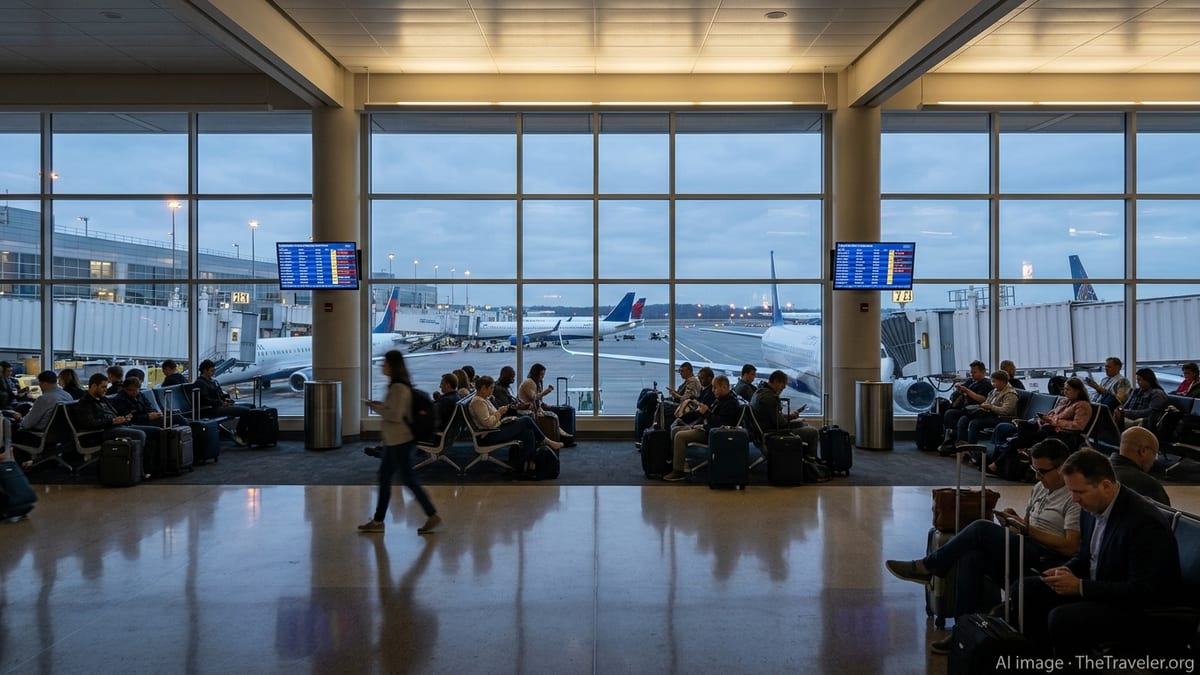
Ground Stop Ripples Across Washington-Area Airports
Publicly available information indicates that the Federal Aviation Administration temporarily stopped traffic to multiple Washington-area airports, including Ronald Reagan Washington National, Washington Dulles International and Baltimore-Washington International Thurgood Marshall. Regional airports in Charlottesville and Richmond, Virginia, were also affected as controllers vacated work areas at the Potomac Consolidated TRACON facility in Warrenton, Virginia.
The halt, which occurred during the busy early evening period on Friday, led to a brief but widespread suspension of both arrivals and departures. Coverage from national and local outlets describes a ground stop lasting longer than an hour at some airports, with flights already in the air forced to hold or divert and departures waiting at gates or on taxiways.
Social media posts from travelers described full shutdowns of operations at Reagan National and long lines forming at gates as departure times slid repeatedly. Aircraft scheduled to land in the capital region were rerouted to airports such as Pittsburgh and Norfolk, contributing to congestion at those alternate hubs while controllers worked to restore normal operations.
By later in the evening, the FAA had lifted the ground stop, and airports reported that flights were again moving. However, residual delays extended into the night as airlines repositioned aircraft and crews and worked through backlogs of passengers displaced by the disruption.
Chemical Smell at Potomac TRACON Triggers Safety Response
The incident centered on Potomac Consolidated TRACON, a terminal radar approach control facility that manages arrivals and departures for a wide swath of airspace over the Washington metropolitan area, Baltimore and parts of Virginia. According to published coverage, a strong chemical odor was detected inside the building, affecting some air traffic controllers and prompting the precautionary response.
TRACON facilities handle low- to mid-level air traffic as aircraft transition between high-altitude en route centers and airport control towers. Because Potomac TRACON is responsible for approach and departure services at several of the region’s busiest airports, even a localized issue there can have fast-moving consequences across the broader airspace system.
Reports indicate that staff temporarily left workstations while emergency responders and technical specialists assessed the source of the smell. Controllers began returning to duty once checks were completed and the building was deemed safe, allowing the facility to ramp back up and gradually restore standard separation and routing procedures.
This is not the first recent disruption linked to odors at Potomac TRACON. Public reports note a similar event earlier in the month in which a strong smell, later associated with an electrical circuit issue, also prompted a brief pause in regional traffic. The latest incident is likely to intensify attention on the facility’s infrastructure and environmental systems.
Travelers Face Delays, Diversions and Limited Information
For passengers across the Washington region, the halt translated into hours of uncertainty. Firsthand accounts shared on social platforms describe travelers sitting onboard aircraft at gates or on taxiways, deplaning and reboarding as airlines adjusted to changing estimates for when the ground stop would lift.
Some travelers reported diversions to airports as far away as Pittsburgh when airspace serving the capital region temporarily closed. Others detailed missed connections, cascading delays and difficulty rebooking as evening schedules tightened and alternative options filled up.
While aviation data indicated delays of up to several hours for some departures, the level of information provided at individual airports varied. Posts from passengers suggested that some carriers were slow to communicate the underlying cause, even as flight-tracking tools and news outlets began to detail the air traffic control center issue.
By late evening, airlines were working to re-accommodate disrupted customers and reposition aircraft. Travel advisories from local agencies in nearby cities, including New York, urged passengers headed to the Washington area to check flight status carefully and be prepared for potential cancellations or extended waits.
Impact on the National Airspace and Ongoing Questions
The disruption underscored how a localized problem at a single control facility can ripple through a large segment of the National Airspace System. With Potomac TRACON responsible for handling approach and departure flows for multiple high-traffic airports and for managing airspace within the Washington Special Flight Rules Area, shutting or scaling back its operations quickly constrains capacity.
While high-altitude traffic controlled by en route centers can sometimes continue with reroutes around affected regions, the loss of a major TRACON’s full capability typically forces regulators and airlines to reduce departures and meter arrivals significantly. That dynamic was evident Friday, as departure queues lengthened and aircraft inbound to the capital region were held or diverted.
Published reporting indicates that investigators are examining what produced the chemical odor at the Warrenton facility. The earlier incident this month, traced to an overheated circuit board, has already prompted questions among aviation observers about the resilience of building systems that support critical air traffic operations.
Safety advocates have long highlighted the importance of maintaining robust ventilation, fire detection and equipment cooling systems at control centers to protect workers and avoid operational interruptions. Recent federal reviews of air traffic infrastructure have pointed to aging facilities and deferred maintenance as emerging risks for a system that depends heavily on redundant, well-conditioned environments.
What Passengers Should Know for Upcoming Trips
Although the immediate ground stop has ended, airlines and airports warn that some knock-on disruption can persist after an event of this scale. Crews and aircraft may still be out of position, and evening delays can bleed into early-morning operations if overnight recovery is incomplete.
Travel industry guidance generally advises passengers booked through Ronald Reagan Washington National, Washington Dulles, Baltimore-Washington International, Richmond International or Charlottesville-Albemarle in the next day or so to monitor flight status frequently. Checking both airline notifications and airport dashboards before leaving for the airport can help travelers avoid unnecessary waits in terminals.
Passengers who experienced lengthy delays or diversions during the incident may also wish to review airline policies on meal vouchers, hotel accommodations and rebooking options, which vary by carrier and the cause of the disruption. While weather-related delays often limit compensation, operational issues tied to infrastructure can lead to more flexible arrangements in some cases.
For now, publicly available information suggests that flight operations in the Washington region are returning to normal, even as aviation regulators and facility managers review the latest chemical odor episode at Potomac TRACON and consider additional measures to prevent a repeat during one of the country’s busiest spring travel periods.