

More news on this day
Flights into and out of the Washington, DC region were abruptly halted on Friday evening, March 13, after a reported strong chemical odor inside the Potomac TRACON radar facility forced air traffic controllers to stop operations, triggering an unprecedented ground stop at four major airports serving Washington, Baltimore, and Richmond.
Get the latest news straight to your inbox!
What Happened at Potomac TRACON
Publicly available information from the Federal Aviation Administration and national news outlets indicates that the disruption began in the early evening when a strong chemical smell was reported inside the Potomac Terminal Radar Approach Control facility in Warrenton, Virginia. Potomac TRACON manages approach and departure traffic for Ronald Reagan Washington National (DCA), Washington Dulles International (IAD), Baltimore-Washington International Thurgood Marshall (BWI), and Richmond International (RIC), making it a critical node for Mid-Atlantic airspace.
Coverage from major news agencies describes the response as an emergency operational shutdown of the facility’s normal functions, effectively putting large portions of the region’s controlled airspace into an “ATC zero” condition, in which a facility can no longer safely provide air traffic services. In practical terms, this meant aircraft could not be safely sequenced in or out of the affected airports until alternative procedures were in place or the facility was able to resume work.
According to initial reports, flights at all four airports were halted for more than an hour, with some departures slowly resuming after 7 p.m. Eastern Time. Arrivals, however, continued to face restrictions and diversions while contingency measures were implemented. Social media posts from passengers and aviation enthusiasts tracking the situation showed dense holding patterns, diversions to other East Coast hubs, and aircraft waiting on ramps for clearance to depart.
As of the latest available updates late Friday and into Saturday, operations at the airports were moving toward recovery, but with lingering knock-on delays. There were no immediate public indications of injuries associated with the odor, and details on the source of the smell had not yet been fully disclosed in official public summaries.
Impact on Washington, Baltimore, and Richmond Airports
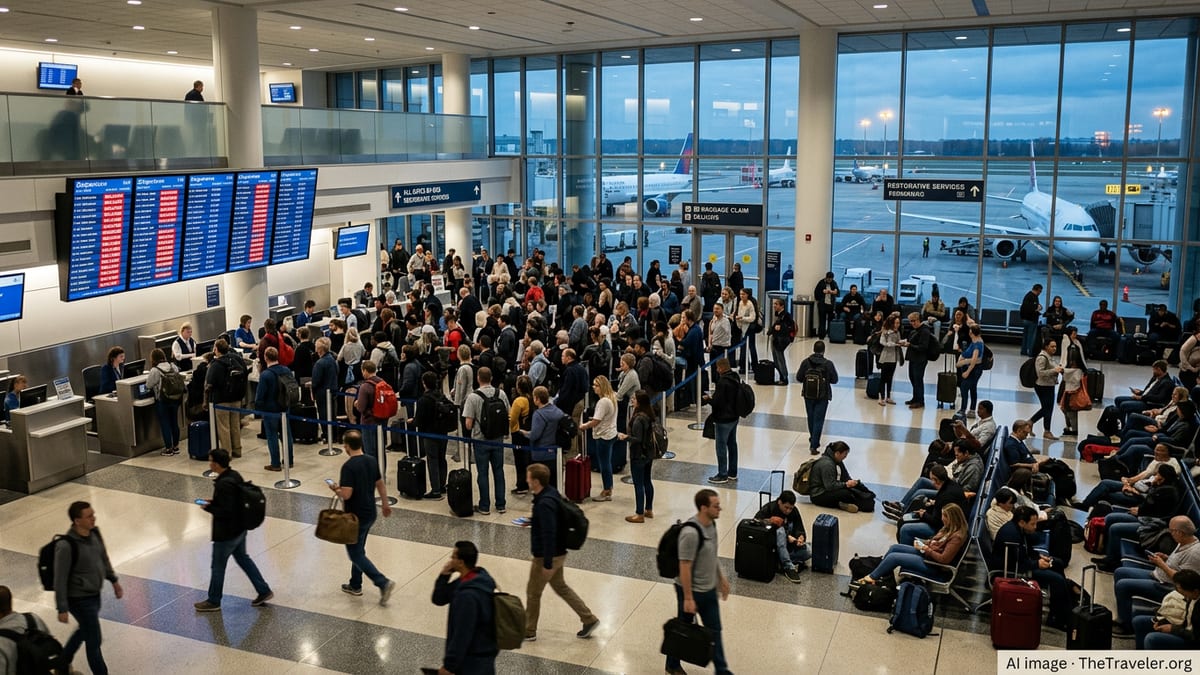
The immediate effect at the passenger level was a sudden standstill at terminals across the region. Reports from on-the-ground coverage and traveler accounts describe departure boards at DCA, IAD, BWI, and RIC rapidly shifting from “on time” to “delayed” or “canceled” as the ground stop took hold. With Potomac TRACON offline, controllers could not safely manage the complex, tightly choreographed flow of aircraft that normally move through the shared airspace around the nation’s capital.
National aviation tracking data cited in media reports shows average departure delays climbing toward or beyond the two-hour mark at times for the busiest hubs. A significant share of flights scheduled for the evening departure banks were delayed, with some carriers choosing to cancel rotations outright when projected knock-on effects extended late into the night.
The breadth of the impact went beyond the metropolitan Washington region. Because the affected airports serve as key connecting points in several domestic networks, the disruption quickly rippled outward. Flights bound for the DC, Baltimore, and Richmond area were held at origin, diverted to alternate airports, or forced into extended holding patterns while traffic managers assessed capacity.
For international and long-haul services into Dulles, the timing of the incident overlapped with peak evening arrival waves. Some long-range flights already airborne faced potential diversions, while others scheduled to depart from overseas hubs were subject to delays as airlines waited for clarity on the status of the airspace and available arrival slots.
How Airlines and the FAA Managed the Crisis
Based on publicly available descriptions of the response, the FAA enacted a formal ground stop affecting arrivals into the four airports while also restricting departures until alternative handling arrangements could be made. Under standard “ATC zero” protocols associated with major facility outages, surrounding air route traffic control centers can assume limited functions, and some procedures can be shifted to nearby facilities, but overall capacity is significantly reduced.
Airlines appeared to respond by implementing a mix of rolling delays, rerouting, and preemptive cancellations. Operational updates shared through airline apps and airport information systems showed departure times repeatedly pushed back in 15 to 60 minute increments as the status of Potomac TRACON evolved. In many cases, crews and aircraft timed to fly later legs in the evening could no longer complete their scheduled rotations, introducing additional disruption into Saturday morning schedules.
Industry analysts quoted in aviation-focused coverage noted that terminal radar approach facilities like Potomac TRACON handle some of the most complex phases of flight, often coordinating simultaneous operations at multiple airports within the same airspace. A sudden interruption at such a facility therefore has an outsized effect, compared with more localized issues such as a runway closure or a short-lived tower communication outage at a single field.
While detailed technical information about the chemical odor incident had not been fully outlined in publicly available safety summaries as of Saturday morning, the event is expected to be reviewed under established FAA safety and occupational health procedures. Future documentation typically addresses how air traffic services were maintained or restored, what mitigation measures were used, and whether any facility upgrades or protocol changes are recommended.
What Travelers Need to Know This Weekend
For travelers holding tickets into or out of DCA, IAD, BWI, or RIC over the remainder of the weekend, the immediate emergency has begun to ease, but residual disruption is likely. Airlines often need several operational cycles to reposition aircraft and crews after a shock of this magnitude, particularly when it coincides with busy Friday evening schedules.
Public flight-tracking data and airport status boards early Saturday suggest that some flights are operating close to schedule, while others remain delayed as carriers work through backlog and crew duty-time limits. Travelers connecting through the region may be especially vulnerable to missed connections if their inbound legs experience even minor additional delays.
Travel advisories from multiple carriers indicate that some are offering flexible rebooking options for affected passengers, particularly those scheduled to travel during the hours surrounding the ground stop. In similar large-scale disruptions, airlines sometimes allow customers to change to alternative flights within a defined date range and fare class without additional fees, though specific policies vary by carrier and ticket type.
For those already en route, the most practical step is to rely on real-time digital tools such as airline mobile apps, text alerts, and airport display systems, which typically update faster than general news summaries. Travelers beginning trips later in the day may wish to arrive at the airport earlier than usual in case check-in lines and security screening queues swell due to rebooked passengers and condensed departure waves.
Broader Questions About Airspace Resilience
The Potomac TRACON shutdown highlights broader questions about the resilience of the United States air traffic system, particularly around high-density, security-sensitive airspace like that surrounding the nation’s capital. Terminal radar approach facilities are designed with redundancy and backup procedures, but an incident severe enough to disrupt controllers inside the building, such as a suspected chemical odor, can temporarily overwhelm these safeguards.
Recent years have seen several high-profile disruptions involving critical aviation infrastructure, including large-scale software outages and localized air traffic facility evacuations. Analysts cited in trade press and transportation coverage have argued that these incidents underline the importance of modernizing both physical facilities and legacy systems, as well as strengthening contingency planning for rare but highly disruptive events.
For travelers, the incident is a reminder that even routine domestic journeys can be affected by comparatively obscure pieces of infrastructure located far from terminal concourses. A single radar room in rural Virginia, largely invisible to the traveling public, effectively halted operations at four major airports and disrupted travel plans across the country for much of an evening.
As formal investigations and after-action reviews move forward, attention is likely to focus on what safeguards can be enhanced at facilities like Potomac TRACON, and how quickly alternate control arrangements can be brought online when a key approach-control center is suddenly unavailable. For the millions of passengers who pass through Washington, Baltimore, and Richmond each year, the answers will play an important role in how robust the region’s skies feel the next time traffic clouds begin to build.