

More news on this day
China Eastern Airlines is set to restore nonstop flights between Shanghai Pudong and Stockholm Arlanda in late June 2026, reopening a key air bridge between Sweden and China that has been dormant since before the pandemic and offering travelers faster, visa-friendly access in both directions.
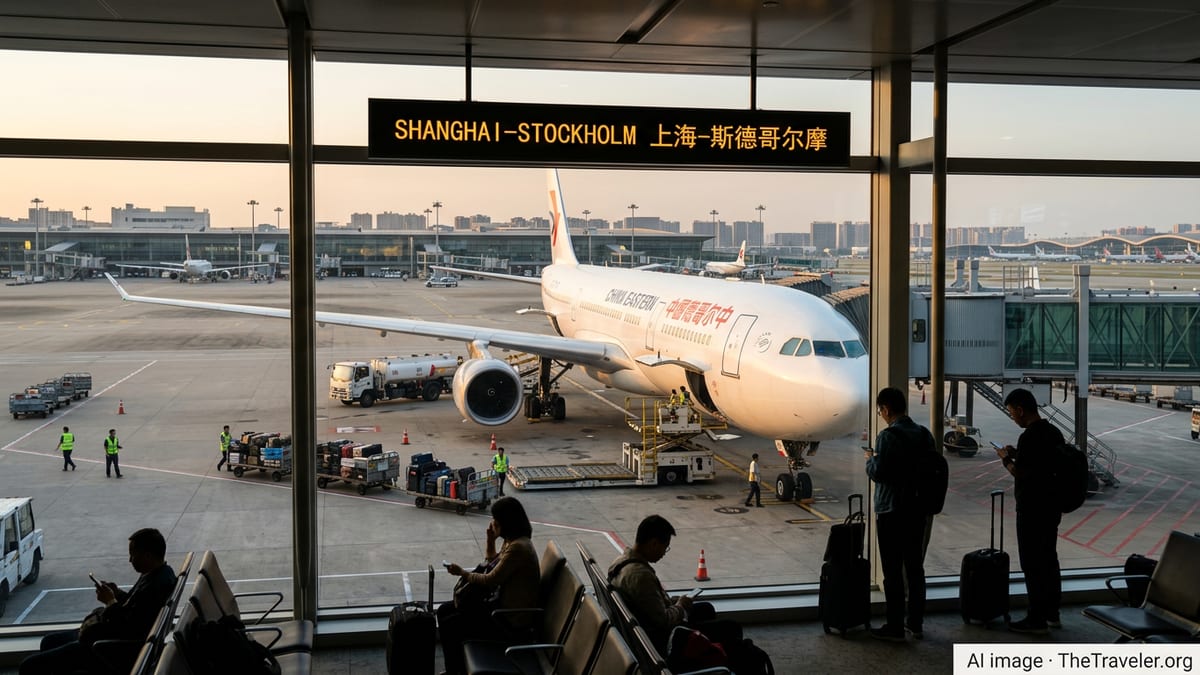
Nonstop Shanghai–Stockholm Flights Return After Years of Suspension
China Eastern has filed plans to resume its Shanghai Pudong to Stockholm Arlanda service from late in the second quarter of 2026, with reservations now open for the summer season. Industry schedules show the carrier re-entering the Swedish market after several years away, in a move that reflects both recovering demand and intensifying competition for China–Europe traffic.
The airline last served Stockholm before the pandemic, with the route suspended amid international travel restrictions and a major retrenchment of long haul capacity. Its return places Sweden back on China Eastern’s European network map alongside established gateways such as Amsterdam and Rome, and follows a broader rebuilding of the carrier’s long haul schedule through 2025 and 2026.
For travelers, the reinstated link means the end of obligatory detours via hubs such as Doha, London or Helsinki to reach Shanghai from Sweden. It also restores a direct option for Chinese visitors heading to Scandinavia, a region that has seen particularly strong demand for nature-focused itineraries and winter tourism.
Seat maps and provisional schedules indicate that the Shanghai–Stockholm operation will be timed to connect with China Eastern’s domestic and regional services at Shanghai Pudong, creating a one-stop option from Stockholm to cities across mainland China and parts of East and Southeast Asia.
What Travelers Can Expect From the New Service
While final operational details remain subject to change ahead of launch, the resumed route is expected to operate several times per week between Shanghai Pudong and Stockholm Arlanda, with overnight flights in at least one direction to maximize aircraft utilization and connectivity. The schedule will allow same-day onward connections in Shanghai to key cities such as Beijing, Guangzhou, Chengdu and Kunming.
China Eastern is likely to deploy widebody aircraft configured with economy, premium economy and business cabins, aligning the Stockholm service with its other European routes. Travelers can expect a modern inflight product familiar from the carrier’s existing long haul network, including seatback entertainment, Chinese and Western meal options and Mandarin- and English-speaking cabin crews.
The restoration of a nonstop option also brings practical advantages beyond comfort. By cutting out intermediate transfers, passengers reduce the risk of missed connections and lost baggage, while trimming several hours off itineraries that currently zigzag through the Middle East or continental hubs. For time-sensitive business travelers commuting between Sweden and China’s financial capital, the new schedule is expected to be particularly attractive.
Travel agencies in both markets are already highlighting the route as a fresh alternative for itineraries that link Sweden with China’s secondary cities. With Shanghai acting as a major domestic hub, the new nonstop service effectively plugs Stockholm into a much denser Chinese network than was available via many existing one-stop options.
Impact on Sweden–China Tourism and Business Links
The return of China Eastern to Stockholm carries wider significance for bilateral ties, coming as both Sweden and China seek to revitalize tourism and business travel in the post-pandemic era. Swedish tourism authorities have long viewed China as a high-growth market, with visitors drawn to northern lights experiences, Arctic landscapes and design-focused city breaks in Stockholm and Gothenburg.
A nonstop connection from Shanghai, one of China’s wealthiest and most globally connected cities, is expected to support higher-spending leisure segments and more frequent short breaks. Tour operators anticipate renewed interest in multi-country Nordic itineraries using Stockholm as a gateway, linking Sweden with Norway and Finland on the same trip.
On the outbound side, Swedish travelers gain a direct corridor to Shanghai’s financial district, consumer markets and innovation clusters. For companies with manufacturing, sourcing or R&D operations in China, the ability to send teams nonstop between the two cities reduces travel friction and can make regular site visits more realistic within a standard workweek.
Economists note that air connectivity tends to track trade and investment flows, and the resumption of this route is seen as both a response to and a catalyst for deepening commercial ties. Swedish and Chinese chambers of commerce are likely to leverage the new service in promotional campaigns, positioning it as a symbol of renewed engagement.
How the Route Fits Into China Eastern’s 2026 Network Strategy
The decision to bring back Shanghai–Stockholm fits into a broader 2026 expansion strategy by China Eastern, which has announced a series of long haul resumptions and launches as international demand rebounds. Recent moves include new or restored services to destinations such as Adelaide and Abu Dhabi, alongside capacity increases on established European routes.
Industry analysts say the airline is selectively rebuilding its European footprint, targeting cities where it can capture both point-to-point demand and connecting traffic over Shanghai. Stockholm’s role as a northern European hub and its strong Scandinavian catchment area make it a logical candidate for reactivation as travel from China normalizes.
The route also highlights evolving competitive dynamics in the China–Europe market. With many European carriers still constrained by Russian airspace restrictions and higher operating costs on alternative routings, Chinese airlines have been able to offer shorter flight times and, in some cases, more competitive fares. A nonstop Shanghai–Stockholm service taps into that advantage while challenging one-stop offerings via the Gulf states and continental hubs.
For Sweden’s main gateway, the return of a Chinese flag carrier strengthens Arlanda’s long haul portfolio and supports the airport’s ambitions to expand its intercontinental reach. Airport operators are expected to work closely with China Eastern on marketing campaigns targeting both leisure and corporate segments ahead of the first flights.
Key Planning Tips for 2026 Travelers Between Sweden and China
With seats now on sale for the resumed Shanghai–Stockholm route, travelers planning 2026 trips between Sweden and China should begin monitoring fares and schedules early, especially for peak summer dates. Nonstop services typically command a premium over one-stop alternatives, but introductory fares and promotional campaigns may offer opportunities for savings in the first months of operation.
Passengers should pay close attention to connection times in Shanghai if they plan to travel onward within China or to neighboring countries. While the new route will unlock convenient same-day options, transit formalities, baggage recheck requirements and visa rules can vary depending on the final destination and ticket type.
Travel experts also advise checking the specific terminal and check in arrangements at both Shanghai Pudong and Stockholm Arlanda, as well as the aircraft type scheduled for each flight, to understand cabin layouts and seat options. For frequent travelers, the route’s integration with global airline partnerships and loyalty programs may influence whether it becomes a preferred corridor.
As 2026 approaches, both Swedish and Chinese authorities are expected to regularly update entry rules, health requirements and visa processing times. Travelers booking the new nonstop service are encouraged to track official government guidance and airline communications closely, but the restoration of a direct link itself is widely viewed as a sign of growing stability and confidence in the Sweden–China travel market.