

More news on this day
Passengers across China reported scenes of confusion and mounting frustration on Thursday as severe disruption at four key airports left hundreds of travelers stranded and scrambling to rebook journeys at the height of the spring travel period.
Get the latest news straight to your inbox!
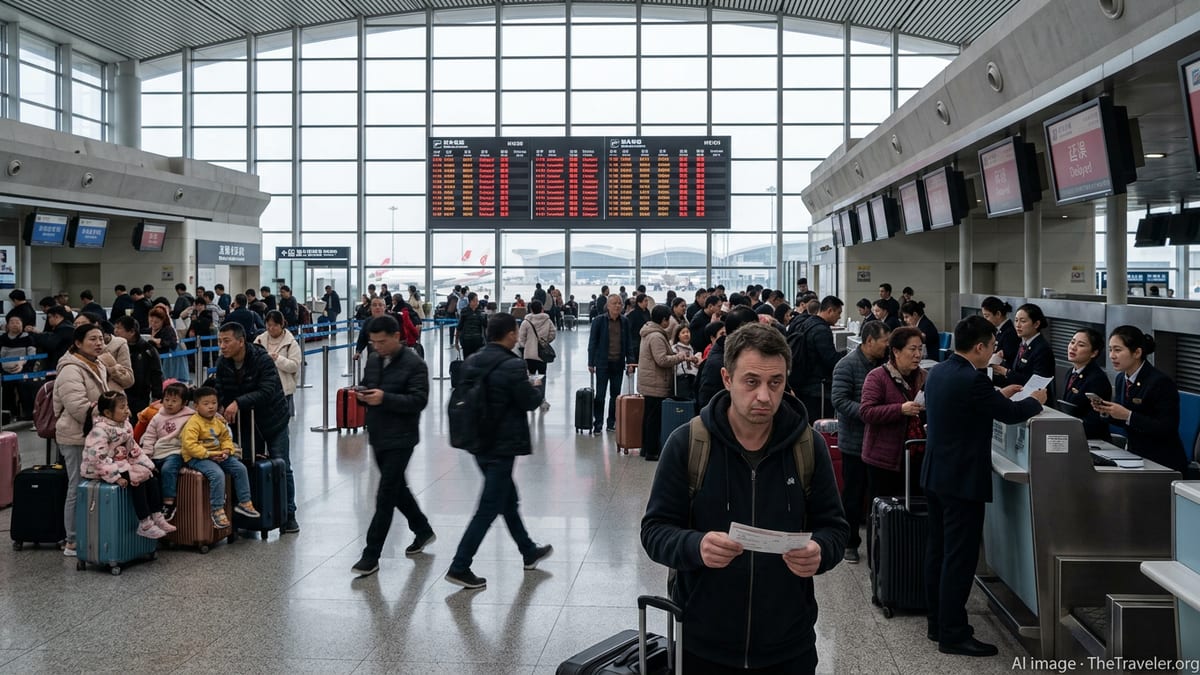
Widespread Disruption From Xinjiang to the Yangtze Delta
According to aggregated data from Chinese flight-tracking and passenger-rights platforms on March 12, 158 flights were delayed and 124 cancelled at Tumxuk and Alaer in the Xinjiang Uygur Autonomous Region, Lanzhou in Gansu Province, and Xi’an Xianyang International Airport in Shaanxi. The disruptions rippled across the domestic network, unsettling travel plans in cities as far apart as Tacheng, Qingyang, Haikou, Nanjing and beyond.
At Xi’an Xianyang, one of northwestern China’s busiest hubs and a critical connection point for services into central and eastern provinces, departure boards showed dense strings of late departures through the afternoon. In Lanzhou, a key link on routes serving Gansu and neighboring Qinghai, passengers reported repeated gate changes and rolling delay estimates for flights bound for eastern coastal cities.
While operational irregularities have become more frequent in recent weeks amid global turbulence affecting Asian and Middle Eastern airspace, today’s figures mark one of the sharpest single-day disruptions concentrated at secondary and regional airports in western China, where alternative routing options are limited.
For travelers departing smaller cities such as Tacheng in Xinjiang or Qingyang in Gansu, the knock-on effect was particularly acute, with missed onward connections in Nanjing and Haikou and limited same-day options for rebooking.
Travelers Confront Long Queues and Sparse Information
At Xi’an Xianyang International Airport, passengers described check-in halls filling with tense crowds by early afternoon as delay notices mounted. Families with children sat on suitcases near closed boarding gates while staff tried to manage a growing line at transfer counters. Travelers said that while basic information appeared on screens, detailed explanations about the causes of cancellations were scarce.
Similar scenes were reported at Lanzhou Zhongchuan International Airport, where domestic tourists headed to coastal destinations found themselves queuing for hours to secure hotel vouchers or alternative flights. Some passengers took to Chinese social media platforms to complain that announcements were vague and that staff at airline counters provided differing estimates for new departure times.
In Haikou, capital of the island province of Hainan and a popular leisure gateway, the disruption upstream at Tumxuk and Alaer translated into a cascade of delayed arrivals and missed connections. Travelers arriving late from the northwest struggled to board their scheduled evening departures to mainland business hubs, adding to a sense of uncertainty that extended far beyond the four directly affected airports.
In Nanjing, an important commercial and academic center, travelers expressed particular frustration over what they perceived as a lack of proactive communication from carriers. Some passengers reported that they learned of cancellations only after arriving at the airport, forcing them to hastily rebook rail tickets or pay higher last-minute fares on remaining flights.
Operational Strain and Weather Among Suspected Triggers
Airline and airport representatives did not immediately release a unified explanation for the concentrated disruptions at Tumxuk, Alaer, Lanzhou, and Xi’an Xianyang. Aviation analysts pointed to a combination of factors that have been weighing on Chinese and regional carriers in recent days, including weather variability in western provinces, tighter aircraft rotations, and ongoing adjustments to long-haul routings linked to airspace constraints beyond China’s borders.
Industry observers noted that even relatively modest schedule shocks can now trigger outsized effects when aircraft and crews are already tightly utilized. Extended flight times on select international routes and the need to reposition planes have reduced the buffer available to absorb local weather or technical issues, leaving domestic operations more vulnerable to cascading delays.
In western hubs such as Tumxuk and Alaer, where fleets are smaller and there are fewer backup aircraft on standby, a single technical inspection or crew duty-time limitation can result in multiple cancellations over the course of a day. When those flights feed into larger hubs like Xi’an and Lanzhou, the disruption quickly spreads along popular domestic corridors.
While there were no immediate reports of safety incidents linked to today’s irregular operations, the scale of the cancellations prompted renewed calls from passenger groups for greater transparency in how carriers communicate schedule risks and contingency plans during periods of sustained operational stress.
Knock-On Effects Across China’s Domestic Network
The disruption at the four airports was acutely felt in outlying cities such as Tacheng and Qingyang, which depend heavily on a small number of daily connections to regional hubs. When those services were delayed or cancelled, entire itineraries collapsed, leaving travelers with limited alternatives apart from overnight stays or long overland journeys.
Tourism operators in Haikou reported a spike in last-minute hotel inquiries from guests unable to depart as scheduled, while corporate travel managers in Nanjing said meetings were pushed online after attendees from the northwest failed to arrive on time. Some business travelers reacted by rebooking to high-speed rail, where available, in an effort to avoid further airport uncertainty.
Data from regional travel agencies suggested that the afternoon’s wave of cancellations also affected cargo and mail operations, particularly on lanes linking Xinjiang to eastern manufacturing centers. Logistics firms warned that repeated disruption of overnight bellyhold capacity could delay time-sensitive shipments and add to freight costs if conditions persist.
For individual travelers, however, the immediate concern remained simply getting home. With evening departures from multiple hubs running behind schedule, many passengers braced for overnight stays in terminal hotels or nearby guesthouses as they waited to be re-accommodated on morning flights.
What Stranded Passengers Can Expect Next
Chinese airlines typically respond to large clusters of cancellations by opening flexible rebooking windows, adding extra sections on high-demand routes, and coordinating with airports to arrange basic care such as water, snacks, and limited accommodation for eligible travelers. Passenger-rights advocates urged affected travelers to keep boarding passes and receipts, and to document the timing of announcements in case compensation or refunds are later offered under carrier policies.
At Xi’an and Lanzhou, additional airline staff were deployed to transfer counters and self-service kiosks late in the day to process changes, though passengers reported that queues remained long. Some carriers also encouraged travelers with non-urgent trips to voluntarily switch to flights later in the week in order to free up seats for those with immediate onward connections.
Travel advisors contacted by TheTraveler.org recommended that passengers due to transit through Xi’an, Lanzhou, Tumxuk, or Alaer over the coming days monitor their flight status closely, arrive earlier than usual at the airport, and have backup options in mind, such as alternative airports or high-speed rail segments where the network allows.
With global aviation still adjusting to shifting airspace patterns and tighter operating margins, today’s disruption underscored how quickly localized problems at a handful of airports can strand travelers across an entire country, leaving passengers from Tacheng to Haikou in a state of utter bafflement about when, and how, they will finally reach their destinations.