

More news on this day
Thousands of passengers across China faced a day of severe disruption on April 6 as major hubs in Beijing, Shanghai, Shenzhen, Chengdu and other cities cancelled 199 flights and delayed a further 1,751, affecting operations at Air China, China Eastern, China Southern and several other carriers.
Get the latest news straight to your inbox!
Major Chinese Hubs Log Hundreds of Disruptions
Data compiled from live aviation tracking platforms and industry bulletins for April 6 show widespread disruption across China’s domestic network, concentrated at the country’s busiest hubs. Beijing Capital, Beijing Daxing, Shanghai Pudong, Shanghai Hongqiao, Shenzhen Bao’an and Chengdu Tianfu all reported high levels of delayed departures and arrivals alongside outright cancellations.
Publicly available operational tallies indicate that, by mid to late afternoon local time, 199 scheduled services within China had been cancelled outright, while 1,751 flights were running behind schedule. The disruption heavily affected Air China, China Eastern, China Southern and partner airlines that dominate trunk routes between Beijing, Shanghai, Guangzhou, Shenzhen and Chengdu.
Travel and aviation monitoring outlets highlight that today’s figures come on the heels of multiple days of elevated disruption across the Chinese network, including more than 300 cancellations and over 2,000 delays recorded on April 5. That pattern left many travellers already rebooked or flying on tight connections particularly vulnerable to additional knock on effects today.
While the impact was national, Shanghai and Beijing once again emerged as focal points, with Shanghai Pudong handling diverted and late running flights and both Beijing airports wrestling with congested departure banks as airlines attempted to recover disrupted schedules.
Weather, Congested Skies and System Strain Behind the Delays
Reports from aviation risk consultancies and regional news outlets trace the current wave of disruption to a combination of severe weather and air traffic control bottlenecks that began building at the start of April. Thunderstorms, low cloud and poor visibility around Shanghai and the Pearl River Delta have repeatedly forced temporary ground stops and reduced arrival rates, particularly at Shanghai Pudong, Shenzhen Bao’an and Guangzhou Baiyun.
On April 5, a line of strong storms and a related air traffic control outage around Shanghai led to a multi hour halt of departures at Pudong, with more than a thousand flights across mainland China registering delays. Today’s cancellations and knock on delays reflect the continuing effort to work through that backlog while new weather systems move across eastern and southern China.
Industry trend reports show that China’s air travel volumes have climbed sharply over the past year, returning to or surpassing pre pandemic levels at several major airports. That growth has left little spare capacity in key air corridors linking Beijing, Shanghai, Chengdu and Shenzhen, which in turn makes the system more vulnerable when weather or technical issues force even temporary reductions in traffic flow.
Analysts note that when hub airports such as Shanghai Pudong and Beijing Capital reduce movements for several hours, aircraft and crews quickly fall out of position. The result can be cascading cancellations on short haul routes, as airlines prioritize long haul or strategically important services and scrub lower yielding flights that cannot be operated within crew duty limits.
Passengers Face Long Queues, Missed Connections and Hotel Scrambles
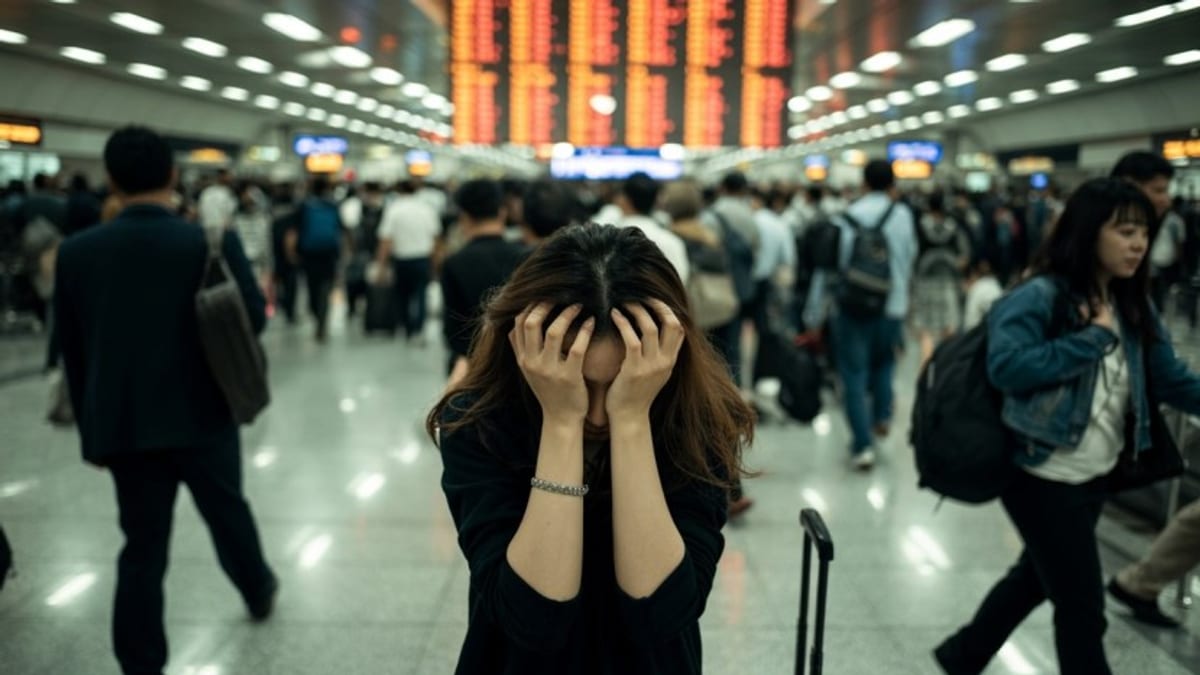
For travelers, today’s numbers translated into crowded terminals and extended uncertainty. Images and accounts shared via social media from Beijing, Shanghai, Shenzhen and Chengdu show long lines at check in counters and transfer desks, as passengers sought rebooking options or clarification on revised departure times.
Published coverage from regional and international travel outlets indicates that thousands of people have been forced to change plans at short notice, with many missing domestic connections to smaller cities or international departures scheduled through Shanghai and Beijing. Disruptions to hub and spoke patterns are particularly painful for passengers traveling onward to secondary Chinese airports or regional destinations in Southeast and Northeast Asia.
With evening waves of flights also affected, hotel availability near major airports has tightened, especially around Shanghai Pudong and Shenzhen Bao’an. Travel advisories from aviation risk and corporate travel firms recommend that passengers transiting these hubs build in extra buffer time, secure flexible accommodation options and maintain direct access to airline apps for real time status updates.
Several consumer focused travel platforms also stress that rebooking and compensation rules vary widely between carriers, and that passengers whose itineraries combine Chinese and foreign airlines may need to work through different policies depending on where their ticket was issued and which segment has been disrupted.
Airlines Adjust Schedules as Operational Pressures Mount
Operational data for April 6 shows that the disruption is not confined to a single company, with national carriers Air China, China Eastern and China Southern all posting elevated delay ratios. Other Chinese airlines, including Shenzhen Airlines, Hainan Airlines and Sichuan Airlines, have also seen schedules affected, particularly on routes feeding into Shanghai, Beijing and Shenzhen.
According to flight performance dashboards, airlines have responded by trimming frequencies on some short haul sectors, consolidating passenger loads onto fewer departures and deploying larger aircraft where possible. This strategy can help to move more passengers with fewer movements, but it also tends to concentrate crowds around the remaining flights and makes same day rebooking harder for those whose services are cancelled.
Several industry briefings suggest that carriers are recalibrating crew rosters and aircraft rotations over the coming days to restore normality, while closely watching weather forecasts for eastern and southern China. Any further storms or visibility problems at Shanghai, Guangzhou or Shenzhen could prolong the period of unstable operations.
Meanwhile, the Civil Aviation Administration of China has been pursuing upgrades to air traffic management systems at key hubs, with plans for expanded satellite based navigation and communication tools over the next two years. Analysts say the current episode is likely to add urgency to those efforts, given the clear economic and reputational costs associated with repeated large scale disruption events.
What Travelers Should Know If Flying Through China Now
Travel experts advising corporate and leisure clients recommend that anyone scheduled to pass through Chinese hubs over the next several days check their flight status frequently and build additional margin into their itineraries. Passengers originating outside China and connecting through Beijing or Shanghai may wish to consider longer layovers or, where available, routing through alternative hubs that are currently operating more smoothly.
Consumer advocacy resources emphasize the importance of reviewing ticket conditions and understanding rebooking or refund options before travel, particularly for itineraries involving nonrefundable fares or multiple carriers on a single booking. While Chinese domestic regulations differ from regimes such as Europe’s EU261, airlines often provide meal vouchers, hotel accommodation or free changes during significant operational disruptions, and such assistance is typically detailed in carrier specific policies.
Travel insurers are also advising customers to check whether their policies include cover for weather related delays or missed connections. In some cases, policies may reimburse additional accommodation, meals or replacement transport when flights are significantly disrupted, although exclusions can apply when the cause is classified as an extraordinary circumstance.
With skies over China expected to remain busy through the spring travel season, today’s widespread delays and cancellations underline how quickly pressure can build on an already crowded air traffic system. For now, both airlines and passengers are focused on navigating one disrupted day at a time, as operations gradually stabilize across Beijing, Shanghai, Shenzhen, Chengdu and the rest of the network.