

More news on this day
A fresh wave of flight cancellations and delays across China is disrupting travel at major hubs including Shanghai, Xi’an, Beijing, Hohhot and Nanjing, with operational data indicating at least 121 affected flights and mounting knock-on impacts for passengers booked on XiamenAir, Air China, Air Changan, China Eastern and several other domestic carriers.
Get the latest news straight to your inbox!
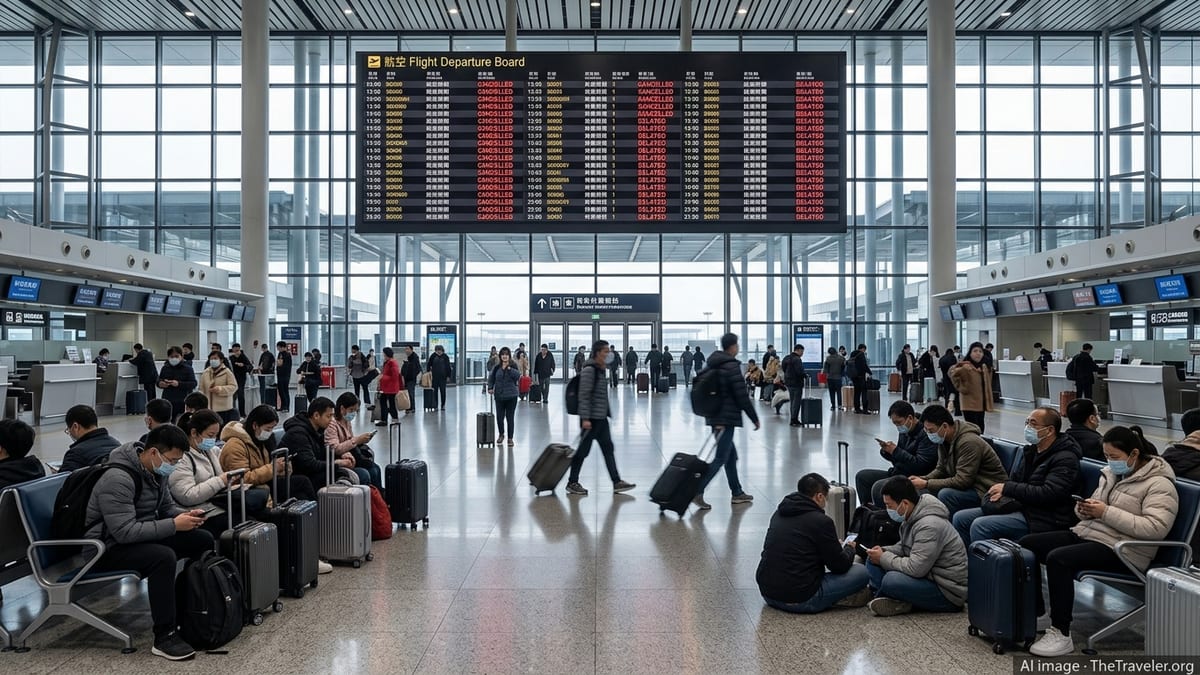
Major Chinese Hubs Experience Operational Turbulence
Recent operational reports from Chinese airports show widespread disruption across several key cities, with cancellations and extended delays concentrated in Shanghai, Xi’an, Beijing, Hohhot, Nanjing and additional regional hubs. While precise causes vary by route and carrier, the cumulative impact has been at least 121 flights either canceled outright or subject to significant schedule changes, affecting both domestic point to point services and feeder connections to international routes.
Shanghai, served by the dual hubs of Pudong and Hongqiao, appears to be at the center of the latest disruption. Publicly available aviation data and passenger accounts indicate a cluster of cancellations on short haul routes linking the city to other major centers such as Beijing and Nanjing, as well as to smaller regional airports in North and Northwest China. The concentration of major carriers at these hubs has amplified the ripple effects of each canceled rotation.
In the north, Beijing and Hohhot have also reported an uptick in irregular operations, with delayed departures and returns complicating crew planning and aircraft utilization. Xi’an and Nanjing, important regional connectors for central and eastern China, are recording their own share of disruption, with some services either consolidated onto fewer daily frequencies or temporarily pulled from schedules.
The 121 affected flights represent a relatively small share of China’s overall daily movements but are heavily clustered around key transit times, magnifying their impact on travelers’ ability to make smooth same day connections. The result has been longer layovers, unexpected overnight stays and rebooked itineraries that add hours, and in some cases a full extra day, to planned journeys.
Multiple Carriers, Shared Strain on Networks
The disruptions are being felt across several of China’s major airlines rather than being isolated to a single carrier. Available schedule and tracking information highlights irregular operations at XiamenAir, Air China, Air Changan and China Eastern among others, with cancellations and rolling delays affecting both trunk routes between large cities and thinner regional services.
China Eastern, with its extensive presence in Shanghai and strong footprint in Nanjing and other eastern cities, appears particularly exposed when bottlenecks form at those hubs. Even a modest number of cancellations during peak hours can cascade across the network, affecting aircraft that are scheduled to continue on to secondary cities later in the day. Passengers have reported itinerary changes where flights that once operated non stop are now rerouted via alternative hubs or shifted to different departure windows.
Air China, which concentrates much of its domestic network around Beijing and major northern cities, has also seen schedule adjustments as part of the broader pattern of disruption. Changes to departure times and aircraft assignments can ripple through onward connections, especially for travelers using Beijing as a transit point to reach other regions of China or connect onto international services.
Smaller and more regionally focused operators are not immune. Air Changan, based in Xi’an and serving a mix of primary and secondary markets, relies on tight rotations of narrow body aircraft to maintain frequency. When delays accumulate, it can quickly become difficult to restore the planned timetable without resorting to selective cancellations or consolidations, further contributing to the count of 121 affected flights.
Knock On Effects for Domestic and International Travelers
The immediate consequence of the latest disruptions has been a rise in missed connections, rebooked itineraries and extended travel times, particularly for passengers relying on hub and spoke transfers through Shanghai, Beijing and Xi’an. Travelers on multi segment journeys have described situations in which a single delayed domestic leg triggered the loss of a subsequent connection, forcing lengthy waits for the next available departure.
International travelers transiting Chinese hubs are especially vulnerable to such irregularities. A delayed arrival into Shanghai or Beijing can compromise a tightly timed connection to onward flights within Asia, Europe or North America, even when the long haul sectors themselves are operating normally. Publicly available information and online traveler discussions suggest that some passengers have been moved to alternative routings or placed on later flights, sometimes involving additional stops.
For domestic travelers, the disruptions translate into compressed schedules and, in some cases, the need to abandon same day plans at their intended destination. Passengers heading to business meetings, family events or onward rail connections may arrive hours later than planned or find that last mile options have become more limited by the time they land.
While many affected travelers are being accommodated on subsequent flights, capacity constraints on popular corridors, especially during busy travel periods, can leave fewer immediate alternatives. This increases the likelihood of overnight stays near airports or the need to consider rerouting to neighboring cities and completing the journey by high speed rail or road.
Airlines Respond With Schedule Adjustments and Flexibility
In response to the disruptions, major Chinese airlines have turned to a familiar mix of schedule adjustments, aircraft swaps and flexible ticket policies aimed at limiting the impact on passengers. Publicly available statements and booking platform notices show that carriers including Air China, China Eastern and XiamenAir continue to offer rebooking options and, in specific cases, refunds for itineraries that have been significantly altered or canceled.
Schedule data suggests that some operators are temporarily trimming or consolidating lightly booked flights in order to protect core trunk routes and reduce the risk of rolling delays. By simplifying patterns of aircraft rotation and focusing resources on the most in demand corridors, airlines seek to stabilize on time performance, even if that means a reduced choice of departure times on certain routes in the short term.
Flexible change policies, which became more widespread during earlier periods of large scale travel disruption, remain a key tool for managing passenger expectations. Many travelers affected by the latest wave of cancellations and delays are being encouraged, through airline and online travel agency channels, to proactively adjust their plans, either shifting to alternative days or choosing different departure windows that are expected to be less congested.
At the operational level, airlines are also drawing on spare aircraft and reserve crew where available, particularly at major hubs, to restore disrupted rotations and prevent further knock on cancellations. However, these reserves are finite, and persistent irregular operations across multiple hubs can quickly exhaust the buffer that carriers rely on to recover from isolated incidents.
What Travelers Should Expect in the Coming Days
With at least 121 flights already affected across Shanghai, Xi’an, Beijing, Hohhot, Nanjing and other cities, travelers planning to fly within or via China in the near term should be prepared for continued schedule volatility. While airlines are working to normalize operations, published timetables may remain subject to change at shorter notice than usual, particularly on busy domestic corridors and routes feeding into major international gateways.
Publicly available tracking data and recent patterns suggest that early morning and late evening departures, which anchor many connecting itineraries, can be especially sensitive when operational challenges arise. Travelers who have flexibility may benefit from choosing mid day flights where possible, or building longer connection windows into multi segment journeys to reduce the risk of missed onward flights.
Passengers are also being advised, through airline and agency communication channels, to monitor booking records and flight status information closely in the 24 hours before departure. In several recent cases, travelers have reported receiving updated schedules or cancellation notices relatively close to travel time, making it important to confirm details before heading to the airport.
Despite the current wave of disruption, China’s domestic aviation system continues to operate thousands of flights daily, and most journeys are still being completed, albeit sometimes with altered timings. For those affected by the 121 cancellations and delays already recorded, the focus now is on securing alternative arrangements and adjusting onward plans as Chinese carriers work to restore more predictable patterns of service across their networks.