

More news on this day
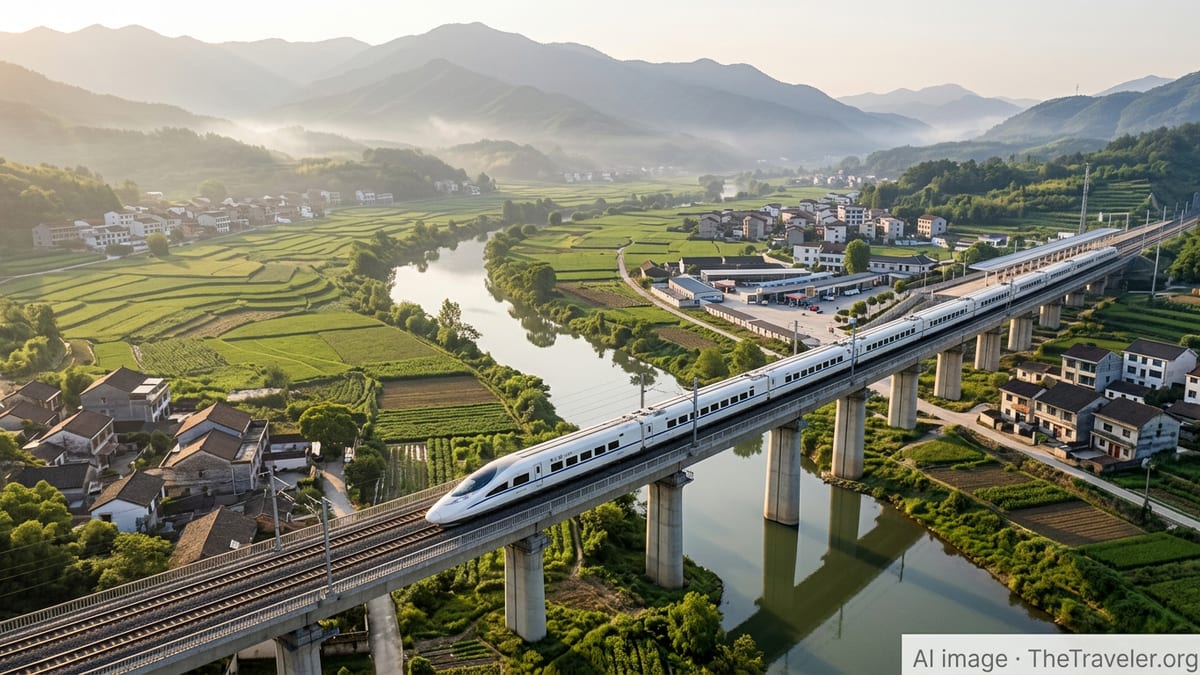
China’s rail network is entering 2026 with record passenger numbers, unprecedented expansion of high-speed lines, and a growing role as the backbone of the country’s tourism revival.
Get the latest news straight to your inbox!
Record Passenger Volumes Cement Global Rail Leadership
Recent data for 2025 and early 2026 show that China’s railways are carrying more passengers than ever, reinforcing the network’s position as the busiest in the world. National railway statistics cited in domestic coverage indicate that nearly 4.6 billion passenger trips were made by rail in 2025, an increase of more than 6 percent year on year. High-speed services account for a dominant share of this traffic, reflecting a long-running shift from conventional lines to faster, more frequent trains.
The momentum has continued into 2026. During the week-long Lunar New Year public holiday in February, China’s railways handled around 121 million passenger trips, according to reports in Chinese media, with the final day of the holiday setting a new single-day record of more than 18 million journeys. These figures build on already elevated volumes recorded during the broader Spring Festival travel season in 2025, when daily train operations exceeded 14,000 services nationwide to keep up with demand.
Longer-term statistics underscore how far the system has come. Publicly available summaries of transport data show that in 2024 China’s railways carried more than 4.3 billion passengers, already surpassing pre-pandemic levels. By 2025, rail’s recovery and subsequent expansion had firmly outpaced other modes in many corridors, with high-speed trains increasingly capturing trips that once went by air or long-distance coach.
For 2026, industry forecasts cited in domestic planning documents anticipate another year of steady growth in passenger numbers, supported by economic recovery, rising incomes and a policy emphasis on rail as a low-carbon mode of transport. Analysts note that even modest percentage increases now translate into hundreds of millions of additional trips given the network’s enormous base.
World’s Longest High-Speed Rail Network Keeps Growing
China already operates the world’s largest high-speed rail network by a wide margin, and expansion has continued at pace. Data compiled in international rail surveys and official statistical bulletins indicate that by the end of 2024, about 48,000 kilometers of high-speed lines were in operation, representing well over 70 percent of global high-speed track length. Network plans outline a target of around 60,000 kilometers by 2030, with incremental additions each year.
Construction and commissioning activity in 2024 and 2025 underline this trend. According to summaries of infrastructure investment released by China State Railway Group and referenced in industry reports, more than 3,000 kilometers of new railway were opened in 2024, including roughly 2,400 kilometers of high-speed lines. New routes such as the Shanghai–Suzhou–Huzhou high-speed railway, which entered service in late 2024, have reinforced dense corridors in the Yangtze River Delta while shortening travel times between major urban hubs and emerging tourism centers.
At the same time, medium- and long-term planning continues to push high-speed lines deeper into inland and border regions. Published route plans point to projects designed to improve access to grassland areas of Inner Mongolia, historic cities in central China, and scenic mountain and lake destinations that were previously served only by slower conventional trains or long highway journeys. As these lines come online over the next few years, the practical reach of high-speed travel is expected to extend to a growing share of the population.
International rail organizations note that China’s high-speed mileage already exceeds the combined total of all other countries and continues to grow. For travelers, this translates into tighter service intervals, more direct city pairs and shorter journey times, particularly on routes where travel speeds of 300 to 350 kilometers per hour have become routine.
Rail-Led Tourism Rebound Reshapes Domestic Travel
The surge in rail ridership is closely intertwined with China’s tourism rebound. Domestic tourism has strengthened across 2023, 2024 and 2025, with publicly reported holiday figures showing sharp increases in trips during major festivals and long weekends. High-speed rail has been central to this trend, enabling millions of city dwellers to reach coastal resorts, heritage towns and mountain regions in just a few hours.
Regional examples illustrate how new lines can quickly alter visitor flows. In Zhejiang province, local coverage of the 2025 Spring Festival travel rush highlighted record passenger volumes at key stations along recently opened high-speed routes, including those linked to the Shanghai–Suzhou–Huzhou corridor. Additional services were added to manage surging demand from travelers heading to popular lakeside and coastal destinations, underscoring how rail capacity can unlock new patterns of short-break tourism.
Specialized rail infrastructure is also targeting leisure travel more directly. One notable example is the Qingyuan Maglev Tourist Line in Guangdong, described in technical and local government documents as a medium-speed maglev connection between a mainline rail station and the Qingyuan Chimelong theme park. Trial operations and test runs in 2023 and 2024 signaled a broader effort to integrate rail with large-scale entertainment complexes, offering smoother “last-mile” links for families and tour groups.
As more scenic regions gain high-speed or upgraded conventional rail access, tourism authorities across multiple provinces have been promoting rail-inclusive itineraries that combine city sightseeing with nature escapes. Public campaigns highlighted in domestic media emphasize shorter booking times via mobile platforms, the ability to reserve group seats, and integrated ticketing with local transit, making long-distance leisure trips more accessible to first-time travelers.
New Corridors Connect Emerging Destinations
Beyond headline city pairs such as Beijing–Shanghai or Guangzhou–Shenzhen, China’s newest rail corridors are designed to connect smaller cities and emerging tourism landscapes. Recent openings like the Chizhou–Huangshan high-speed railway in Anhui province, which began service in 2024, have cut journey times to UNESCO-listed mountain scenery and traditional villages, reshaping how both domestic and international visitors access these sites.
Further north, projects described in planning and construction reports, such as the Taizicheng–Xilinhot railway, are intended to improve links between Beijing, Inner Mongolia’s grasslands and winter sports hubs. While some of these lines are still under development, early segments and associated stations have already started to influence local tourism strategies, with new hotels and visitor facilities clustering around rail hubs rather than highways.
If current timetables and project pipelines hold, 2026 and the subsequent years are likely to see more second- and third-tier cities integrated into the high-speed grid. This is expected to disperse visitor flows away from a handful of “must-see” metropolises and toward lesser-known destinations offering cultural festivals, outdoor recreation and rural experiences. Travel analysts note that the flexibility of rail scheduling allows these areas to scale up capacity quickly during peak seasons while maintaining regular service for residents.
For travelers, the practical effect is a broader menu of weekend and multi-day trips that do not require domestic flights. With journey times between many new city pairs falling to three hours or less, overnight stays in previously remote locations become realistic options even for time-pressed urban professionals.
Technology, Comfort and Sustainability Drive Future Growth
Technological improvements are also shaping the next phase of China’s rail expansion. Rolling stock manufacturers and railway research institutes have been publicizing advances in train efficiency, noise reduction and onboard connectivity, while experimental maglev and higher-speed concepts remain under active development. At the operational level, digital ticketing platforms and dynamic pricing tools continue to refine how capacity is allocated on busy routes, particularly during holiday peaks.
Passenger comfort has become a more prominent focus in recent years. Coverage in national newspapers and industry outlets describes investment in upgraded seating, improved catering, enhanced luggage storage and more family-friendly compartments on high-speed services. Additional late-night and early-morning departures during peak periods are also being used to spread demand, reducing overcrowding at traditional departure times.
Environmental considerations underpin many of these developments. Rail is repeatedly highlighted in transport and climate policy documents as a key component of China’s strategy to reduce emissions from the travel sector. Compared with short-haul flights and private car trips, high-speed trains offer substantially lower per-passenger carbon footprints, especially on electrified corridors powered increasingly by cleaner energy sources.
As 2026 unfolds, analysts expect China’s rail network to maintain its position as the world leader in both scale and activity. With record passenger numbers, continuous network growth and a clear link to tourism development, the system is emerging not just as a means of getting from city to city, but as a central force reshaping how people experience the country’s landscapes, culture and regional diversity.