

More news on this day
China’s 2026 Spring Festival travel season is shaping up to be the country’s busiest on record, with railway journeys surpassing 258 million at the halfway point of the 40-day period and overall daily passenger flows hitting historic highs as hundreds of millions of people crisscross the nation for family reunions, work, and leisure travel.
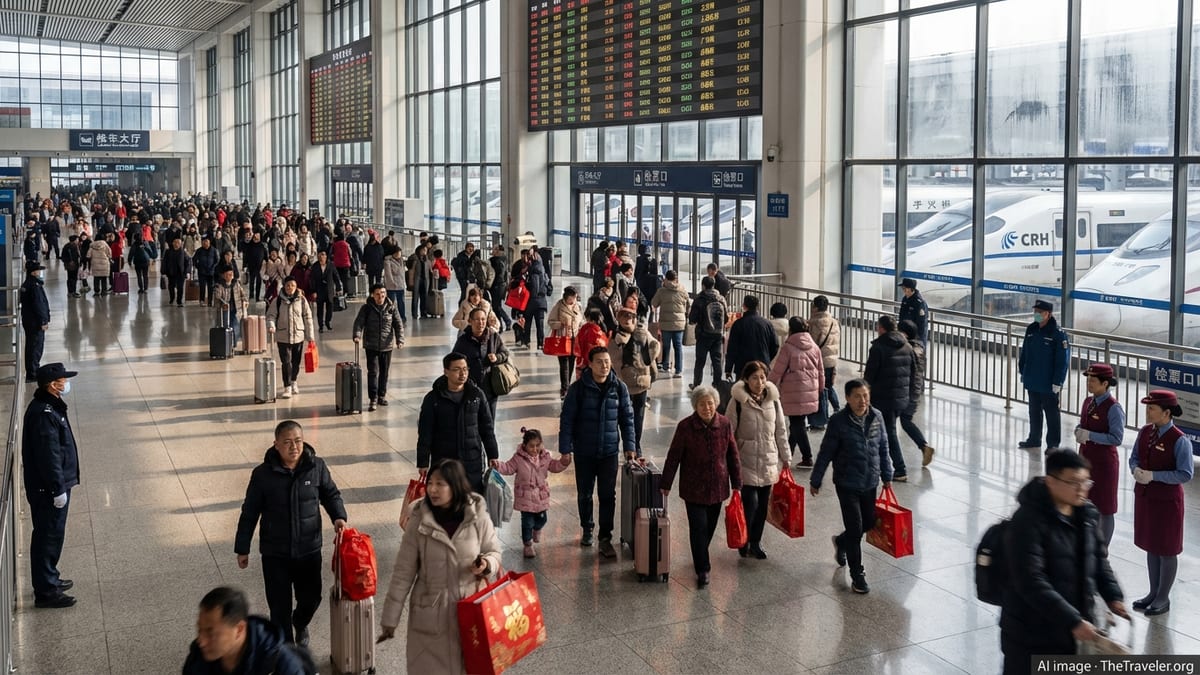
A Historic Spring Festival on the Move
Data released by national transport authorities indicate that China’s Spring Festival rush in 2026 is not just rebounding from the pandemic era but decisively surpassing previous peaks. The 40-day chunyun period, which runs this year from February 2 to March 13, is long known as the world’s largest annual human migration. This year, the scale is unprecedented, driven by robust economic activity, expanded transport capacity, and pent-up travel demand.
By February 22, halfway through the official travel window, China’s railway system had already handled 258 million passenger trips, according to figures from China State Railway Group. On February 21 alone, the network processed about 17.19 million journeys, and rail operators expect volumes to remain elevated in the coming days as both outbound and return flows overlap.
Beyond rail, the entire transport system is under pressure from record mobility. On February 20, the Ministry of Transport reported that cross-regional passenger traffic hit 352.999 million trips in a single day, a new all-time high and more than 12 percent higher than the same day during the 2025 Spring Festival rush. Authorities project up to 9.5 billion individual cross-regional passenger movements over the full season, underscoring how dramatically Chinese travel has scaled up in 2026.
The numbers encapsulate the evolution of Spring Festival from a strictly homebound holiday into a complex blend of homecoming, domestic tourism, and business-linked travel. For transport planners, the challenge is not only to move more people than ever before but to do so safely, efficiently, and with a service quality that meets rising public expectations.
Railways at the Heart of a Massive Migration
Rail remains the backbone of China’s Spring Festival travel system, carrying a significant share of medium and long-distance passengers between inland hometowns and coastal megacities. The 258 million railway trips recorded by February 22 represent a powerful vote of confidence in the speed, reliability, and reach of the high-speed rail network, which now connects most major urban clusters and an increasing number of smaller cities.
To handle the surge, China State Railway Group has scheduled more than 2,200 additional passenger trains across key corridors. Major hubs such as Beijing, Shanghai, Guangzhou, Chengdu, and Wuhan are seeing dense timetables, with early-morning and late-night departures added to spread demand throughout the day. Capacity has been reinforced on classic migrant-worker routes linking coastal manufacturing centers with provinces such as Henan, Hunan, Sichuan, and Anhui.
On the ground, stations across the country have been instructed to intensify passenger services, from streamlined ticket checks and security procedures to expanded waiting areas and improved signage. At Beijing West, Guangzhou South, and Shanghai Hongqiao stations, crowds have been met with additional volunteers, temporary guidance desks, and strengthened coordination between station staff and city transport operators to help passengers complete the “last mile” of their journeys.
The push to keep trains running on time is complicated by winter weather, localized congestion, and the need to maintain safety amid heavy flows. Railway authorities report enhanced inspection regimes for tracks, signals, and rolling stock, along with contingency plans for rerouting trains in the event of disruptions. Real-time passenger updates via apps and loudspeaker announcements are intended to reduce stress for travelers and prevent overcrowding at boarding gates.
Record-Breaking Daily Mobility Across All Modes
While rail is under intense spotlight, the headline-grabbing figure of 352.999 million passenger trips on February 20 reflects a multi-modal surge. That tally includes road, rail, air, and water transport, painting a picture of a society in near-constant motion at the height of the Lunar New Year season, which this year centers on the holiday period around February 17.
Intercity coaches and private vehicles still account for a substantial portion of travel, particularly for journeys under 500 kilometers and for those moving between smaller cities and rural areas. Expressways leading into and out of major economic belts have faced heavy congestion at peak hours, prompting toll station traffic management, temporary lane reassignments, and staggered flow controls to keep vehicles moving.
Civil aviation is also seeing strong growth, especially on routes connecting major economic centers with regional tourist hotspots and resource-rich regions. Airlines have deployed larger aircraft and opened temporary charter services, while some carriers have boosted frequencies on routes into and out of the Xinjiang Uygur Autonomous Region, anticipating a strong post-holiday return wave as workers and tourists fly back to eastern and southern cities.
Waterborne transport plays a smaller but still important role, particularly along coastal corridors, river systems, and island-bound routes. Ferries, riverboats, and coastal services have been coordinated within the broader seasonal plan, with authorities emphasizing safety checks and crowd control at key terminals during the busiest days of the surge.
Tourism Surge Transforms the Holiday Map
Alongside the classic homecoming routes, tourism flows are reshaping the geography of Spring Festival travel. This year’s holiday has seen strong demand for cultural, heritage, and winter sports destinations, as well as short-haul city breaks. Major attractions in Beijing, including the Palace Museum and historic hutong neighborhoods, have reported dense crowds as domestic tourists capitalize on the extended nine-day holiday break.
Southern and coastal cities with milder climates, such as Guangzhou, Shenzhen, and Xiamen, are attracting families seeking warmer weather, outdoor dining, and waterfront leisure. Meanwhile, the southwestern regions and highland areas have drawn nature-focused travelers who combine family visits with side trips to scenic parks, hot springs, and mountain resorts catering to skiing and snow activities.
Outside the Chinese mainland, popular getaway hubs in the Greater Bay Area, including the Macao Special Administrative Region, have recorded sharp spikes in visitor arrivals. Macao alone received more than 1.2 million visitors in the first week of the Lunar New Year, as mainland residents took advantage of relaxed border procedures and a growing range of hotel, entertainment, and retail options.
The diversification of travel intentions places additional complexity on the transport network, as flows are no longer dominated solely by point-to-point hometown journeys. Authorities and operators are being pushed to integrate tourism promotion with transport planning, using data from ticketing platforms and tourism bureaus to anticipate where visitor pressure will be highest and to allocate resources accordingly.
Technology and Operations Under Strain
The record-breaking travel rush is stress-testing China’s sophisticated transport technologies and operations. Ticketing systems, mobile apps, and online platforms have had to handle enormous surges in traffic as millions of passengers search for seats, adjust itineraries, and monitor real-time updates. While digitalization has greatly simplified booking and check-in for most travelers, the strain of peak demand occasionally manifests in slowdowns and glitches that operators scramble to resolve.
High-speed rail control centers are running around the clock, managing dense schedules with tight headways between trains. Dispatchers monitor conditions in real time and coordinate with regional control rooms to deal with any disruptions caused by weather, technical issues, or unexpected crowding at stations. The ability to quickly add or reassign rolling stock, and to introduce extra trains on high-demand lines, has become a critical factor in keeping the system fluid.
Urban transport networks in major cities are also feeling the impact. Subway systems in Beijing, Shanghai, Guangzhou, and other metropolises have lengthened operating hours during peak days and added additional services to accommodate surging passenger transfers between intercity terminals and city centers. Taxi and ride-hailing services, often a final link in the travel chain, face heavy demand that can drive up wait times and prices during the busiest hours.
Behind the scenes, data analytics play a growing role in managing the travel rush. National and local authorities rely on passenger flow models that incorporate real-time ticket sales, location-based services, and historical patterns to forecast bottlenecks. This data-driven approach allows for more precise deployment of staff, rolling stock, and traffic control, even as the absolute numbers of travelers reach new heights.
Traveler Experience: Crowds, Delays and New Comforts
For travelers, the 2026 Spring Festival rush is a mix of excitement, crowding, and gradually improving comforts. Many passengers report that while stations are as busy as ever, boarding processes feel more orderly than in the past, with clearer signage, more staff on hand, and better use of digital tools such as QR-code tickets and real-name verification integrated into mobile apps.
Some travelers still face delays and long queues, particularly at peak departure times in the days immediately before and after the official Lunar New Year holiday. Winter weather, including snow and freezing rain in parts of northern and central China, has occasionally slowed trains and flights, leading to rescheduling and extended waiting times at terminals. However, authorities emphasize that major disruptions have so far been contained and that safety remains the overriding priority.
To ease the experience, many railway stations and airports have upgraded amenities in recent years, and those investments are being tested this season. Larger waiting halls, thermal comfort improvements, child-friendly play areas, and a wider choice of food and beverage outlets help passengers cope with long transits. Free or low-cost charging points, better Wi-Fi coverage, and dedicated waiting zones for elderly passengers and families are increasingly visible across major hubs.
At the same time, the extraordinary scale of this year’s rush serves as a reminder that even the most modern infrastructure has limits. Authorities continue to encourage travelers to stagger their journeys when possible, use off-peak trains and flights, and plan connections with extra time built in, especially when traveling with children, elderly family members, or multiple transfers.
Economic Tailwinds and Policy Support
The intensity of the 2026 Spring Festival travel rush also carries clear economic and policy implications. Heavy travel volumes are both a reflection and a driver of domestic consumption, with transport, catering, accommodation, and retail sectors all benefiting from increased foot traffic and holiday spending. In many smaller cities and rural counties, returning migrants bring not only remittances but also new purchases and services that support local businesses.
For authorities in Beijing and across provincial capitals, the rush underscores the importance of continued investment in transport infrastructure. Projects to expand high-speed rail coverage, upgrade conventional rail lines, and improve intermodal hubs remain high on the agenda, with planners pointing to this year’s record mobility as proof that capacity increases are quickly absorbed by demand.
Policy support for travel has also taken the form of flexible ticketing rules, promotional fares, and targeted subsidies on certain routes or for specific groups, such as students and migrant workers. These measures aim to keep travel broadly affordable while smoothing demand across different time windows. In parallel, safety campaigns and public information drives remind passengers to avoid risky behaviors, respect station regulations, and be alert to scams or illegal transport services.
As the second half of the chunyun period unfolds, officials will be watching closely for signs of fatigue in the system, as well as for opportunities to replicate successful operational measures in future peak seasons. The lessons from 2026 are likely to influence transport planning well beyond the Spring Festival context, informing strategies for Golden Week holidays and other mass-mobility events.
Looking Ahead as the Rush Continues
With several weeks still remaining in the official travel window, China’s 2026 Spring Festival rush is far from over. The focus is gradually shifting from outbound journeys to a complex blend of staggered returns, extended leisure trips, and business travel as factories, offices, and schools resume normal schedules. Railway operators expect daily volumes to remain elevated, even if they moderate slightly from the dramatic peaks seen around February 20.
Transport authorities are maintaining heightened alert levels through the end of the travel period on March 13, with contingency plans in place for weather changes, localized outbreaks of illness, or infrastructure incidents. Continuous monitoring and communication between central agencies, provincial departments, and individual operators are intended to ensure a smooth landing from what has already been a historic mobility surge.
For the millions of travelers still on the move, the immediate priority is far simpler: getting home or reaching their next destination safely and with as little disruption as possible. Yet every individual journey contributes to a vast national tapestry of movement that is reshaping how China works, celebrates, and connects.
By the time the final trains and flights of the 2026 Spring Festival rush pull into stations and land on tarmacs in mid-March, China will have logged billions of trips and set new benchmarks for large-scale mobility. The challenge for policymakers and operators will be to harness the momentum of this extraordinary season to build a transport system that is not only bigger, but smarter, more resilient, and more responsive to the evolving ways Chinese people choose to travel.